

28
D. Shah and V. J. Badheka
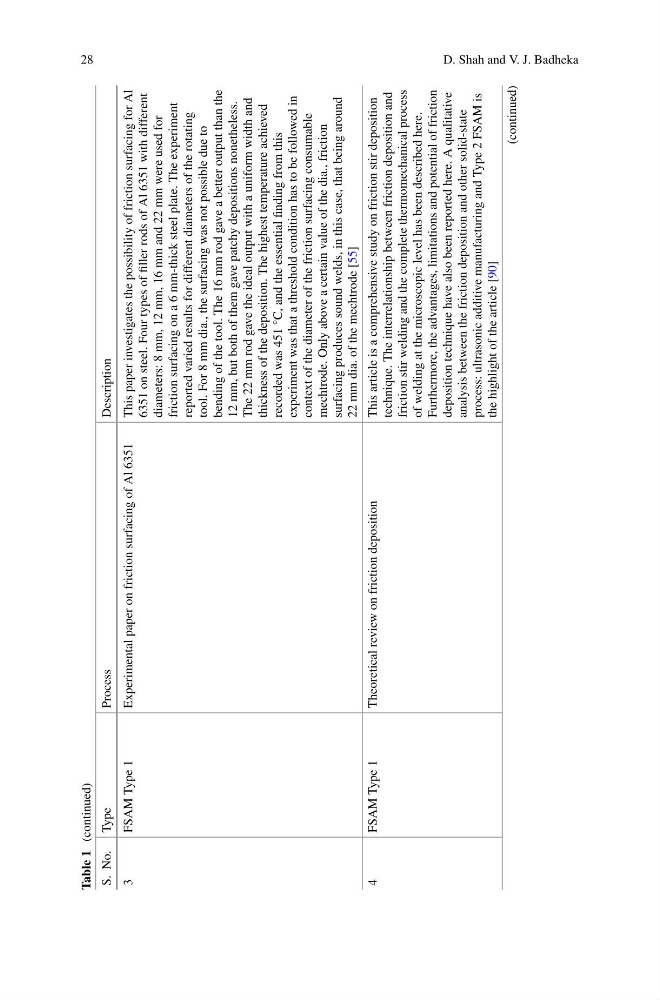
Table 1
(continued)
S. No. Type
Process
Description
3
FSAM Type 1
Experimental paper on friction surfacing of Al 6351
This paper investigates the possibility of friction surfacing for Al
6351 on steel. Four types of filler rods of Al 6351 with different
diameters: 8 mm, 12 mm, 16 mm and 22 mm were used for
friction surfacing on a 6 mm-thick steel plate. The experiment
reported varied results for different diameters of the rotating
tool. For 8 mm dia., the surfacing was not possible due to
bending of the tool. The 16 mm rod gave a better output than the
12 mm, but both of them gave patchy depositions nonetheless.
The 22 mm rod gave the ideal output with a uniform width and
thickness of the deposition. The highest temperature achieved
recorded was 451 °C, and the essential finding from this
experiment was that a threshold condition has to be followed in
context of the diameter of the friction surfacing consumable
mechtrode. Only above a certain value of the dia., friction
surfacing produces sound welds, in this case, that being around
22 mm dia. of the mechtrode [55]
4
FSAM Type 1
Theoretical review on friction deposition
This article is a comprehensive study on friction stir deposition
technique. The interrelationship between friction deposition and
friction stir welding and the complete thermomechanical process
of welding at the microscopic level has been described here.
Furthermore, the advantages, limitations and potential of friction
deposition technique have also been reported here. A qualitative
analysis between the friction deposition and other solid-state
process: ultrasonic additive manufacturing and Type 2 FSAM is
the highlight of the article [90]
(continued)
D. Shah and V. J. Badheka
Table 1
(continued)
S. No. Type
Process
Description
3
FSAM Type 1
Experimental paper on friction surfacing of Al 6351
This paper investigates the possibility of friction surfacing for Al
6351 on steel. Four types of filler rods of Al 6351 with different
diameters: 8 mm, 12 mm, 16 mm and 22 mm were used for
friction surfacing on a 6 mm-thick steel plate. The experiment
reported varied results for different diameters of the rotating
tool. For 8 mm dia., the surfacing was not possible due to
bending of the tool. The 16 mm rod gave a better output than the
12 mm, but both of them gave patchy depositions nonetheless.
The 22 mm rod gave the ideal output with a uniform width and
thickness of the deposition. The highest temperature achieved
recorded was 451 °C, and the essential finding from this
experiment was that a threshold condition has to be followed in
context of the diameter of the friction surfacing consumable
mechtrode. Only above a certain value of the dia., friction
surfacing produces sound welds, in this case, that being around
22 mm dia. of the mechtrode [55]
4
FSAM Type 1
Theoretical review on friction deposition
This article is a comprehensive study on friction stir deposition
technique. The interrelationship between friction deposition and
friction stir welding and the complete thermomechanical process
of welding at the microscopic level has been described here.
Furthermore, the advantages, limitations and potential of friction
deposition technique have also been reported here. A qualitative
analysis between the friction deposition and other solid-state
process: ultrasonic additive manufacturing and Type 2 FSAM is
the highlight of the article [90]
(continued)