

Estimation of Boundary Heat Flux with Conjugate …
351
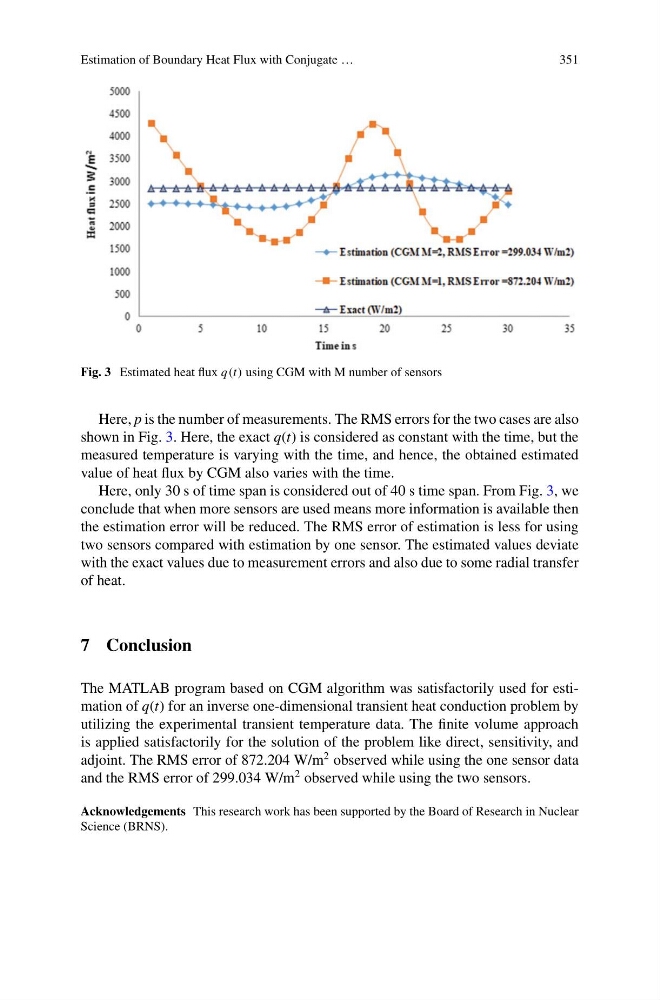
Fig. 3 Estimated heat flux q(t) using CGM with M number of sensors
Here, p is the number of measurements. The RMS errors for the two cases are also
shown in Fig. 3. Here, the exact q(t) is considered as constant with the time, but the
measured temperature is varying with the time, and hence, the obtained estimated
value of heat flux by CGM also varies with the time.
Here, only 30 s of time span is considered out of 40 s time span. From Fig. 3, we
conclude that when more sensors are used means more information is available then
the estimation error will be reduced. The RMS error of estimation is less for using
two sensors compared with estimation by one sensor. The estimated values deviate
with the exact values due to measurement errors and also due to some radial transfer
of heat.
7 Conclusion
The MATLAB program based on CGM algorithm was satisfactorily used for estimation of q(t) for an inverse one-dimensional transient heat conduction problem by
utilizing the experimental transient temperature data. The finite volume approach
is applied satisfactorily for the solution of the problem like direct, sensitivity, and
adjoint. The RMS error of 872.204 W/m
2 observed while using the one sensor data
and the RMS error of 299.034 W/m
2 observed while using the two sensors.
Acknowledgements This research work has been supported by the Board of Research in Nuclear
Science (BRNS).
351
Fig. 3 Estimated heat flux q(t) using CGM with M number of sensors
Here, p is the number of measurements. The RMS errors for the two cases are also
shown in Fig. 3. Here, the exact q(t) is considered as constant with the time, but the
measured temperature is varying with the time, and hence, the obtained estimated
value of heat flux by CGM also varies with the time.
Here, only 30 s of time span is considered out of 40 s time span. From Fig. 3, we
conclude that when more sensors are used means more information is available then
the estimation error will be reduced. The RMS error of estimation is less for using
two sensors compared with estimation by one sensor. The estimated values deviate
with the exact values due to measurement errors and also due to some radial transfer
of heat.
7 Conclusion
The MATLAB program based on CGM algorithm was satisfactorily used for estimation of q(t) for an inverse one-dimensional transient heat conduction problem by
utilizing the experimental transient temperature data. The finite volume approach
is applied satisfactorily for the solution of the problem like direct, sensitivity, and
adjoint. The RMS error of 872.204 W/m
2 observed while using the one sensor data
and the RMS error of 299.034 W/m
2 observed while using the two sensors.
Acknowledgements This research work has been supported by the Board of Research in Nuclear
Science (BRNS).