

Emission and Performance Analysis of Four-Stroke Dual-Cylinder …
329
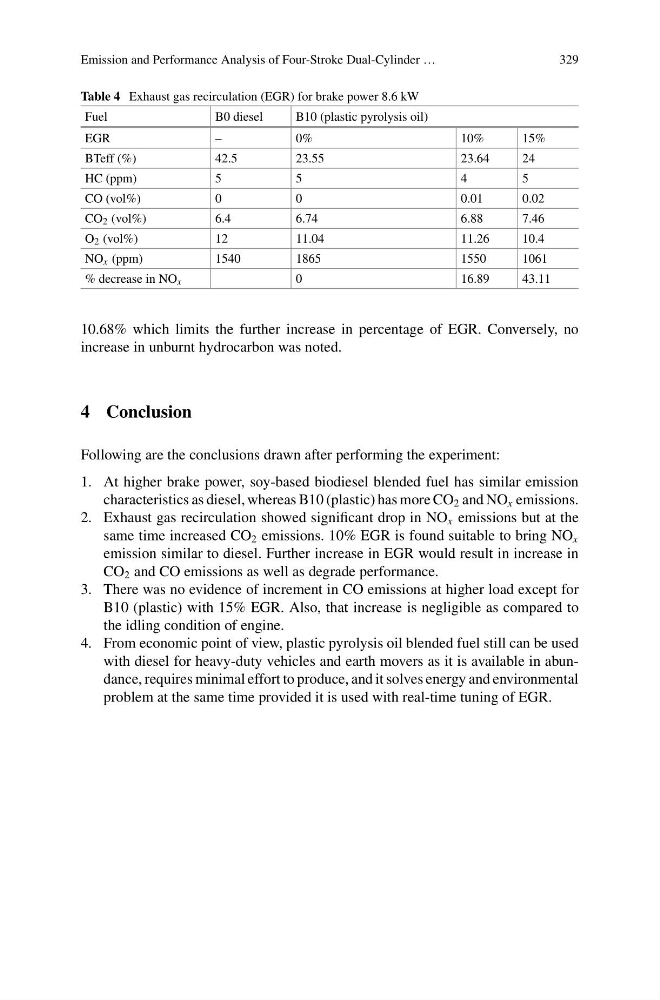
Table 4 Exhaust gas recirculation (EGR) for brake power 8.6 kW
Fuel
B0 diesel
B10 (plastic pyrolysis oil)
EGR
–
0%
10%
15%
BTeff (%)
42.5
23.55
23.64
24
HC (ppm)
5
5
4
5
CO (vol%)
0
0
0.01
0.02
CO 2 (vol%)
6.4
6.74
6.88
7.46
O 2 (vol%)
12
11.04
11.26
10.4
NO x (ppm)
1540
1865
1550
1061
% decrease in NO x
0
16.89
43.11
10.68% which limits the further increase in percentage of EGR. Conversely, no
increase in unburnt hydrocarbon was noted.
4 Conclusion
Following are the conclusions drawn after performing the experiment:
1. At higher brake power, soy-based biodiesel blended fuel has similar emission
characteristics as diesel, whereas B10 (plastic) has more CO 2 and NO x emissions.
2. Exhaust gas recirculation showed significant drop in NO x emissions but at the
same time increased CO 2 emissions. 10% EGR is found suitable to bring NO x
emission similar to diesel. Further increase in EGR would result in increase in
CO 2 and CO emissions as well as degrade performance.
3. There was no evidence of increment in CO emissions at higher load except for
B10 (plastic) with 15% EGR. Also, that increase is negligible as compared to
the idling condition of engine.
4. From economic point of view, plastic pyrolysis oil blended fuel still can be used
with diesel for heavy-duty vehicles and earth movers as it is available in abundance, requires minimal effort to produce, and it solves energy and environmental
problem at the same time provided it is used with real-time tuning of EGR.
329
Table 4 Exhaust gas recirculation (EGR) for brake power 8.6 kW
Fuel
B0 diesel
B10 (plastic pyrolysis oil)
EGR
–
0%
10%
15%
BTeff (%)
42.5
23.55
23.64
24
HC (ppm)
5
5
4
5
CO (vol%)
0
0
0.01
0.02
CO 2 (vol%)
6.4
6.74
6.88
7.46
O 2 (vol%)
12
11.04
11.26
10.4
NO x (ppm)
1540
1865
1550
1061
% decrease in NO x
0
16.89
43.11
10.68% which limits the further increase in percentage of EGR. Conversely, no
increase in unburnt hydrocarbon was noted.
4 Conclusion
Following are the conclusions drawn after performing the experiment:
1. At higher brake power, soy-based biodiesel blended fuel has similar emission
characteristics as diesel, whereas B10 (plastic) has more CO 2 and NO x emissions.
2. Exhaust gas recirculation showed significant drop in NO x emissions but at the
same time increased CO 2 emissions. 10% EGR is found suitable to bring NO x
emission similar to diesel. Further increase in EGR would result in increase in
CO 2 and CO emissions as well as degrade performance.
3. There was no evidence of increment in CO emissions at higher load except for
B10 (plastic) with 15% EGR. Also, that increase is negligible as compared to
the idling condition of engine.
4. From economic point of view, plastic pyrolysis oil blended fuel still can be used
with diesel for heavy-duty vehicles and earth movers as it is available in abundance, requires minimal effort to produce, and it solves energy and environmental
problem at the same time provided it is used with real-time tuning of EGR.