

Performance Analysis of Double Pipe by Using Different Nanofluids
309
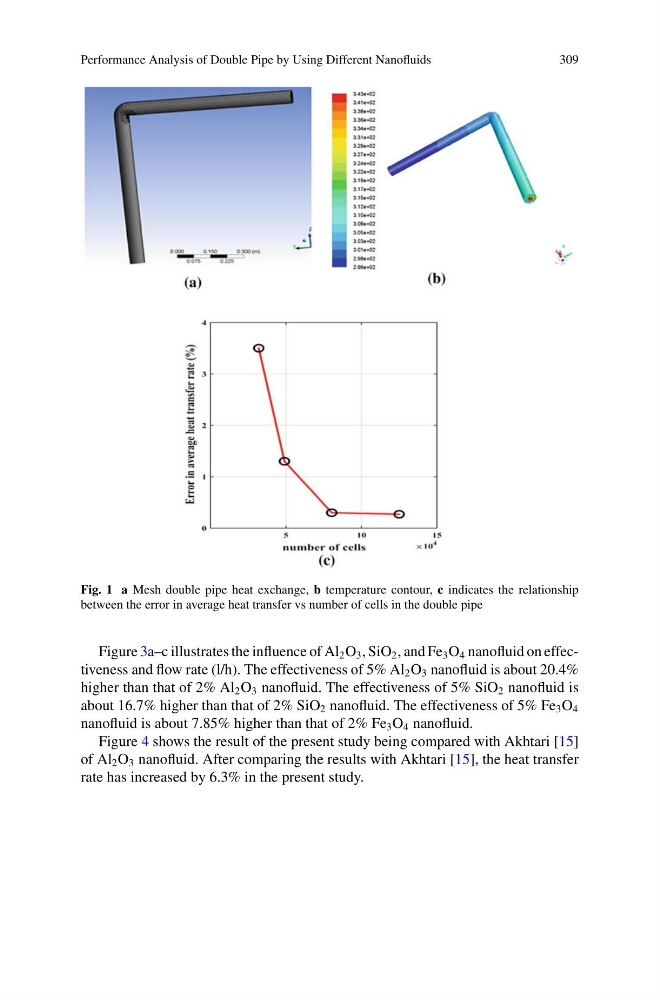
Fig. 1 a Mesh double pipe heat exchange, b temperature contour, c indicates the relationship
between the error in average heat transfer vs number of cells in the double pipe
Figure 3a–c illustrates the influence of Al 2 O 3 , SiO 2 , and Fe 3 O 4 nanofluid on effectiveness and flow rate (l/h). The effectiveness of 5% Al 2 O 3 nanofluid is about 20.4%
higher than that of 2% Al 2 O 3 nanofluid. The effectiveness of 5% SiO 2 nanofluid is
about 16.7% higher than that of 2% SiO 2 nanofluid. The effectiveness of 5% Fe 3 O 4
nanofluid is about 7.85% higher than that of 2% Fe 3 O 4 nanofluid.
Figure 4 shows the result of the present study being compared with Akhtari [15]
of Al 2 O 3 nanofluid. After comparing the results with Akhtari [15], the heat transfer
rate has increased by 6.3% in the present study.
309
Fig. 1 a Mesh double pipe heat exchange, b temperature contour, c indicates the relationship
between the error in average heat transfer vs number of cells in the double pipe
Figure 3a–c illustrates the influence of Al 2 O 3 , SiO 2 , and Fe 3 O 4 nanofluid on effectiveness and flow rate (l/h). The effectiveness of 5% Al 2 O 3 nanofluid is about 20.4%
higher than that of 2% Al 2 O 3 nanofluid. The effectiveness of 5% SiO 2 nanofluid is
about 16.7% higher than that of 2% SiO 2 nanofluid. The effectiveness of 5% Fe 3 O 4
nanofluid is about 7.85% higher than that of 2% Fe 3 O 4 nanofluid.
Figure 4 shows the result of the present study being compared with Akhtari [15]
of Al 2 O 3 nanofluid. After comparing the results with Akhtari [15], the heat transfer
rate has increased by 6.3% in the present study.