

20
D. Shah and V. J. Badheka
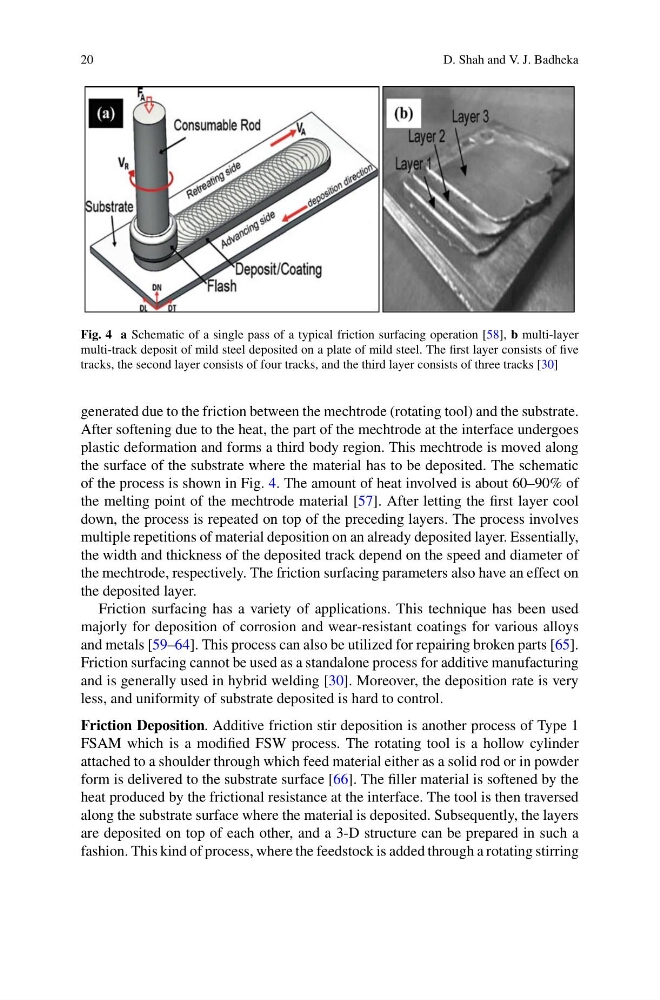
Fig. 4 a Schematic of a single pass of a typical friction surfacing operation [58], b multi-layer
multi-track deposit of mild steel deposited on a plate of mild steel. The first layer consists of five
tracks, the second layer consists of four tracks, and the third layer consists of three tracks [30]
generated due to the friction between the mechtrode (rotating tool) and the substrate.
After softening due to the heat, the part of the mechtrode at the interface undergoes
plastic deformation and forms a third body region. This mechtrode is moved along
the surface of the substrate where the material has to be deposited. The schematic
of the process is shown in Fig. 4. The amount of heat involved is about 60–90% of
the melting point of the mechtrode material [57]. After letting the first layer cool
down, the process is repeated on top of the preceding layers. The process involves
multiple repetitions of material deposition on an already deposited layer. Essentially,
the width and thickness of the deposited track depend on the speed and diameter of
the mechtrode, respectively. The friction surfacing parameters also have an effect on
the deposited layer.
Friction surfacing has a variety of applications. This technique has been used
majorly for deposition of corrosion and wear-resistant coatings for various alloys
and metals [59–64]. This process can also be utilized for repairing broken parts [65].
Friction surfacing cannot be used as a standalone process for additive manufacturing
and is generally used in hybrid welding [30]. Moreover, the deposition rate is very
less, and uniformity of substrate deposited is hard to control.
Friction Deposition. Additive friction stir deposition is another process of Type 1
FSAM which is a modified FSW process. The rotating tool is a hollow cylinder
attached to a shoulder through which feed material either as a solid rod or in powder
form is delivered to the substrate surface [66]. The filler material is softened by the
heat produced by the frictional resistance at the interface. The tool is then traversed
along the substrate surface where the material is deposited. Subsequently, the layers
are deposited on top of each other, and a 3-D structure can be prepared in such a
fashion. This kind of process, where the feedstock is added through a rotating stirring
D. Shah and V. J. Badheka
Fig. 4 a Schematic of a single pass of a typical friction surfacing operation [58], b multi-layer
multi-track deposit of mild steel deposited on a plate of mild steel. The first layer consists of five
tracks, the second layer consists of four tracks, and the third layer consists of three tracks [30]
generated due to the friction between the mechtrode (rotating tool) and the substrate.
After softening due to the heat, the part of the mechtrode at the interface undergoes
plastic deformation and forms a third body region. This mechtrode is moved along
the surface of the substrate where the material has to be deposited. The schematic
of the process is shown in Fig. 4. The amount of heat involved is about 60–90% of
the melting point of the mechtrode material [57]. After letting the first layer cool
down, the process is repeated on top of the preceding layers. The process involves
multiple repetitions of material deposition on an already deposited layer. Essentially,
the width and thickness of the deposited track depend on the speed and diameter of
the mechtrode, respectively. The friction surfacing parameters also have an effect on
the deposited layer.
Friction surfacing has a variety of applications. This technique has been used
majorly for deposition of corrosion and wear-resistant coatings for various alloys
and metals [59–64]. This process can also be utilized for repairing broken parts [65].
Friction surfacing cannot be used as a standalone process for additive manufacturing
and is generally used in hybrid welding [30]. Moreover, the deposition rate is very
less, and uniformity of substrate deposited is hard to control.
Friction Deposition. Additive friction stir deposition is another process of Type 1
FSAM which is a modified FSW process. The rotating tool is a hollow cylinder
attached to a shoulder through which feed material either as a solid rod or in powder
form is delivered to the substrate surface [66]. The filler material is softened by the
heat produced by the frictional resistance at the interface. The tool is then traversed
along the substrate surface where the material is deposited. Subsequently, the layers
are deposited on top of each other, and a 3-D structure can be prepared in such a
fashion. This kind of process, where the feedstock is added through a rotating stirring