

306
B. Naik et al.
1 Introduction
Heat exchanger is a device which is designed to perform the heat transfer action by
obeying the fundamentals of thermodynamics. The applications of heat exchangers
are in various sectors such as power plants, heating and air conditioning in buildings,
household refrigerators, and radiators. The heat exchangers are classified according
to heat transferring method, design and construction, flow configuration, and the
number of fluids used. The examples of heat exchangers are boilers, superheaters,
condensers, automobile radiators, etc. The most commonly used fluids in the heat
exchangers which are being used in the current industries are less efficient. There
is a demand needed in industries for fluids which are having higher heat transfer
co-efficient. There are various methods for enhancing the thermal properties and its
performances and one of the best methods to do so is by using nanofluids [1–5].
Nanofluids are colloidal suspensions of nanosized (smaller than 100 nm) particles.
Nanofluids are used for various applications and have many advantages such as better
stability and rheological properties, no extra pressure drop, and high thermal conductivity. Masuda et al. [6] experimented thermal conduction of nanofluids using water
as the base fluid which contains the particles of SiO 2 , TiO 2 , and Al 2 O 3 . Thermal
Conductivity is determined from Maxwell model [7]. Li [8] studied the effects of
temperature on thermal conduction of Al 2 O 3 and CuO using water (base fluid),
keeping volume fraction as constant, the nanofluids clearly indicate thermal conductivity ratio increases with temperature. The viscosity of the base fluid affects the
thermal conductivity and Brownian motion of the nanofluid [9]. Mateescu et al.
[10] detailed an exploratory examination on constrained convective warmth move on
nanofluids with 0–0.2 vol% of Al 2 O 3 nanoparticles streaming in a twofold funnel heat
exchanger. According to Palm et al. [11] and Liu et al. [12], introducing nanoparticles
at low concentrations (i.e., 1–5%) can enhance the heat transfer co-efficient.
2 Numerical Analysis
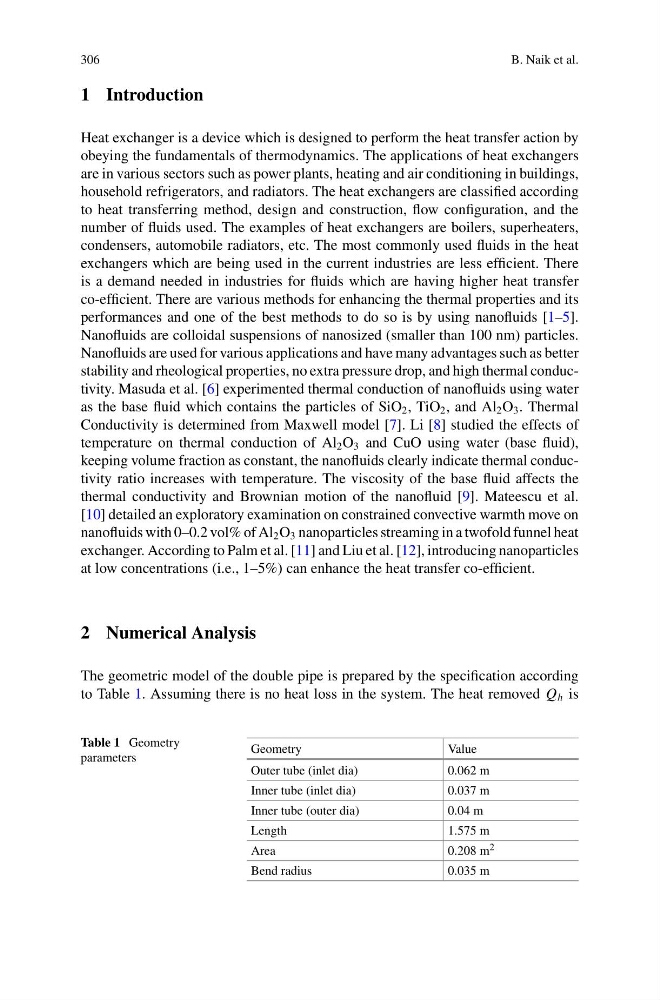
The geometric model of the double pipe is prepared by the specification according
to Table 1. Assuming there is no heat loss in the system. The heat removed Q h is
Table 1 Geometry
parameters
Geometry
Value
Outer tube (inlet dia)
0.062 m
Inner tube (inlet dia)
0.037 m
Inner tube (outer dia)
0.04 m
Length
1.575 m
Area
0.208 m 2
Bend radius
0.035 m
B. Naik et al.
1 Introduction
Heat exchanger is a device which is designed to perform the heat transfer action by
obeying the fundamentals of thermodynamics. The applications of heat exchangers
are in various sectors such as power plants, heating and air conditioning in buildings,
household refrigerators, and radiators. The heat exchangers are classified according
to heat transferring method, design and construction, flow configuration, and the
number of fluids used. The examples of heat exchangers are boilers, superheaters,
condensers, automobile radiators, etc. The most commonly used fluids in the heat
exchangers which are being used in the current industries are less efficient. There
is a demand needed in industries for fluids which are having higher heat transfer
co-efficient. There are various methods for enhancing the thermal properties and its
performances and one of the best methods to do so is by using nanofluids [1–5].
Nanofluids are colloidal suspensions of nanosized (smaller than 100 nm) particles.
Nanofluids are used for various applications and have many advantages such as better
stability and rheological properties, no extra pressure drop, and high thermal conductivity. Masuda et al. [6] experimented thermal conduction of nanofluids using water
as the base fluid which contains the particles of SiO 2 , TiO 2 , and Al 2 O 3 . Thermal
Conductivity is determined from Maxwell model [7]. Li [8] studied the effects of
temperature on thermal conduction of Al 2 O 3 and CuO using water (base fluid),
keeping volume fraction as constant, the nanofluids clearly indicate thermal conductivity ratio increases with temperature. The viscosity of the base fluid affects the
thermal conductivity and Brownian motion of the nanofluid [9]. Mateescu et al.
[10] detailed an exploratory examination on constrained convective warmth move on
nanofluids with 0–0.2 vol% of Al 2 O 3 nanoparticles streaming in a twofold funnel heat
exchanger. According to Palm et al. [11] and Liu et al. [12], introducing nanoparticles
at low concentrations (i.e., 1–5%) can enhance the heat transfer co-efficient.
2 Numerical Analysis
The geometric model of the double pipe is prepared by the specification according
to Table 1. Assuming there is no heat loss in the system. The heat removed Q h is
Table 1 Geometry
parameters
Geometry
Value
Outer tube (inlet dia)
0.062 m
Inner tube (inlet dia)
0.037 m
Inner tube (outer dia)
0.04 m
Length
1.575 m
Area
0.208 m 2
Bend radius
0.035 m