

268
M. P. Parmar et al.
4 Simulation Setup, Data, and Mathematical Equation
4.1 Simulation Setup
The geometrical shape of the lithium-ion battery is cylindrical. The software that
we have used for this simulation is Ansys Fluent (Available in Ansys Workbench
2020 R1 Student Version) [12]. In Ansys Fluent, there are two types of battery
models available: (1) single-potential empirical battery model and (2) dual-potential
MSMD battery model. From these battery models, we have chosen the dual-potential
MSMD battery model, because after going through several references [13] we found
that single-potential empirical battery model is suitable for only a single lithium-ion
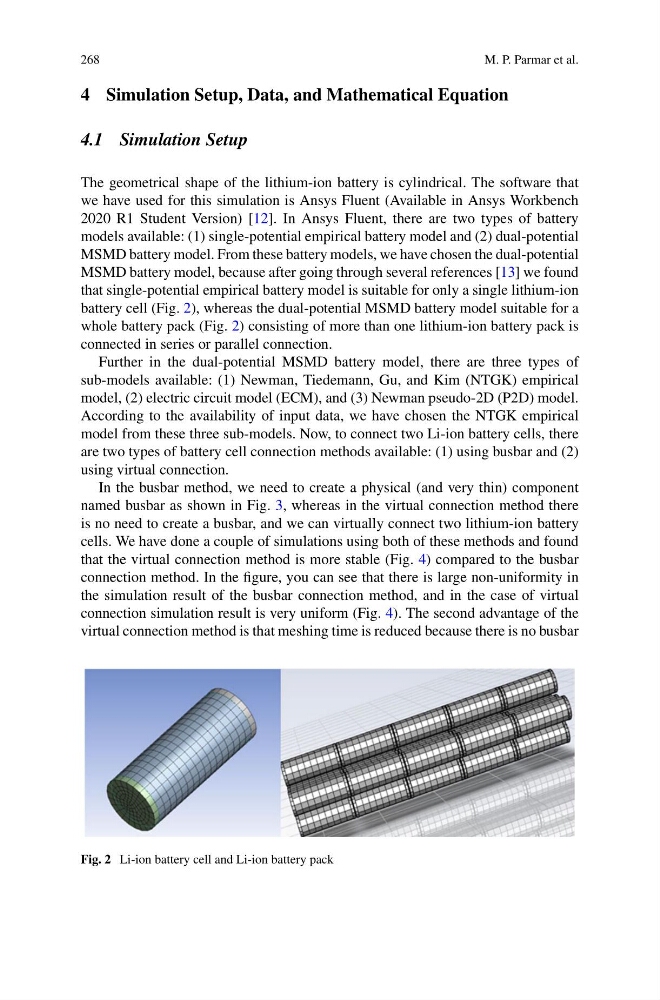
battery cell (Fig. 2), whereas the dual-potential MSMD battery model suitable for a
whole battery pack (Fig. 2) consisting of more than one lithium-ion battery pack is
connected in series or parallel connection.
Further in the dual-potential MSMD battery model, there are three types of
sub-models available: (1) Newman, Tiedemann, Gu, and Kim (NTGK) empirical
model, (2) electric circuit model (ECM), and (3) Newman pseudo-2D (P2D) model.
According to the availability of input data, we have chosen the NTGK empirical
model from these three sub-models. Now, to connect two Li-ion battery cells, there
are two types of battery cell connection methods available: (1) using busbar and (2)
using virtual connection.
In the busbar method, we need to create a physical (and very thin) component
named busbar as shown in Fig. 3, whereas in the virtual connection method there
is no need to create a busbar, and we can virtually connect two lithium-ion battery
cells. We have done a couple of simulations using both of these methods and found
that the virtual connection method is more stable (Fig. 4) compared to the busbar
connection method. In the figure, you can see that there is large non-uniformity in
the simulation result of the busbar connection method, and in the case of virtual
connection simulation result is very uniform (Fig. 4). The second advantage of the
virtual connection method is that meshing time is reduced because there is no busbar
Fig. 2 Li-ion battery cell and Li-ion battery pack
M. P. Parmar et al.
4 Simulation Setup, Data, and Mathematical Equation
4.1 Simulation Setup
The geometrical shape of the lithium-ion battery is cylindrical. The software that
we have used for this simulation is Ansys Fluent (Available in Ansys Workbench
2020 R1 Student Version) [12]. In Ansys Fluent, there are two types of battery
models available: (1) single-potential empirical battery model and (2) dual-potential
MSMD battery model. From these battery models, we have chosen the dual-potential
MSMD battery model, because after going through several references [13] we found
that single-potential empirical battery model is suitable for only a single lithium-ion
battery cell (Fig. 2), whereas the dual-potential MSMD battery model suitable for a
whole battery pack (Fig. 2) consisting of more than one lithium-ion battery pack is
connected in series or parallel connection.
Further in the dual-potential MSMD battery model, there are three types of
sub-models available: (1) Newman, Tiedemann, Gu, and Kim (NTGK) empirical
model, (2) electric circuit model (ECM), and (3) Newman pseudo-2D (P2D) model.
According to the availability of input data, we have chosen the NTGK empirical
model from these three sub-models. Now, to connect two Li-ion battery cells, there
are two types of battery cell connection methods available: (1) using busbar and (2)
using virtual connection.
In the busbar method, we need to create a physical (and very thin) component
named busbar as shown in Fig. 3, whereas in the virtual connection method there
is no need to create a busbar, and we can virtually connect two lithium-ion battery
cells. We have done a couple of simulations using both of these methods and found
that the virtual connection method is more stable (Fig. 4) compared to the busbar
connection method. In the figure, you can see that there is large non-uniformity in
the simulation result of the busbar connection method, and in the case of virtual
connection simulation result is very uniform (Fig. 4). The second advantage of the
virtual connection method is that meshing time is reduced because there is no busbar
Fig. 2 Li-ion battery cell and Li-ion battery pack