

266
M. P. Parmar et al.
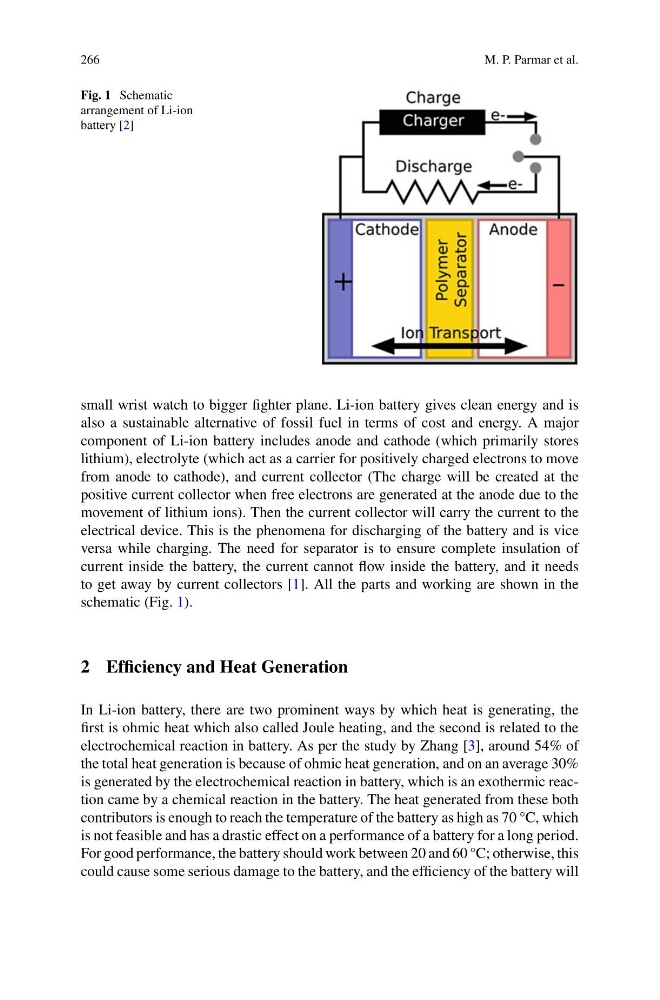
Fig. 1 Schematic
arrangement of Li-ion
battery [2]
small wrist watch to bigger fighter plane. Li-ion battery gives clean energy and is
also a sustainable alternative of fossil fuel in terms of cost and energy. A major
component of Li-ion battery includes anode and cathode (which primarily stores
lithium), electrolyte (which act as a carrier for positively charged electrons to move
from anode to cathode), and current collector (The charge will be created at the
positive current collector when free electrons are generated at the anode due to the
movement of lithium ions). Then the current collector will carry the current to the
electrical device. This is the phenomena for discharging of the battery and is vice
versa while charging. The need for separator is to ensure complete insulation of
current inside the battery, the current cannot flow inside the battery, and it needs
to get away by current collectors [1]. All the parts and working are shown in the
schematic (Fig. 1).
2 Efficiency and Heat Generation
In Li-ion battery, there are two prominent ways by which heat is generating, the
first is ohmic heat which also called Joule heating, and the second is related to the
electrochemical reaction in battery. As per the study by Zhang [3], around 54% of
the total heat generation is because of ohmic heat generation, and on an average 30%
is generated by the electrochemical reaction in battery, which is an exothermic reaction came by a chemical reaction in the battery. The heat generated from these both
contributors is enough to reach the temperature of the battery as high as 70 °C, which
is not feasible and has a drastic effect on a performance of a battery for a long period.
For good performance, the battery should work between 20 and 60 °C; otherwise, this
could cause some serious damage to the battery, and the efficiency of the battery will
M. P. Parmar et al.
Fig. 1 Schematic
arrangement of Li-ion
battery [2]
small wrist watch to bigger fighter plane. Li-ion battery gives clean energy and is
also a sustainable alternative of fossil fuel in terms of cost and energy. A major
component of Li-ion battery includes anode and cathode (which primarily stores
lithium), electrolyte (which act as a carrier for positively charged electrons to move
from anode to cathode), and current collector (The charge will be created at the
positive current collector when free electrons are generated at the anode due to the
movement of lithium ions). Then the current collector will carry the current to the
electrical device. This is the phenomena for discharging of the battery and is vice
versa while charging. The need for separator is to ensure complete insulation of
current inside the battery, the current cannot flow inside the battery, and it needs
to get away by current collectors [1]. All the parts and working are shown in the
schematic (Fig. 1).
2 Efficiency and Heat Generation
In Li-ion battery, there are two prominent ways by which heat is generating, the
first is ohmic heat which also called Joule heating, and the second is related to the
electrochemical reaction in battery. As per the study by Zhang [3], around 54% of
the total heat generation is because of ohmic heat generation, and on an average 30%
is generated by the electrochemical reaction in battery, which is an exothermic reaction came by a chemical reaction in the battery. The heat generated from these both
contributors is enough to reach the temperature of the battery as high as 70 °C, which
is not feasible and has a drastic effect on a performance of a battery for a long period.
For good performance, the battery should work between 20 and 60 °C; otherwise, this
could cause some serious damage to the battery, and the efficiency of the battery will