

Grain Refinement and Improvement in Microhardness of AZ91 Mg …
203
distributed with grain refinement. For refinement of grains, it was reported that
mechanical separation and nucleation and growth of new grains during deformation are the two main criteria [10]. It has been proposed that the rupturing of α-grains
(mechanical separation) to fine grains is mainly determined by the distribution of
eutectic and β-phases (Mg 17 Al 12 ). The eutectic phases uniformly distribute in the
inter-dendrites because the eutectic or β-phase (Mg 17 Al 12 ) is relatively hard, and for
deforming, it is difficult, while the α-phase is soft and easy to deform. Specimens
processed at 545 the very fine grain microstructure was observed with very small
α-grain.
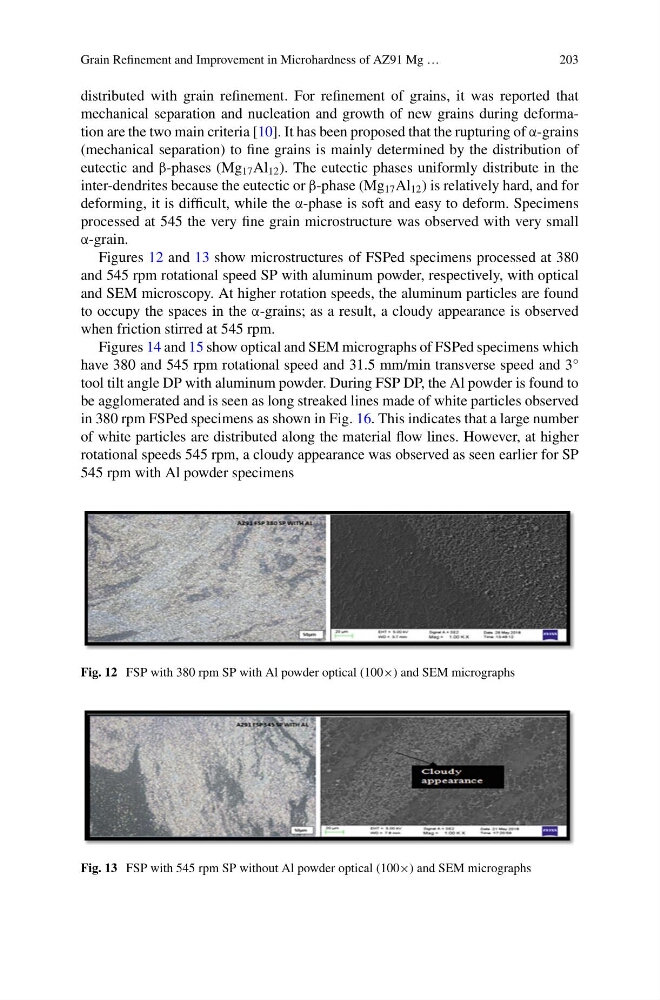
Figures 12 and 13 show microstructures of FSPed specimens processed at 380
and 545 rpm rotational speed SP with aluminum powder, respectively, with optical
and SEM microscopy. At higher rotation speeds, the aluminum particles are found
to occupy the spaces in the α-grains; as a result, a cloudy appearance is observed
when friction stirred at 545 rpm.
Figures 14 and 15 show optical and SEM micrographs of FSPed specimens which
have 380 and 545 rpm rotational speed and 31.5 mm/min transverse speed and 3°
tool tilt angle DP with aluminum powder. During FSP DP, the Al powder is found to
be agglomerated and is seen as long streaked lines made of white particles observed
in 380 rpm FSPed specimens as shown in Fig. 16. This indicates that a large number
of white particles are distributed along the material flow lines. However, at higher
rotational speeds 545 rpm, a cloudy appearance was observed as seen earlier for SP
545 rpm with Al powder specimens
Fig. 12 FSP with 380 rpm SP with Al powder optical (100×) and SEM micrographs
Fig. 13 FSP with 545 rpm SP without Al powder optical (100×) and SEM micrographs
203
distributed with grain refinement. For refinement of grains, it was reported that
mechanical separation and nucleation and growth of new grains during deformation are the two main criteria [10]. It has been proposed that the rupturing of α-grains
(mechanical separation) to fine grains is mainly determined by the distribution of
eutectic and β-phases (Mg 17 Al 12 ). The eutectic phases uniformly distribute in the
inter-dendrites because the eutectic or β-phase (Mg 17 Al 12 ) is relatively hard, and for
deforming, it is difficult, while the α-phase is soft and easy to deform. Specimens
processed at 545 the very fine grain microstructure was observed with very small
α-grain.
Figures 12 and 13 show microstructures of FSPed specimens processed at 380
and 545 rpm rotational speed SP with aluminum powder, respectively, with optical
and SEM microscopy. At higher rotation speeds, the aluminum particles are found
to occupy the spaces in the α-grains; as a result, a cloudy appearance is observed
when friction stirred at 545 rpm.
Figures 14 and 15 show optical and SEM micrographs of FSPed specimens which
have 380 and 545 rpm rotational speed and 31.5 mm/min transverse speed and 3°
tool tilt angle DP with aluminum powder. During FSP DP, the Al powder is found to
be agglomerated and is seen as long streaked lines made of white particles observed
in 380 rpm FSPed specimens as shown in Fig. 16. This indicates that a large number
of white particles are distributed along the material flow lines. However, at higher
rotational speeds 545 rpm, a cloudy appearance was observed as seen earlier for SP
545 rpm with Al powder specimens
Fig. 12 FSP with 380 rpm SP with Al powder optical (100×) and SEM micrographs
Fig. 13 FSP with 545 rpm SP without Al powder optical (100×) and SEM micrographs