

140
D. K. Sharma et al.
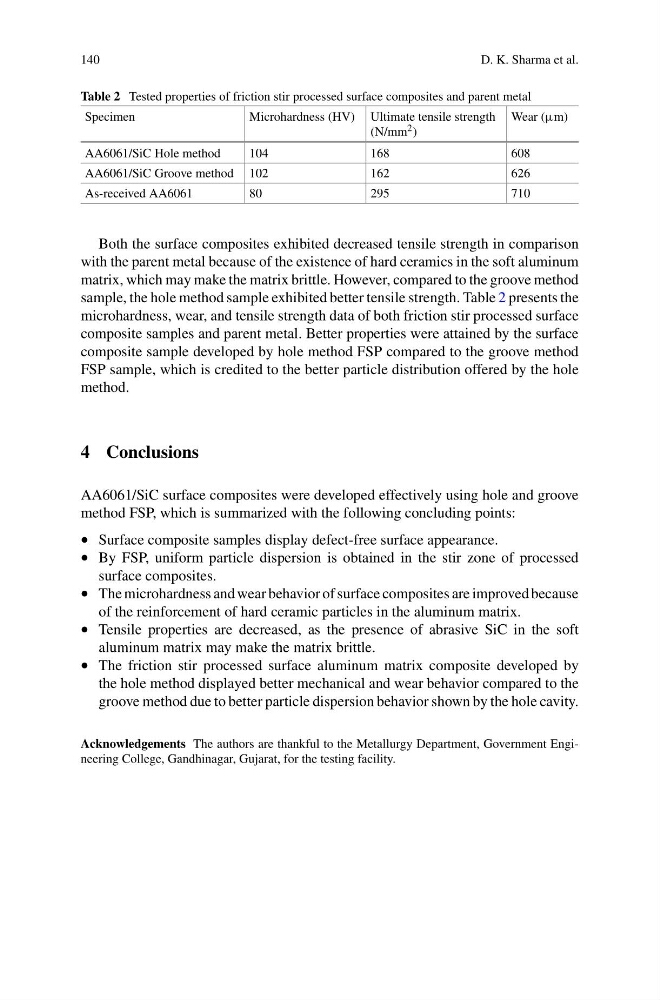
Table 2 Tested properties of friction stir processed surface composites and parent metal
Specimen
Microhardness (HV) Ultimate tensile strength
(N/mm 2 )
Wear (µm)
AA6061/SiC Hole method
104
168
608
AA6061/SiC Groove method 102
162
626
As-received AA6061
80
295
710
Both the surface composites exhibited decreased tensile strength in comparison
with the parent metal because of the existence of hard ceramics in the soft aluminum
matrix, which may make the matrix brittle. However, compared to the groove method
sample, the hole method sample exhibited better tensile strength. Table 2 presents the
microhardness, wear, and tensile strength data of both friction stir processed surface
composite samples and parent metal. Better properties were attained by the surface
composite sample developed by hole method FSP compared to the groove method
FSP sample, which is credited to the better particle distribution offered by the hole
method.
4 Conclusions
AA6061/SiC surface composites were developed effectively using hole and groove
method FSP, which is summarized with the following concluding points:
• Surface composite samples display defect-free surface appearance.
• By FSP, uniform particle dispersion is obtained in the stir zone of processed
surface composites.
• The microhardness and wear behavior of surface composites are improved because
of the reinforcement of hard ceramic particles in the aluminum matrix.
• Tensile properties are decreased, as the presence of abrasive SiC in the soft
aluminum matrix may make the matrix brittle.
• The friction stir processed surface aluminum matrix composite developed by
the hole method displayed better mechanical and wear behavior compared to the
groove method due to better particle dispersion behavior shown by the hole cavity.
Acknowledgements The authors are thankful to the Metallurgy Department, Government Engineering College, Gandhinagar, Gujarat, for the testing facility.
D. K. Sharma et al.
Table 2 Tested properties of friction stir processed surface composites and parent metal
Specimen
Microhardness (HV) Ultimate tensile strength
(N/mm 2 )
Wear (µm)
AA6061/SiC Hole method
104
168
608
AA6061/SiC Groove method 102
162
626
As-received AA6061
80
295
710
Both the surface composites exhibited decreased tensile strength in comparison
with the parent metal because of the existence of hard ceramics in the soft aluminum
matrix, which may make the matrix brittle. However, compared to the groove method
sample, the hole method sample exhibited better tensile strength. Table 2 presents the
microhardness, wear, and tensile strength data of both friction stir processed surface
composite samples and parent metal. Better properties were attained by the surface
composite sample developed by hole method FSP compared to the groove method
FSP sample, which is credited to the better particle distribution offered by the hole
method.
4 Conclusions
AA6061/SiC surface composites were developed effectively using hole and groove
method FSP, which is summarized with the following concluding points:
• Surface composite samples display defect-free surface appearance.
• By FSP, uniform particle dispersion is obtained in the stir zone of processed
surface composites.
• The microhardness and wear behavior of surface composites are improved because
of the reinforcement of hard ceramic particles in the aluminum matrix.
• Tensile properties are decreased, as the presence of abrasive SiC in the soft
aluminum matrix may make the matrix brittle.
• The friction stir processed surface aluminum matrix composite developed by
the hole method displayed better mechanical and wear behavior compared to the
groove method due to better particle dispersion behavior shown by the hole cavity.
Acknowledgements The authors are thankful to the Metallurgy Department, Government Engineering College, Gandhinagar, Gujarat, for the testing facility.