

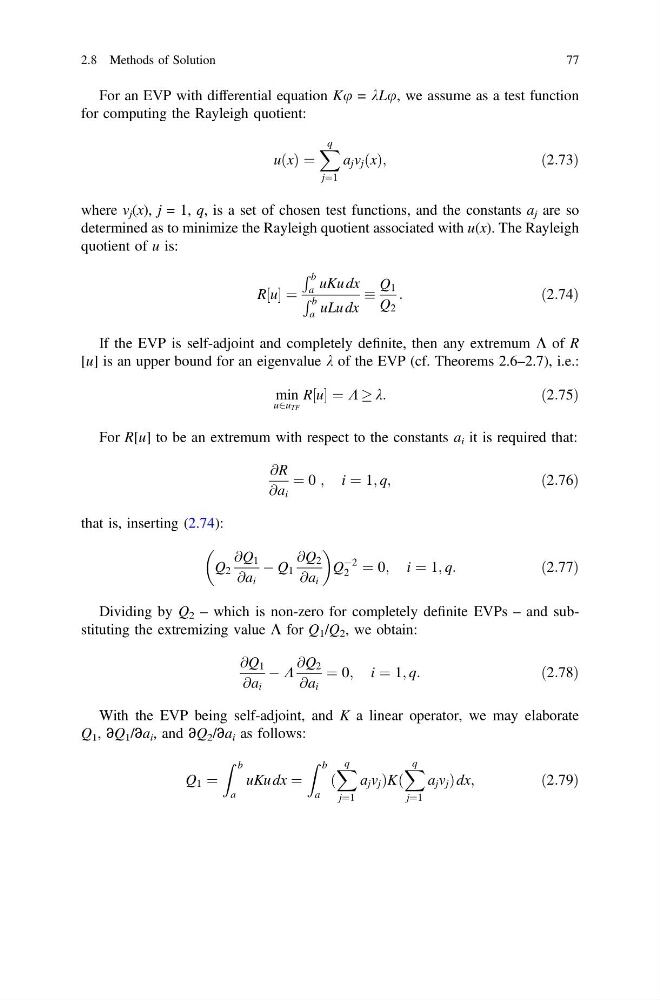
For an EVP with differential equation Ku = kLu, we assume as a test function
for computing the Rayleigh quotient:
uðxÞ ¼
X q
j¼1
a j v j ðxÞ;
ð2:73Þ
where v j (x), j = 1, q, is a set of chosen test functions, and the constants a j are so
determined as to minimize the Rayleigh quotient associated with u(x). The Rayleigh
quotient of u is:
R u
½ ¼
R b
a uKu dx
R b
a uLu dx
Q 1
Q 2
:
ð2:74Þ
If the EVP is self-adjoint and completely definite, then any extremum K of R
[u] is an upper bound for an eigenvalue k of the EVP (cf. Theorems 2.6–2.7), i.e.:
min
u2u TF
R u
½ ¼ K ! k:
ð2:75Þ
For R[u] to be an extremum with respect to the constants a i it is required that:
@R
@a i
¼ 0 ; i ¼ 1; q;
ð2:76Þ
that is, inserting (2.74):
Q 2
@Q 1
@a i
À Q 1
@Q 2
@a i
Q
À2
2 ¼ 0; i ¼ 1; q:
ð2:77Þ
Dividing by Q 2 – which is non-zero for completely definite EVPs – and substituting the extremizing value K for Q 1 /Q 2 , we obtain:
@Q 1
@a i
À K
@Q 2
@a i
¼ 0; i ¼ 1; q:
ð2:78Þ
With the EVP being self-adjoint, and K a linear operator, we may elaborate
Q 1 , ∂Q 1 /∂a i , and ∂Q 2 /∂a i as follows:
Q 1 ¼
Z b
a
uKu dx ¼
Z b
a
ð
X q
j¼1
a j v j ÞKð
X q
j¼1
a j v j Þdx;
ð2:79Þ
2.8 Methods of Solution
77
for computing the Rayleigh quotient:
uðxÞ ¼
X q
j¼1
a j v j ðxÞ;
ð2:73Þ
where v j (x), j = 1, q, is a set of chosen test functions, and the constants a j are so
determined as to minimize the Rayleigh quotient associated with u(x). The Rayleigh
quotient of u is:
R u
½ ¼
R b
a uKu dx
R b
a uLu dx
Q 1
Q 2
:
ð2:74Þ
If the EVP is self-adjoint and completely definite, then any extremum K of R
[u] is an upper bound for an eigenvalue k of the EVP (cf. Theorems 2.6–2.7), i.e.:
min
u2u TF
R u
½ ¼ K ! k:
ð2:75Þ
For R[u] to be an extremum with respect to the constants a i it is required that:
@R
@a i
¼ 0 ; i ¼ 1; q;
ð2:76Þ
that is, inserting (2.74):
Q 2
@Q 1
@a i
À Q 1
@Q 2
@a i
Q
À2
2 ¼ 0; i ¼ 1; q:
ð2:77Þ
Dividing by Q 2 – which is non-zero for completely definite EVPs – and substituting the extremizing value K for Q 1 /Q 2 , we obtain:
@Q 1
@a i
À K
@Q 2
@a i
¼ 0; i ¼ 1; q:
ð2:78Þ
With the EVP being self-adjoint, and K a linear operator, we may elaborate
Q 1 , ∂Q 1 /∂a i , and ∂Q 2 /∂a i as follows:
Q 1 ¼
Z b
a
uKu dx ¼
Z b
a
ð
X q
j¼1
a j v j ÞKð
X q
j¼1
a j v j Þdx;
ð2:79Þ
2.8 Methods of Solution
77