

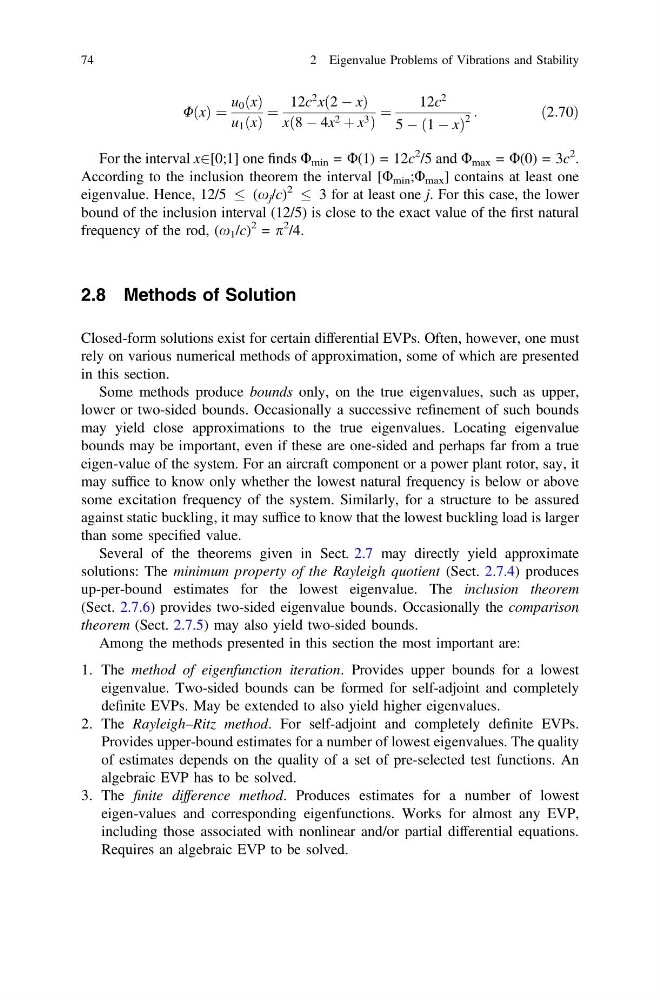
UðxÞ ¼
u 0 ðxÞ
u 1 ðxÞ
¼
12c
2 xð2 À xÞ
xð8 À 4x 2 þ x 3 Þ
¼
12c
2
5 À ð1 À xÞ
2
:
ð2:70Þ
For the interval x2[0;1] one finds U min = U(1) = 12c
2 /5 and U max = U(0) = 3c
2 .
According to the inclusion theorem the interval [U min ;U max ] contains at least one
eigenvalue. Hence, 12/5
(x j /c)
2
3 for at least one j. For this case, the lower
bound of the inclusion interval (12/5) is close to the exact value of the first natural
frequency of the rod, (x 1 /c)
2 = p
2 /4.
2.8 Methods of Solution
Closed-form solutions exist for certain differential EVPs. Often, however, one must
rely on various numerical methods of approximation, some of which are presented
in this section.
Some methods produce bounds only, on the true eigenvalues, such as upper,
lower or two-sided bounds. Occasionally a successive refinement of such bounds
may yield close approximations to the true eigenvalues. Locating eigenvalue
bounds may be important, even if these are one-sided and perhaps far from a true
eigen-value of the system. For an aircraft component or a power plant rotor, say, it
may suffice to know only whether the lowest natural frequency is below or above
some excitation frequency of the system. Similarly, for a structure to be assured
against static buckling, it may suffice to know that the lowest buckling load is larger
than some specified value.
Several of the theorems given in Sect. 2.7 may directly yield approximate
solutions: The minimum property of the Rayleigh quotient (Sect. 2.7.4) produces
up-per-bound estimates for the lowest eigenvalue. The inclusion theorem
(Sect. 2.7.6) provides two-sided eigenvalue bounds. Occasionally the comparison
theorem (Sect. 2.7.5) may also yield two-sided bounds.
Among the methods presented in this section the most important are:
1. The method of eigenfunction iteration. Provides upper bounds for a lowest
eigenvalue. Two-sided bounds can be formed for self-adjoint and completely
definite EVPs. May be extended to also yield higher eigenvalues.
2. The Rayleigh–Ritz method. For self-adjoint and completely definite EVPs.
Provides upper-bound estimates for a number of lowest eigenvalues. The quality
of estimates depends on the quality of a set of pre-selected test functions. An
algebraic EVP has to be solved.
3. The finite difference method. Produces estimates for a number of lowest
eigen-values and corresponding eigenfunctions. Works for almost any EVP,
including those associated with nonlinear and/or partial differential equations.
Requires an algebraic EVP to be solved.
74
2 Eigenvalue Problems of Vibrations and Stability
u 0 ðxÞ
u 1 ðxÞ
¼
12c
2 xð2 À xÞ
xð8 À 4x 2 þ x 3 Þ
¼
12c
2
5 À ð1 À xÞ
2
:
ð2:70Þ
For the interval x2[0;1] one finds U min = U(1) = 12c
2 /5 and U max = U(0) = 3c
2 .
According to the inclusion theorem the interval [U min ;U max ] contains at least one
eigenvalue. Hence, 12/5
(x j /c)
2
3 for at least one j. For this case, the lower
bound of the inclusion interval (12/5) is close to the exact value of the first natural
frequency of the rod, (x 1 /c)
2 = p
2 /4.
2.8 Methods of Solution
Closed-form solutions exist for certain differential EVPs. Often, however, one must
rely on various numerical methods of approximation, some of which are presented
in this section.
Some methods produce bounds only, on the true eigenvalues, such as upper,
lower or two-sided bounds. Occasionally a successive refinement of such bounds
may yield close approximations to the true eigenvalues. Locating eigenvalue
bounds may be important, even if these are one-sided and perhaps far from a true
eigen-value of the system. For an aircraft component or a power plant rotor, say, it
may suffice to know only whether the lowest natural frequency is below or above
some excitation frequency of the system. Similarly, for a structure to be assured
against static buckling, it may suffice to know that the lowest buckling load is larger
than some specified value.
Several of the theorems given in Sect. 2.7 may directly yield approximate
solutions: The minimum property of the Rayleigh quotient (Sect. 2.7.4) produces
up-per-bound estimates for the lowest eigenvalue. The inclusion theorem
(Sect. 2.7.6) provides two-sided eigenvalue bounds. Occasionally the comparison
theorem (Sect. 2.7.5) may also yield two-sided bounds.
Among the methods presented in this section the most important are:
1. The method of eigenfunction iteration. Provides upper bounds for a lowest
eigenvalue. Two-sided bounds can be formed for self-adjoint and completely
definite EVPs. May be extended to also yield higher eigenvalues.
2. The Rayleigh–Ritz method. For self-adjoint and completely definite EVPs.
Provides upper-bound estimates for a number of lowest eigenvalues. The quality
of estimates depends on the quality of a set of pre-selected test functions. An
algebraic EVP has to be solved.
3. The finite difference method. Produces estimates for a number of lowest
eigen-values and corresponding eigenfunctions. Works for almost any EVP,
including those associated with nonlinear and/or partial differential equations.
Requires an algebraic EVP to be solved.
74
2 Eigenvalue Problems of Vibrations and Stability