

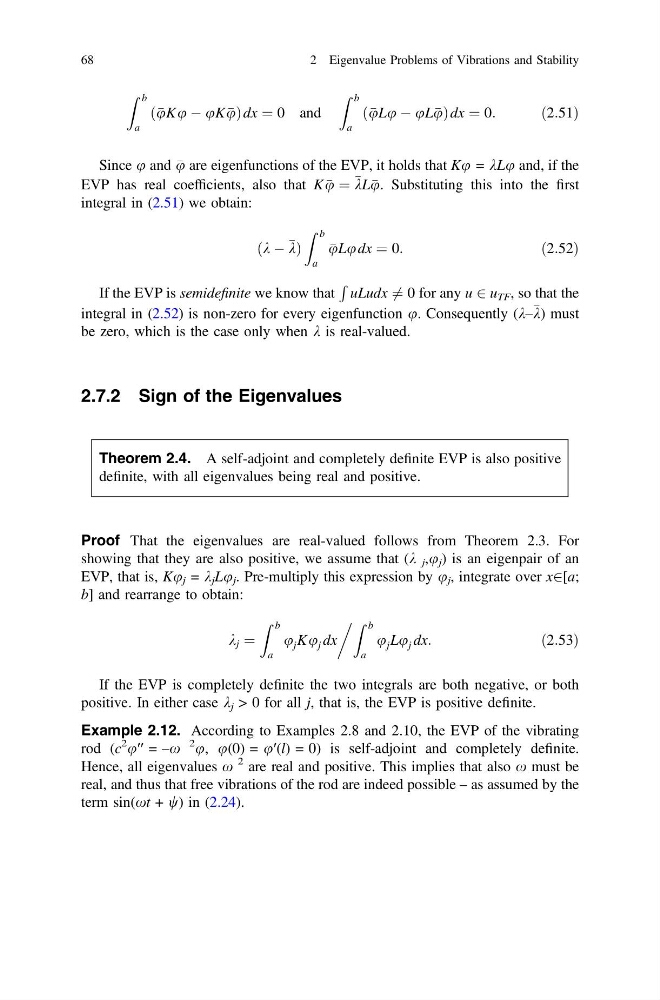
Z b
a
uKu À uK
u
ð
Þ dx ¼ 0 and
Z b
a
uLu À uL u
ð
Þ dx ¼ 0:
ð2:51Þ
Since u and
u are eigenfunctions of the EVP, it holds that Ku = kLu and, if the
EVP has real coefficients, also that K
u ¼ kL u. Substituting this into the first
integral in (2.51) we obtain:
ðk À kÞ
Z b
a
uLu dx ¼ 0:
ð2:52Þ
If the EVP is semidefinite we know that
R
uLudx 6 ¼ 0 for any u 2 u TF , so that the
integral in (2.52) is non-zero for every eigenfunction u. Consequently (k– k) must
be zero, which is the case only when k is real-valued.
2.7.2 Sign of the Eigenvalues
Theorem 2.4. A self-adjoint and completely definite EVP is also positive
definite, with all eigenvalues being real and positive.
Proof That the eigenvalues are real-valued follows from Theorem 2.3. For
showing that they are also positive, we assume that (k j ,u j ) is an eigenpair of an
EVP, that is, Ku j = k j Lu j . Pre-multiply this expression by u j , integrate over x2[a;
b] and rearrange to obtain:
k j ¼
Z b
a
u j Ku j dx
0Z b
a
u j Lu j dx:
ð2:53Þ
If the EVP is completely definite the two integrals are both negative, or both
positive. In either case k j > 0 for all j, that is, the EVP is positive definite.
Example 2.12. According to Examples 2.8 and 2.10, the EVP of the vibrating
rod (c
2 u′′ = –x
2 u, u(0) = u′(l) = 0) is self-adjoint and completely definite.
Hence, all eigenvalues x
2 are real and positive. This implies that also x must be
real, and thus that free vibrations of the rod are indeed possible – as assumed by the
term sin(xt + w) in (2.24).
68
2 Eigenvalue Problems of Vibrations and Stability
a
uKu À uK
u
ð
Þ dx ¼ 0 and
Z b
a
uLu À uL u
ð
Þ dx ¼ 0:
ð2:51Þ
Since u and
u are eigenfunctions of the EVP, it holds that Ku = kLu and, if the
EVP has real coefficients, also that K
u ¼ kL u. Substituting this into the first
integral in (2.51) we obtain:
ðk À kÞ
Z b
a
uLu dx ¼ 0:
ð2:52Þ
If the EVP is semidefinite we know that
R
uLudx 6 ¼ 0 for any u 2 u TF , so that the
integral in (2.52) is non-zero for every eigenfunction u. Consequently (k– k) must
be zero, which is the case only when k is real-valued.
2.7.2 Sign of the Eigenvalues
Theorem 2.4. A self-adjoint and completely definite EVP is also positive
definite, with all eigenvalues being real and positive.
Proof That the eigenvalues are real-valued follows from Theorem 2.3. For
showing that they are also positive, we assume that (k j ,u j ) is an eigenpair of an
EVP, that is, Ku j = k j Lu j . Pre-multiply this expression by u j , integrate over x2[a;
b] and rearrange to obtain:
k j ¼
Z b
a
u j Ku j dx
0Z b
a
u j Lu j dx:
ð2:53Þ
If the EVP is completely definite the two integrals are both negative, or both
positive. In either case k j > 0 for all j, that is, the EVP is positive definite.
Example 2.12. According to Examples 2.8 and 2.10, the EVP of the vibrating
rod (c
2 u′′ = –x
2 u, u(0) = u′(l) = 0) is self-adjoint and completely definite.
Hence, all eigenvalues x
2 are real and positive. This implies that also x must be
real, and thus that free vibrations of the rod are indeed possible – as assumed by the
term sin(xt + w) in (2.24).
68
2 Eigenvalue Problems of Vibrations and Stability