

Z b
a
uKv À vKu
ð
Þ dx ¼
Z l
0
u c
2 v
00
À
Á À v c
2 u
00
À
Á
À
Á
dx
¼ uc
2 v
0
Â
à l
0
À vc
2 u
0
Â
à l
0
À
Z l
0
u
0 c
2 v
0
À v
0 c
2 u
0
À
Á
dx ¼ 0
Z b
a
uLv À vLu
ð
Þ dx ¼
Z l
0
uðÀvÞ À vðÀuÞ
ð
Þ dx ¼ 0;
ð2:44Þ
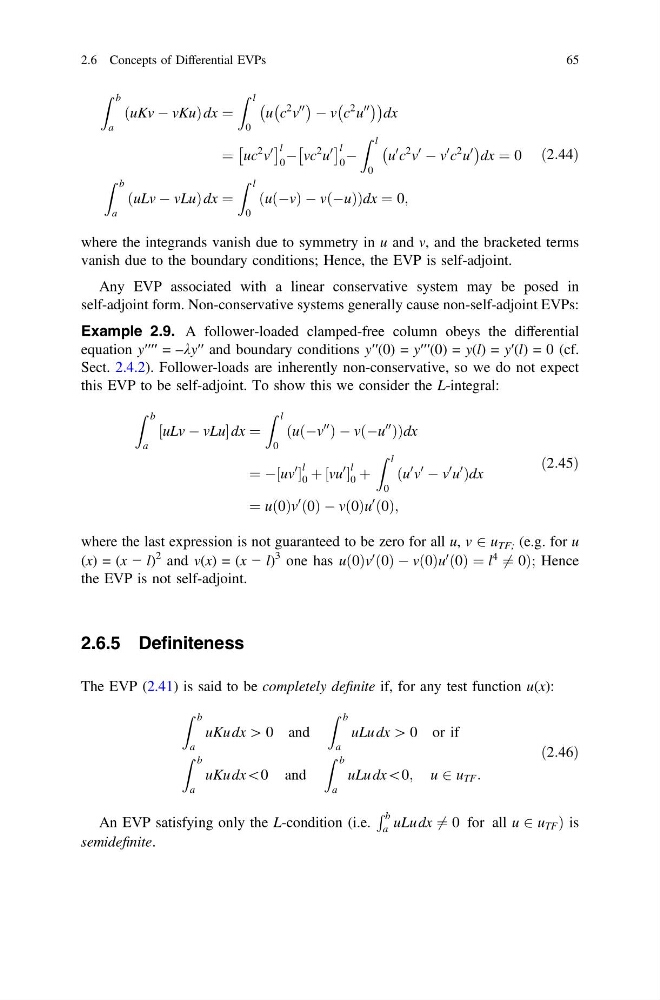
where the integrands vanish due to symmetry in u and v, and the bracketed terms
vanish due to the boundary conditions; Hence, the EVP is self-adjoint.
Any EVP associated with a linear conservative system may be posed in
self-adjoint form. Non-conservative systems generally cause non-self-adjoint EVPs:
Example 2.9. A follower-loaded clamped-free column obeys the differential
equation y′′′′ = –ky′′ and boundary conditions y′′(0) = y′′′(0) = y(l) = y′(l) = 0 (cf.
Sect. 2.4.2). Follower-loads are inherently non-conservative, so we do not expect
this EVP to be self-adjoint. To show this we consider the L-integral:
Z b
a
uLv À vLu
½
dx ¼
Z l
0
uðÀv
00
Þ À v Àu
00
ð
Þ
ð
Þ dx
¼ À uv
0
½
l
0 þ vu
0
½
l
0 þ
Z l
0
u
0 v
0
À v
0 u
0
ð
Þ dx
¼ uð0Þv
0
ð0Þ À vð0Þu
0
ð0Þ;
ð2:45Þ
where the last expression is not guaranteed to be zero for all u, v 2 u TF; (e.g. for u
(x) = (x − l)
2 and v(x) = (x − l)
3 one has uð0Þv
0
ð0Þ À vð0Þu
0
ð0Þ ¼ l
4
6 ¼ 0Þ; Hence
the EVP is not self-adjoint.
2.6.5 Definiteness
The EVP (2.41) is said to be completely definite if, for any test function u(x):
Z b
a
uKu dx [ 0 and
Z b
a
uLu dx [ 0 or if
Z b
a
uKu dx\0 and
Z b
a
uLu dx\0; u 2 u TF :
ð2:46Þ
An EVP satisfying only the L-condition (i.e.
R b
a uLudx 6 ¼ 0 for all u 2 u TF Þ is
semidefinite.
2.6 Concepts of Differential EVPs
65
a
uKv À vKu
ð
Þ dx ¼
Z l
0
u c
2 v
00
À
Á À v c
2 u
00
À
Á
À
Á
dx
¼ uc
2 v
0
Â
à l
0
À vc
2 u
0
Â
à l
0
À
Z l
0
u
0 c
2 v
0
À v
0 c
2 u
0
À
Á
dx ¼ 0
Z b
a
uLv À vLu
ð
Þ dx ¼
Z l
0
uðÀvÞ À vðÀuÞ
ð
Þ dx ¼ 0;
ð2:44Þ
where the integrands vanish due to symmetry in u and v, and the bracketed terms
vanish due to the boundary conditions; Hence, the EVP is self-adjoint.
Any EVP associated with a linear conservative system may be posed in
self-adjoint form. Non-conservative systems generally cause non-self-adjoint EVPs:
Example 2.9. A follower-loaded clamped-free column obeys the differential
equation y′′′′ = –ky′′ and boundary conditions y′′(0) = y′′′(0) = y(l) = y′(l) = 0 (cf.
Sect. 2.4.2). Follower-loads are inherently non-conservative, so we do not expect
this EVP to be self-adjoint. To show this we consider the L-integral:
Z b
a
uLv À vLu
½
dx ¼
Z l
0
uðÀv
00
Þ À v Àu
00
ð
Þ
ð
Þ dx
¼ À uv
0
½
l
0 þ vu
0
½
l
0 þ
Z l
0
u
0 v
0
À v
0 u
0
ð
Þ dx
¼ uð0Þv
0
ð0Þ À vð0Þu
0
ð0Þ;
ð2:45Þ
where the last expression is not guaranteed to be zero for all u, v 2 u TF; (e.g. for u
(x) = (x − l)
2 and v(x) = (x − l)
3 one has uð0Þv
0
ð0Þ À vð0Þu
0
ð0Þ ¼ l
4
6 ¼ 0Þ; Hence
the EVP is not self-adjoint.
2.6.5 Definiteness
The EVP (2.41) is said to be completely definite if, for any test function u(x):
Z b
a
uKu dx [ 0 and
Z b
a
uLu dx [ 0 or if
Z b
a
uKu dx\0 and
Z b
a
uLu dx\0; u 2 u TF :
ð2:46Þ
An EVP satisfying only the L-condition (i.e.
R b
a uLudx 6 ¼ 0 for all u 2 u TF Þ is
semidefinite.
2.6 Concepts of Differential EVPs
65