

We may conclude, seemingly, that the follower-loaded column is elastically
stable in its straight position, however large the value of P. Of course it is not – or
rather: the conclusion is right but the premises fail. The paradox puzzled scientists
for many years, until in the early 1950s it became clear that a follower-load requires
some sort of dynamic device for its realization. Consequently, the problem calls for
a dynamic analysis. In fact, including mass and acceleration into the formulation, it
is revealed that large values of P cause the column to lose stability through the
so-called flutter-mechanism (e.g. Bolotin 1963; Pedersen 1986; Sugiyama et al.
1999; Ziegler 1968; Sugiyama and Langthjem 2007; the survey by Langthjem and
Sugiyama 2000; the critical review by Elishakoff 2005; and the book by Sugiyama
et al. 2019). During flutter a structure oscillates at growing amplitudes, until failure
occurs or nonlinearities limit the response.
2.4.3 Buckling by Gravity
The columns of the preceding two examples were assumed to have constant
cross-sectional properties. The differential equations of the EVPs turned out to have
constant coefficients. However, differential equations with non-constant coefficients
may appear, even for uniform beams.
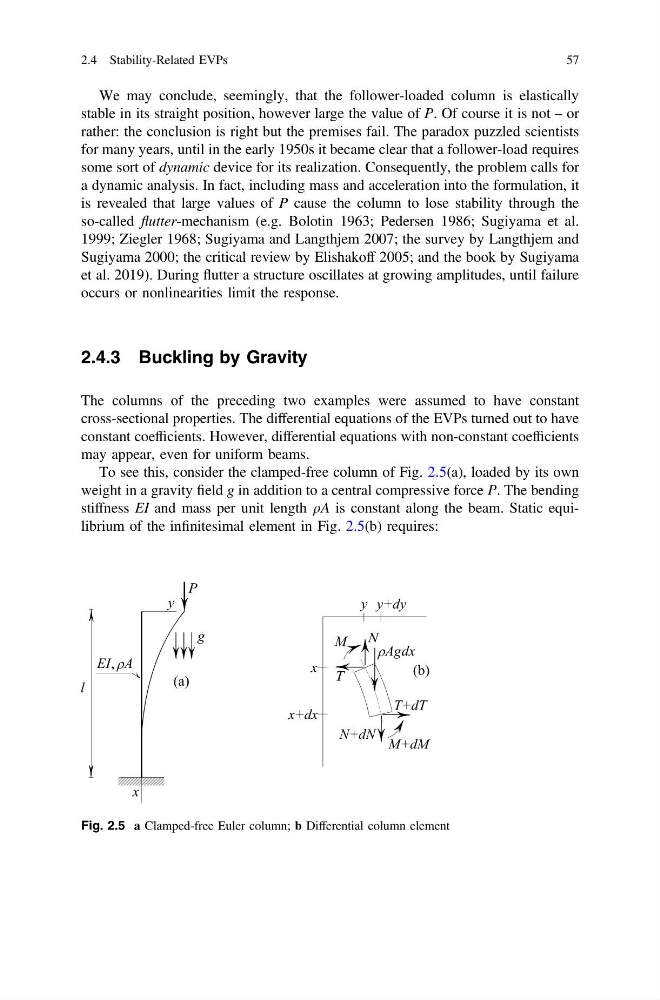
To see this, consider the clamped-free column of Fig. 2.5(a), loaded by its own
weight in a gravity field g in addition to a central compressive force P. The bending
stiffness EI and mass per unit length qA is constant along the beam. Static equilibrium of the infinitesimal element in Fig. 2.5(b) requires:
Fig. 2.5 a Clamped-free Euler column; b Differential column element
2.4 Stability-Related EVPs
57
stable in its straight position, however large the value of P. Of course it is not – or
rather: the conclusion is right but the premises fail. The paradox puzzled scientists
for many years, until in the early 1950s it became clear that a follower-load requires
some sort of dynamic device for its realization. Consequently, the problem calls for
a dynamic analysis. In fact, including mass and acceleration into the formulation, it
is revealed that large values of P cause the column to lose stability through the
so-called flutter-mechanism (e.g. Bolotin 1963; Pedersen 1986; Sugiyama et al.
1999; Ziegler 1968; Sugiyama and Langthjem 2007; the survey by Langthjem and
Sugiyama 2000; the critical review by Elishakoff 2005; and the book by Sugiyama
et al. 2019). During flutter a structure oscillates at growing amplitudes, until failure
occurs or nonlinearities limit the response.
2.4.3 Buckling by Gravity
The columns of the preceding two examples were assumed to have constant
cross-sectional properties. The differential equations of the EVPs turned out to have
constant coefficients. However, differential equations with non-constant coefficients
may appear, even for uniform beams.
To see this, consider the clamped-free column of Fig. 2.5(a), loaded by its own
weight in a gravity field g in addition to a central compressive force P. The bending
stiffness EI and mass per unit length qA is constant along the beam. Static equilibrium of the infinitesimal element in Fig. 2.5(b) requires:
Fig. 2.5 a Clamped-free Euler column; b Differential column element
2.4 Stability-Related EVPs
57