

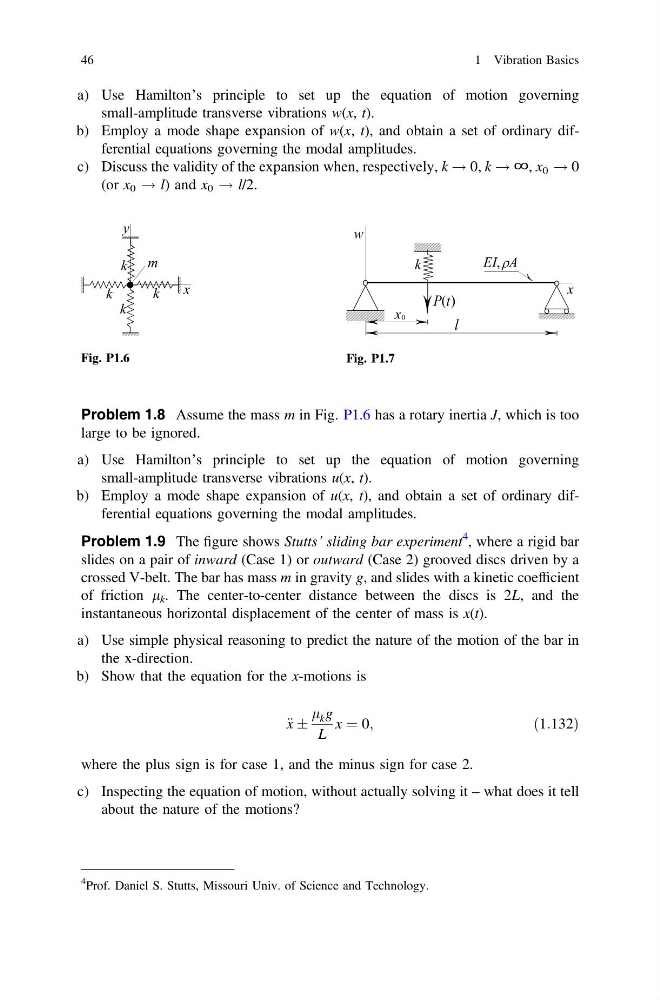
a) Use Hamilton’s principle to set up the equation of motion governing
small-amplitude transverse vibrations w(x, t).
b) Employ a mode shape expansion of w(x, t), and obtain a set of ordinary differential equations governing the modal amplitudes.
c) Discuss the validity of the expansion when, respectively, k ! 0, k ! ∞, x 0 ! 0
(or x 0 ! l) and x 0 ! l/2.
Problem 1.8 Assume the mass m in Fig. P1.6 has a rotary inertia J, which is too
large to be ignored.
a) Use Hamilton’s principle to set up the equation of motion governing
small-amplitude transverse vibrations u(x, t).
b) Employ a mode shape expansion of u(x, t), and obtain a set of ordinary differential equations governing the modal amplitudes.
Problem 1.9 The figure shows Stutts’ sliding bar experiment
4 , where a rigid bar
slides on a pair of inward (Case 1) or outward (Case 2) grooved discs driven by a
crossed V-belt. The bar has mass m in gravity g, and slides with a kinetic coefficient
of friction l k . The center-to-center distance between the discs is 2L, and the
instantaneous horizontal displacement of the center of mass is x(t).
a) Use simple physical reasoning to predict the nature of the motion of the bar in
the x-direction.
b) Show that the equation for the x-motions is
€ x Æ
l k g
L
x ¼ 0;
ð1:132Þ
where the plus sign is for case 1, and the minus sign for case 2.
c) Inspecting the equation of motion, without actually solving it – what does it tell
about the nature of the motions?
Fig. P1.6
Fig. P1.7
4
Prof. Daniel S. Stutts, Missouri Univ. of Science and Technology.
46
1 Vibration Basics
small-amplitude transverse vibrations w(x, t).
b) Employ a mode shape expansion of w(x, t), and obtain a set of ordinary differential equations governing the modal amplitudes.
c) Discuss the validity of the expansion when, respectively, k ! 0, k ! ∞, x 0 ! 0
(or x 0 ! l) and x 0 ! l/2.
Problem 1.8 Assume the mass m in Fig. P1.6 has a rotary inertia J, which is too
large to be ignored.
a) Use Hamilton’s principle to set up the equation of motion governing
small-amplitude transverse vibrations u(x, t).
b) Employ a mode shape expansion of u(x, t), and obtain a set of ordinary differential equations governing the modal amplitudes.
Problem 1.9 The figure shows Stutts’ sliding bar experiment
4 , where a rigid bar
slides on a pair of inward (Case 1) or outward (Case 2) grooved discs driven by a
crossed V-belt. The bar has mass m in gravity g, and slides with a kinetic coefficient
of friction l k . The center-to-center distance between the discs is 2L, and the
instantaneous horizontal displacement of the center of mass is x(t).
a) Use simple physical reasoning to predict the nature of the motion of the bar in
the x-direction.
b) Show that the equation for the x-motions is
€ x Æ
l k g
L
x ¼ 0;
ð1:132Þ
where the plus sign is for case 1, and the minus sign for case 2.
c) Inspecting the equation of motion, without actually solving it – what does it tell
about the nature of the motions?
Fig. P1.6
Fig. P1.7
4
Prof. Daniel S. Stutts, Missouri Univ. of Science and Technology.
46
1 Vibration Basics