

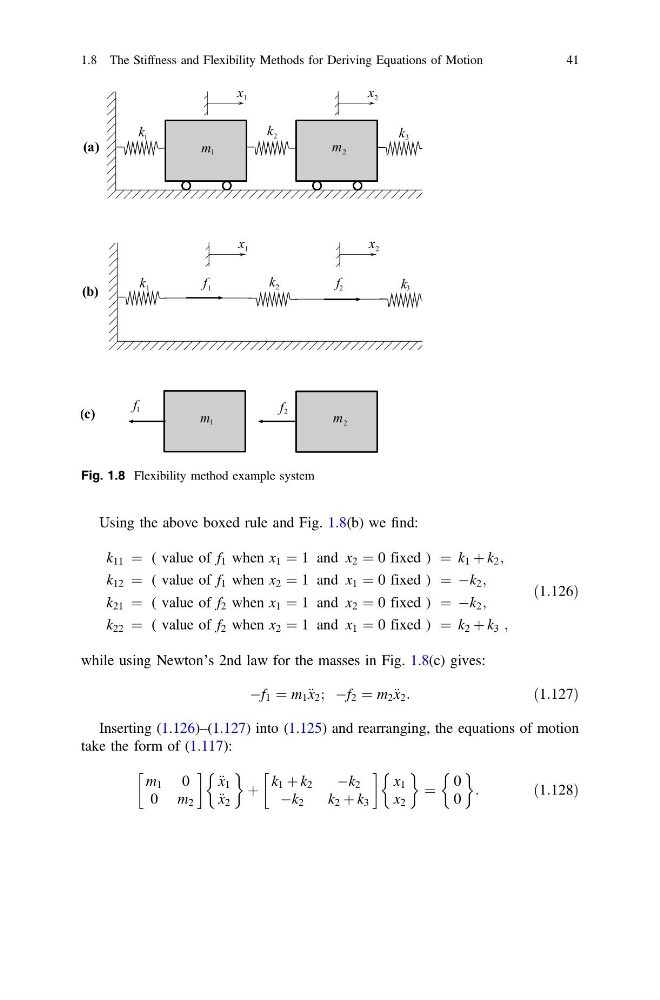
Using the above boxed rule and Fig. 1.8(b) we find:
k 11 ¼ ( value of f 1 when x 1 ¼ 1 and x 2 ¼ 0 fixed ) ¼ k 1 þ k 2 ;
k 12 ¼ ( value of f 1 when x 2 ¼ 1 and x 1 ¼ 0 fixed ) ¼ Àk 2 ;
k 21 ¼ ( value of f 2 when x 1 ¼ 1 and x 2 ¼ 0 fixed ) ¼ Àk 2 ;
k 22 ¼ ( value of f 2 when x 2 ¼ 1 and x 1 ¼ 0 fixed ) ¼ k 2 þ k 3 ;
ð1:126Þ
while using Newton’s 2nd law for the masses in Fig. 1.8(c) gives:
Àf 1 ¼ m 1 € x 2 ; Àf 2 ¼ m 2 € x 2 :
ð1:127Þ
Inserting (1.126)–(1.127) into (1.125) and rearranging, the equations of motion
take the form of (1.117):
m 1 0
0 m 2
! € x 1
€ x 2
& '
þ
k 1 þ k 2
Àk 2
Àk 2
k 2 þ k 3
!
x 1
x 2
& '
¼
0
0
& '
:
ð1:128Þ
Fig. 1.8 Flexibility method example system
1.8 The Stiffness and Flexibility Methods for Deriving Equations of Motion
41
k 11 ¼ ( value of f 1 when x 1 ¼ 1 and x 2 ¼ 0 fixed ) ¼ k 1 þ k 2 ;
k 12 ¼ ( value of f 1 when x 2 ¼ 1 and x 1 ¼ 0 fixed ) ¼ Àk 2 ;
k 21 ¼ ( value of f 2 when x 1 ¼ 1 and x 2 ¼ 0 fixed ) ¼ Àk 2 ;
k 22 ¼ ( value of f 2 when x 2 ¼ 1 and x 1 ¼ 0 fixed ) ¼ k 2 þ k 3 ;
ð1:126Þ
while using Newton’s 2nd law for the masses in Fig. 1.8(c) gives:
Àf 1 ¼ m 1 € x 2 ; Àf 2 ¼ m 2 € x 2 :
ð1:127Þ
Inserting (1.126)–(1.127) into (1.125) and rearranging, the equations of motion
take the form of (1.117):
m 1 0
0 m 2
! € x 1
€ x 2
& '
þ
k 1 þ k 2
Àk 2
Àk 2
k 2 þ k 3
!
x 1
x 2
& '
¼
0
0
& '
:
ð1:128Þ
Fig. 1.8 Flexibility method example system
1.8 The Stiffness and Flexibility Methods for Deriving Equations of Motion
41