

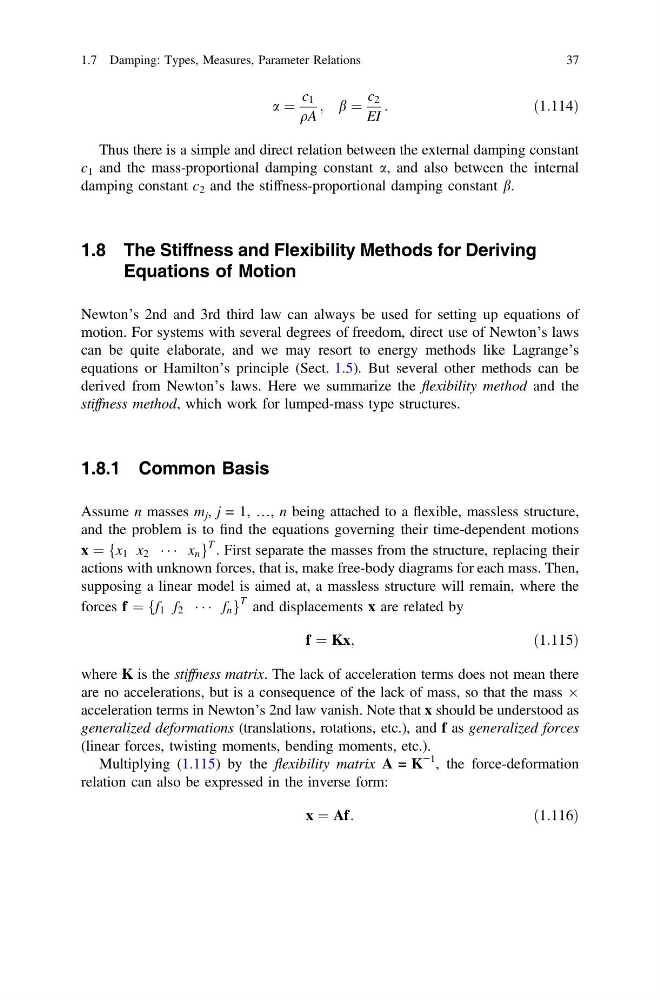
a ¼
c 1
qA
; b ¼
c 2
EI
:
ð1:114Þ
Thus there is a simple and direct relation between the external damping constant
c 1 and the mass-proportional damping constant a, and also between the internal
damping constant c 2 and the stiffness-proportional damping constant b.
1.8 The Stiffness and Flexibility Methods for Deriving
Equations of Motion
Newton’s 2nd and 3rd third law can always be used for setting up equations of
motion. For systems with several degrees of freedom, direct use of Newton’s laws
can be quite elaborate, and we may resort to energy methods like Lagrange’s
equations or Hamilton’s principle (Sect. 1.5). But several other methods can be
derived from Newton’s laws. Here we summarize the flexibility method and the
stiffness method, which work for lumped-mass type structures.
1.8.1 Common Basis
Assume n masses m j , j = 1, …, n being attached to a flexible, massless structure,
and the problem is to find the equations governing their time-dependent motions
x ¼ x 1 x 2 Á Á Á x n
f
g
T : First separate the masses from the structure, replacing their
actions with unknown forces, that is, make free-body diagrams for each mass. Then,
supposing a linear model is aimed at, a massless structure will remain, where the
forces f ¼ f 1 f 2 Á Á Á f n
f
g
T and displacements x are related by
f ¼ Kx;
ð1:115Þ
where K is the stiffness matrix. The lack of acceleration terms does not mean there
are no accelerations, but is a consequence of the lack of mass, so that the mass Â
acceleration terms in Newton’s 2nd law vanish. Note that x should be understood as
generalized deformations (translations, rotations, etc.), and f as generalized forces
(linear forces, twisting moments, bending moments, etc.).
Multiplying (1.115) by the flexibility matrix A = K
−1 , the force-deformation
relation can also be expressed in the inverse form:
x ¼ Af:
ð1:116Þ
1.7 Damping: Types, Measures, Parameter Relations
37
c 1
qA
; b ¼
c 2
EI
:
ð1:114Þ
Thus there is a simple and direct relation between the external damping constant
c 1 and the mass-proportional damping constant a, and also between the internal
damping constant c 2 and the stiffness-proportional damping constant b.
1.8 The Stiffness and Flexibility Methods for Deriving
Equations of Motion
Newton’s 2nd and 3rd third law can always be used for setting up equations of
motion. For systems with several degrees of freedom, direct use of Newton’s laws
can be quite elaborate, and we may resort to energy methods like Lagrange’s
equations or Hamilton’s principle (Sect. 1.5). But several other methods can be
derived from Newton’s laws. Here we summarize the flexibility method and the
stiffness method, which work for lumped-mass type structures.
1.8.1 Common Basis
Assume n masses m j , j = 1, …, n being attached to a flexible, massless structure,
and the problem is to find the equations governing their time-dependent motions
x ¼ x 1 x 2 Á Á Á x n
f
g
T : First separate the masses from the structure, replacing their
actions with unknown forces, that is, make free-body diagrams for each mass. Then,
supposing a linear model is aimed at, a massless structure will remain, where the
forces f ¼ f 1 f 2 Á Á Á f n
f
g
T and displacements x are related by
f ¼ Kx;
ð1:115Þ
where K is the stiffness matrix. The lack of acceleration terms does not mean there
are no accelerations, but is a consequence of the lack of mass, so that the mass Â
acceleration terms in Newton’s 2nd law vanish. Note that x should be understood as
generalized deformations (translations, rotations, etc.), and f as generalized forces
(linear forces, twisting moments, bending moments, etc.).
Multiplying (1.115) by the flexibility matrix A = K
−1 , the force-deformation
relation can also be expressed in the inverse form:
x ¼ Af:
ð1:116Þ
1.7 Damping: Types, Measures, Parameter Relations
37