

will never decay, and the predicted output will be a mix of free and forced vibrations at all times – with no resemblance to reality, where the free vibrations will
always decay. Here we quantify the relation between damping and the time-to-settle
into stationary forced vibrations, i.e. the transient period.
For linear viscous damping one can show that with zero initial conditions (i.e.
starting from rest) the response envelope with resonant harmonic excitation of a
linear single-DOF oscillator is Xð1 À e
Àfx 0 t
Þ; where f is the damping ratio, x 0 the
linear natural frequency, x d ¼
ffiffiffiffiffiffiffiffiffiffiffiffi ffi
1 À f
2
p
x 0 the damped natural frequency, and
X ¼ p 0 =ð2fx 0 Þ the stationary amplitude of forced harmonic vibrations with forcing
amplitude p 0 and frequency X = x d . Thus the response is:
xðtÞ ¼ X 1 À e
Àfx 0 t
À
Á
sinðx d tÞ;
ð1:108Þ
with an amplitude that in the beginning increases from zero almost linearly with
time ð1 À e
Àfx 0 t
! fx 0 t for t ! 0Þ; but later turns into a saturated response with
stationary amplitude X ðsince 1 À e
Àfx 0 t
! 1 for t ! 1Þ:
The time taken to reach a certain fraction R2[0;1[of the full resonant stationary
amplitude X is:
t R ¼
À lnð1 À RÞ
fx 0
;
ð1:109Þ
with a corresponding number N R of oscillation periods T(= 2p/X = 2p/x d ):
N R ¼
t R
T
%
À lnð1 À RÞ
2pf
:
ð1:110Þ
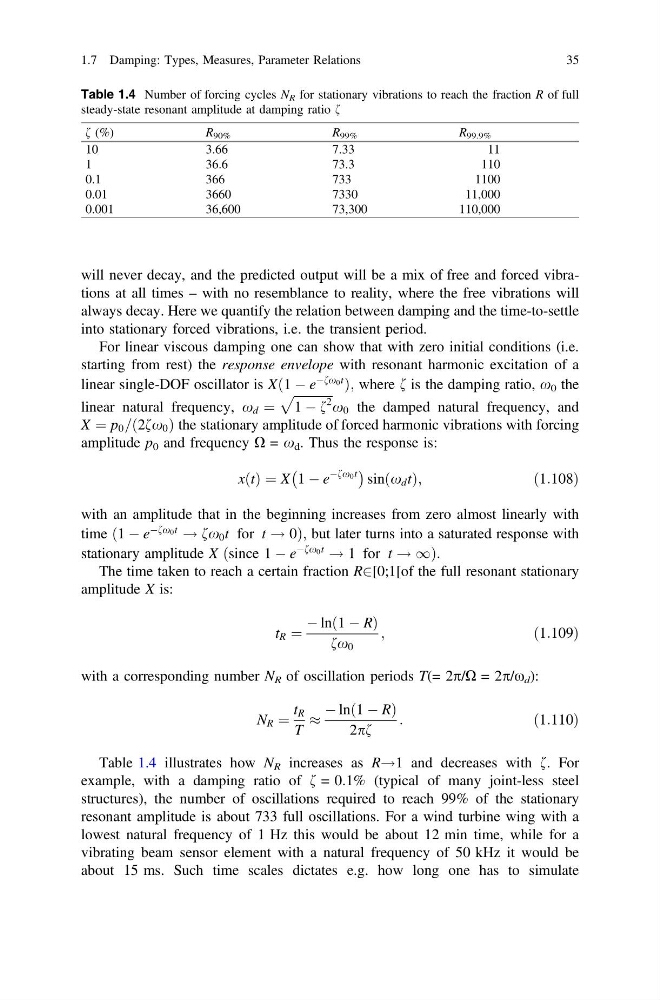
Table 1.4 illustrates how N R increases as R!1 and decreases with f. For
example, with a damping ratio of f = 0.1% (typical of many joint-less steel
structures), the number of oscillations required to reach 99% of the stationary
resonant amplitude is about 733 full oscillations. For a wind turbine wing with a
lowest natural frequency of 1 Hz this would be about 12 min time, while for a
vibrating beam sensor element with a natural frequency of 50 kHz it would be
about 15 ms. Such time scales dictates e.g. how long one has to simulate
Table 1.4 Number of forcing cycles N R for stationary vibrations to reach the fraction R of full
steady-state resonant amplitude at damping ratio f
f (%)
R 90%
R 99%
R 99.9%
10
3.66
7.33
11
1
36.6
73.3
110
0.1
366
733
1100
0.01
3660
7330
11,000
0.001
36,600
73,300
110,000
1.7 Damping: Types, Measures, Parameter Relations
35
always decay. Here we quantify the relation between damping and the time-to-settle
into stationary forced vibrations, i.e. the transient period.
For linear viscous damping one can show that with zero initial conditions (i.e.
starting from rest) the response envelope with resonant harmonic excitation of a
linear single-DOF oscillator is Xð1 À e
Àfx 0 t
Þ; where f is the damping ratio, x 0 the
linear natural frequency, x d ¼
ffiffiffiffiffiffiffiffiffiffiffiffi ffi
1 À f
2
p
x 0 the damped natural frequency, and
X ¼ p 0 =ð2fx 0 Þ the stationary amplitude of forced harmonic vibrations with forcing
amplitude p 0 and frequency X = x d . Thus the response is:
xðtÞ ¼ X 1 À e
Àfx 0 t
À
Á
sinðx d tÞ;
ð1:108Þ
with an amplitude that in the beginning increases from zero almost linearly with
time ð1 À e
Àfx 0 t
! fx 0 t for t ! 0Þ; but later turns into a saturated response with
stationary amplitude X ðsince 1 À e
Àfx 0 t
! 1 for t ! 1Þ:
The time taken to reach a certain fraction R2[0;1[of the full resonant stationary
amplitude X is:
t R ¼
À lnð1 À RÞ
fx 0
;
ð1:109Þ
with a corresponding number N R of oscillation periods T(= 2p/X = 2p/x d ):
N R ¼
t R
T
%
À lnð1 À RÞ
2pf
:
ð1:110Þ
Table 1.4 illustrates how N R increases as R!1 and decreases with f. For
example, with a damping ratio of f = 0.1% (typical of many joint-less steel
structures), the number of oscillations required to reach 99% of the stationary
resonant amplitude is about 733 full oscillations. For a wind turbine wing with a
lowest natural frequency of 1 Hz this would be about 12 min time, while for a
vibrating beam sensor element with a natural frequency of 50 kHz it would be
about 15 ms. Such time scales dictates e.g. how long one has to simulate
Table 1.4 Number of forcing cycles N R for stationary vibrations to reach the fraction R of full
steady-state resonant amplitude at damping ratio f
f (%)
R 90%
R 99%
R 99.9%
10
3.66
7.33
11
1
36.6
73.3
110
0.1
366
733
1100
0.01
3660
7330
11,000
0.001
36,600
73,300
110,000
1.7 Damping: Types, Measures, Parameter Relations
35