

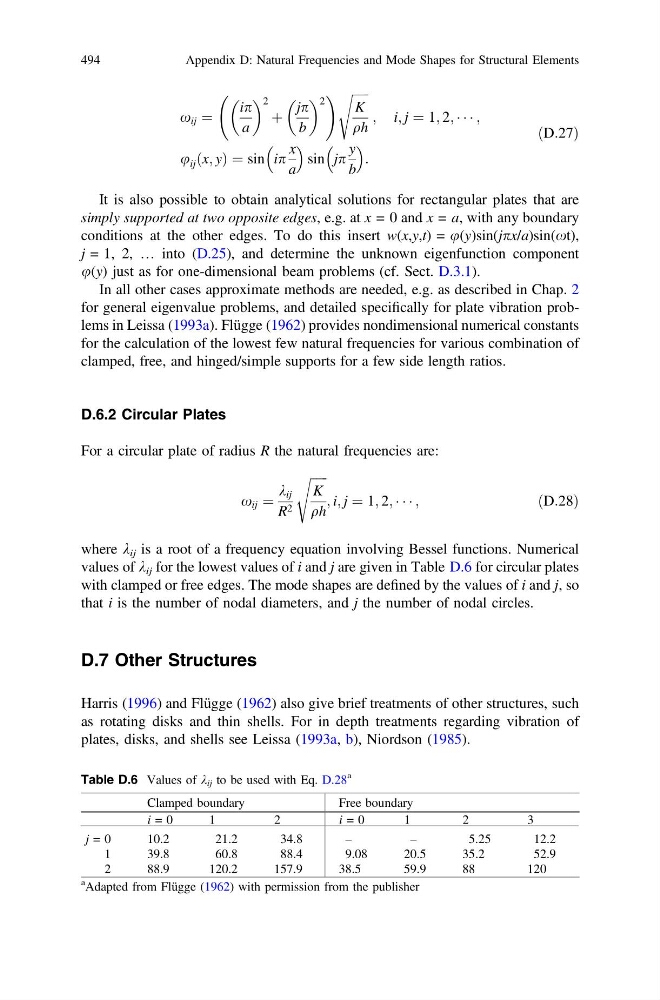
x ij ¼
ip
a
2
þ
jp
b
2
! ffiffiffiffiffi ffi
K
qh
s
; i; j ¼ 1; 2; Á Á Á ;
u ij ðx; yÞ ¼ sin ip
x
a
sin jp
y
b
:
ðD:27Þ
It is also possible to obtain analytical solutions for rectangular plates that are
simply supported at two opposite edges, e.g. at x = 0 and x = a, with any boundary
conditions at the other edges. To do this insert w(x,y,t) = u(y)sin(jpx/a)sin(xt),
j = 1, 2, … into (D.25), and determine the unknown eigenfunction component
u(y) just as for one-dimensional beam problems (cf. Sect. D.3.1).
In all other cases approximate methods are needed, e.g. as described in Chap. 2
for general eigenvalue problems, and detailed specifically for plate vibration problems in Leissa (1993a). Flügge (1962) provides nondimensional numerical constants
for the calculation of the lowest few natural frequencies for various combination of
clamped, free, and hinged/simple supports for a few side length ratios.
D.6.2 Circular Plates
For a circular plate of radius R the natural frequencies are:
x ij ¼
k ij
R 2
ffiffiffiffiffi ffi
K
qh
s
; i; j ¼ 1; 2; Á Á Á ;
ðD:28Þ
where k ij is a root of a frequency equation involving Bessel functions. Numerical
values of k ij for the lowest values of i and j are given in Table D.6 for circular plates
with clamped or free edges. The mode shapes are defined by the values of i and j, so
that i is the number of nodal diameters, and j the number of nodal circles.
D.7 Other Structures
Harris (1996) and Flügge (1962) also give brief treatments of other structures, such
as rotating disks and thin shells. For in depth treatments regarding vibration of
plates, disks, and shells see Leissa (1993a, b), Niordson (1985).
Table D.6 Values of k ij to be used with Eq. D.28
a
Clamped boundary
Free boundary
i = 0
1
2
i = 0
1
2
3
j = 0
10.2
21.2
34.8
–
–
5.25
12.2
1
39.8
60.8
88.4
9.08
20.5
35.2
52.9
2
88.9
120.2
157.9
38.5
59.9
88
120
a Adapted from Flügge (1962) with permission from the publisher
494
Appendix D: Natural Frequencies and Mode Shapes for Structural Elements
ip
a
2
þ
jp
b
2
! ffiffiffiffiffi ffi
K
qh
s
; i; j ¼ 1; 2; Á Á Á ;
u ij ðx; yÞ ¼ sin ip
x
a
sin jp
y
b
:
ðD:27Þ
It is also possible to obtain analytical solutions for rectangular plates that are
simply supported at two opposite edges, e.g. at x = 0 and x = a, with any boundary
conditions at the other edges. To do this insert w(x,y,t) = u(y)sin(jpx/a)sin(xt),
j = 1, 2, … into (D.25), and determine the unknown eigenfunction component
u(y) just as for one-dimensional beam problems (cf. Sect. D.3.1).
In all other cases approximate methods are needed, e.g. as described in Chap. 2
for general eigenvalue problems, and detailed specifically for plate vibration problems in Leissa (1993a). Flügge (1962) provides nondimensional numerical constants
for the calculation of the lowest few natural frequencies for various combination of
clamped, free, and hinged/simple supports for a few side length ratios.
D.6.2 Circular Plates
For a circular plate of radius R the natural frequencies are:
x ij ¼
k ij
R 2
ffiffiffiffiffi ffi
K
qh
s
; i; j ¼ 1; 2; Á Á Á ;
ðD:28Þ
where k ij is a root of a frequency equation involving Bessel functions. Numerical
values of k ij for the lowest values of i and j are given in Table D.6 for circular plates
with clamped or free edges. The mode shapes are defined by the values of i and j, so
that i is the number of nodal diameters, and j the number of nodal circles.
D.7 Other Structures
Harris (1996) and Flügge (1962) also give brief treatments of other structures, such
as rotating disks and thin shells. For in depth treatments regarding vibration of
plates, disks, and shells see Leissa (1993a, b), Niordson (1985).
Table D.6 Values of k ij to be used with Eq. D.28
a
Clamped boundary
Free boundary
i = 0
1
2
i = 0
1
2
3
j = 0
10.2
21.2
34.8
–
–
5.25
12.2
1
39.8
60.8
88.4
9.08
20.5
35.2
52.9
2
88.9
120.2
157.9
38.5
59.9
88
120
a Adapted from Flügge (1962) with permission from the publisher
494
Appendix D: Natural Frequencies and Mode Shapes for Structural Elements