

D.2.2 Torsional Vibrations
For a rod of uniform circular cross-section the free and undamped torsional motions
are governed by:
€ h ¼ ~ c
2
0 h
00
;
ðD:5Þ
where ~ c 0 ¼
ffiffiffiffiffiffiffiffiffi
G=q
p
is the torsional wave speed. This equation of motion is the same
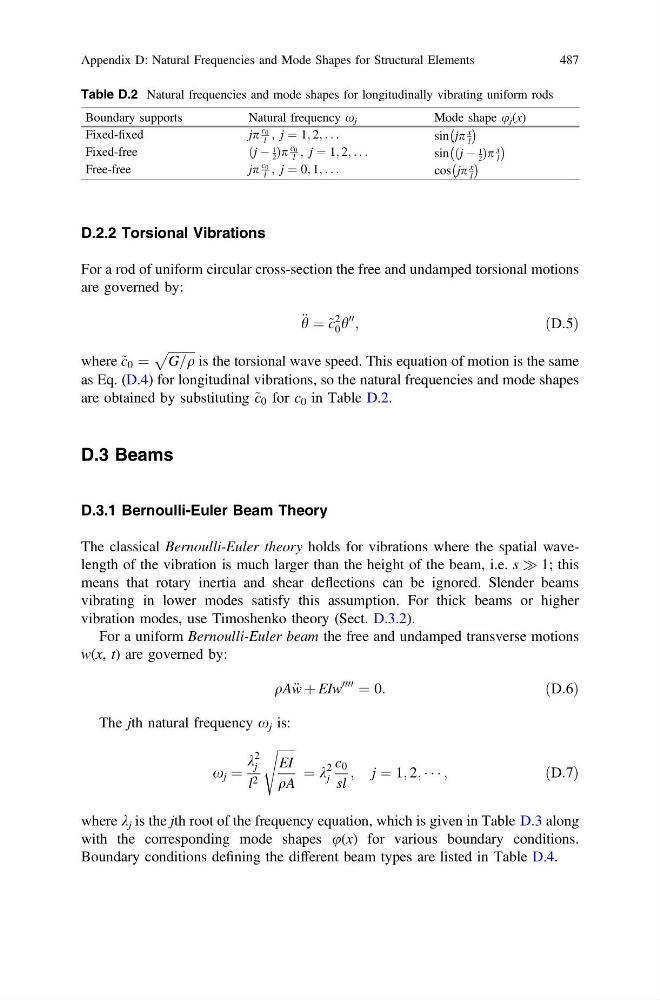
as Eq. (D.4) for longitudinal vibrations, so the natural frequencies and mode shapes
are obtained by substituting ~ c 0 for c 0 in Table D.2.
D.3 Beams
D.3.1 Bernoulli-Euler Beam Theory
The classical Bernoulli-Euler theory holds for vibrations where the spatial wavelength of the vibration is much larger than the height of the beam, i.e. s ) 1; this
means that rotary inertia and shear deflections can be ignored. Slender beams
vibrating in lower modes satisfy this assumption. For thick beams or higher
vibration modes, use Timoshenko theory (Sect. D.3.2).
For a uniform Bernoulli-Euler beam the free and undamped transverse motions
w(x, t) are governed by:
qA€ w þ EIw
0000
¼ 0:
ðD:6Þ
The jth natural frequency x j is:
x j ¼
k
2
j
l 2
ffiffiffiffiffiffi
EI
qA
s
¼ k
2
j
c 0
sl
; j ¼ 1; 2; Á Á Á ;
ðD:7Þ
where k j is the jth root of the frequency equation, which is given in Table D.3 along
with the corresponding mode shapes u(x) for various boundary conditions.
Boundary conditions defining the different beam types are listed in Table D.4.
Table D.2 Natural frequencies and mode shapes for longitudinally vibrating uniform rods
Boundary supports
Natural frequency x j
Mode shape u j (x)
Fixed-fixed
jp
c0
l ; j ¼ 1; 2; . . .
sin jp
x
l
À Á
Fixed-free
ðj À
1
2 Þp
c0
l ; j ¼ 1; 2; . . .
sin ðj À
1
2 Þp
x
l
À
Á
Free-free
jp
c0
l ; j ¼ 0; 1; . . .
cos jp
x
l
À Á
Appendix D: Natural Frequencies and Mode Shapes for Structural Elements
487
For a rod of uniform circular cross-section the free and undamped torsional motions
are governed by:
€ h ¼ ~ c
2
0 h
00
;
ðD:5Þ
where ~ c 0 ¼
ffiffiffiffiffiffiffiffiffi
G=q
p
is the torsional wave speed. This equation of motion is the same
as Eq. (D.4) for longitudinal vibrations, so the natural frequencies and mode shapes
are obtained by substituting ~ c 0 for c 0 in Table D.2.
D.3 Beams
D.3.1 Bernoulli-Euler Beam Theory
The classical Bernoulli-Euler theory holds for vibrations where the spatial wavelength of the vibration is much larger than the height of the beam, i.e. s ) 1; this
means that rotary inertia and shear deflections can be ignored. Slender beams
vibrating in lower modes satisfy this assumption. For thick beams or higher
vibration modes, use Timoshenko theory (Sect. D.3.2).
For a uniform Bernoulli-Euler beam the free and undamped transverse motions
w(x, t) are governed by:
qA€ w þ EIw
0000
¼ 0:
ðD:6Þ
The jth natural frequency x j is:
x j ¼
k
2
j
l 2
ffiffiffiffiffiffi
EI
qA
s
¼ k
2
j
c 0
sl
; j ¼ 1; 2; Á Á Á ;
ðD:7Þ
where k j is the jth root of the frequency equation, which is given in Table D.3 along
with the corresponding mode shapes u(x) for various boundary conditions.
Boundary conditions defining the different beam types are listed in Table D.4.
Table D.2 Natural frequencies and mode shapes for longitudinally vibrating uniform rods
Boundary supports
Natural frequency x j
Mode shape u j (x)
Fixed-fixed
jp
c0
l ; j ¼ 1; 2; . . .
sin jp
x
l
À Á
Fixed-free
ðj À
1
2 Þp
c0
l ; j ¼ 1; 2; . . .
sin ðj À
1
2 Þp
x
l
À
Á
Free-free
jp
c0
l ; j ¼ 0; 1; . . .
cos jp
x
l
À Á
Appendix D: Natural Frequencies and Mode Shapes for Structural Elements
487