

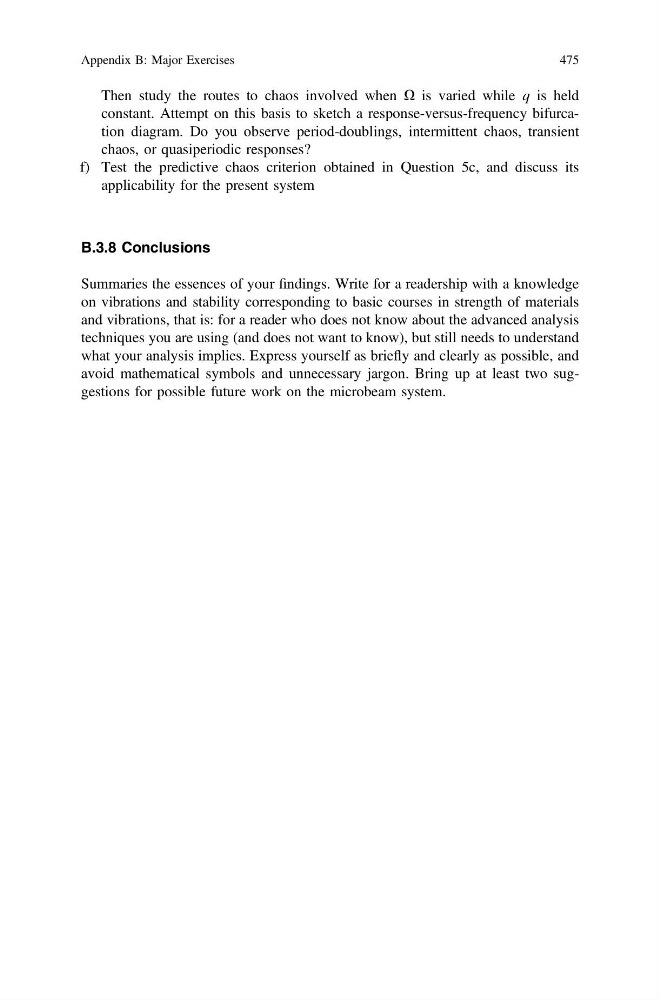
Then study the routes to chaos involved when X is varied while q is held
constant. Attempt on this basis to sketch a response-versus-frequency bifurcation diagram. Do you observe period-doublings, intermittent chaos, transient
chaos, or quasiperiodic responses?
f) Test the predictive chaos criterion obtained in Question 5c, and discuss its
applicability for the present system
B.3.8 Conclusions
Summaries the essences of your findings. Write for a readership with a knowledge
on vibrations and stability corresponding to basic courses in strength of materials
and vibrations, that is: for a reader who does not know about the advanced analysis
techniques you are using (and does not want to know), but still needs to understand
what your analysis implies. Express yourself as briefly and clearly as possible, and
avoid mathematical symbols and unnecessary jargon. Bring up at least two suggestions for possible future work on the microbeam system.
Appendix B: Major Exercises
475
constant. Attempt on this basis to sketch a response-versus-frequency bifurcation diagram. Do you observe period-doublings, intermittent chaos, transient
chaos, or quasiperiodic responses?
f) Test the predictive chaos criterion obtained in Question 5c, and discuss its
applicability for the present system
B.3.8 Conclusions
Summaries the essences of your findings. Write for a readership with a knowledge
on vibrations and stability corresponding to basic courses in strength of materials
and vibrations, that is: for a reader who does not know about the advanced analysis
techniques you are using (and does not want to know), but still needs to understand
what your analysis implies. Express yourself as briefly and clearly as possible, and
avoid mathematical symbols and unnecessary jargon. Bring up at least two suggestions for possible future work on the microbeam system.
Appendix B: Major Exercises
475