

b) It appears from (B.4) that the open-loop and closed-loop elements of the control
(Q 1 and Q 2 , respectively) affect the system in different ways. When both elements are employed, the modal amplitudes are governed by a set of nonlinear,
coupled, parametrically and externally excited ODEs.
1. Which kind of equations governs the modal amplitude when only open-loop
control is employed? And when only closed-loop is employed?
2. Choosing an open-loop control Q 1 ðtÞ ¼ K cosð ~
XtÞ may invite problems for
certain values of ~
X. Which problems, and which ~
X?
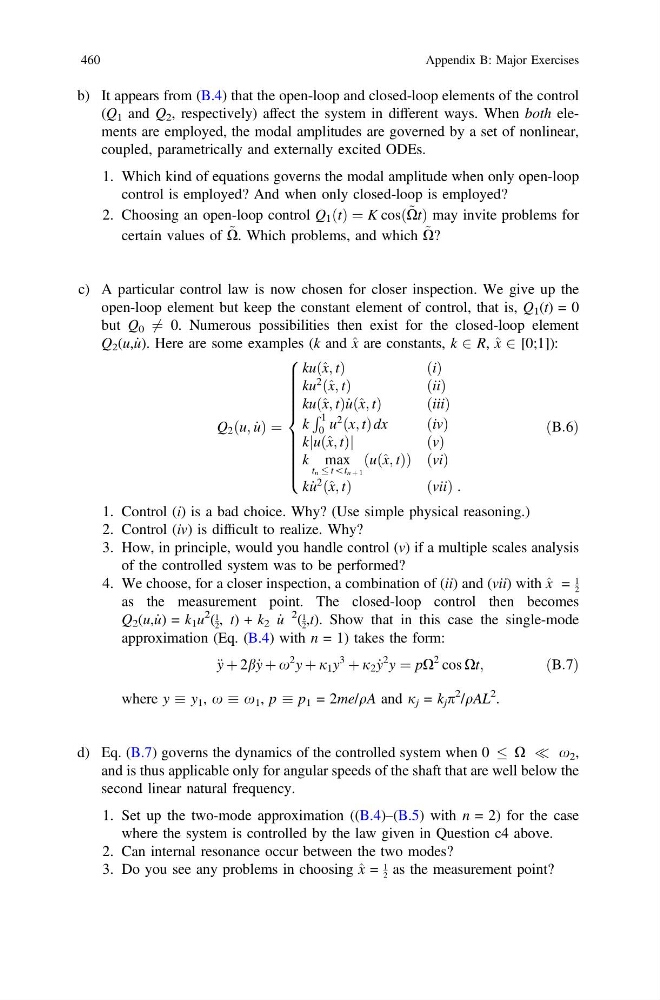
c) A particular control law is now chosen for closer inspection. We give up the
open-loop element but keep the constant element of control, that is, Q 1 (t) = 0
but Q 0 6 ¼ 0. Numerous possibilities then exist for the closed-loop element
Q 2 (u, _
u). Here are some examples (k and ^ x are constants, k 2 R, ^ x 2 [0;1]):
Q 2 ðu; _
uÞ ¼
kuð^ x; tÞ
ð iÞ
ku
2
ð^ x; tÞ
ð iiÞ
kuð^ x; tÞ _
uð^ x; tÞ
ð iiiÞ
k
R 1
0 u
2
ðx; tÞdx
ðivÞ
k uð^ x; tÞ
j
j
ðvÞ
k max
t n t\t n þ 1
uð^ x; tÞ
ð
Þ ðviÞ
k _
u
2
ð^ x; tÞ
ð viiÞ :
8
> > > > > > > > > <
> > > > > > > > > :
ðB:6Þ
1. Control (i) is a bad choice. Why? (Use simple physical reasoning.)
2. Control (iv) is difficult to realize. Why?
3. How, in principle, would you handle control (v) if a multiple scales analysis
of the controlled system was to be performed?
4. We choose, for a closer inspection, a combination of (ii) and (vii) with ^ x =
1
2
as the measurement point. The closed-loop control then becomes
Q 2 (u, _
u) = k 1 u
2 (
1
2 , t) + k 2 _
u
2 (
1
2 ,t). Show that in this case the single-mode
approximation (Eq. (B.4) with n = 1) takes the form:
€ y þ 2b_ y þ x
2 y þ j 1 y
3
þ j 2 _
y
2 y ¼ pX
2 cos Xt;
ðB:7Þ
where y y 1 , x x 1 , p p 1 = 2me/qA and j j = k j p
2 /qAL
2 .
d) Eq. (B.7) governs the dynamics of the controlled system when 0
X ( x 2 ,
and is thus applicable only for angular speeds of the shaft that are well below the
second linear natural frequency.
1. Set up the two-mode approximation ((B.4)–(B.5) with n = 2) for the case
where the system is controlled by the law given in Question c4 above.
2. Can internal resonance occur between the two modes?
3. Do you see any problems in choosing ^ x =
1
2 as the measurement point?
460
Appendix B: Major Exercises
(Q 1 and Q 2 , respectively) affect the system in different ways. When both elements are employed, the modal amplitudes are governed by a set of nonlinear,
coupled, parametrically and externally excited ODEs.
1. Which kind of equations governs the modal amplitude when only open-loop
control is employed? And when only closed-loop is employed?
2. Choosing an open-loop control Q 1 ðtÞ ¼ K cosð ~
XtÞ may invite problems for
certain values of ~
X. Which problems, and which ~
X?
c) A particular control law is now chosen for closer inspection. We give up the
open-loop element but keep the constant element of control, that is, Q 1 (t) = 0
but Q 0 6 ¼ 0. Numerous possibilities then exist for the closed-loop element
Q 2 (u, _
u). Here are some examples (k and ^ x are constants, k 2 R, ^ x 2 [0;1]):
Q 2 ðu; _
uÞ ¼
kuð^ x; tÞ
ð iÞ
ku
2
ð^ x; tÞ
ð iiÞ
kuð^ x; tÞ _
uð^ x; tÞ
ð iiiÞ
k
R 1
0 u
2
ðx; tÞdx
ðivÞ
k uð^ x; tÞ
j
j
ðvÞ
k max
t n t\t n þ 1
uð^ x; tÞ
ð
Þ ðviÞ
k _
u
2
ð^ x; tÞ
ð viiÞ :
8
> > > > > > > > > <
> > > > > > > > > :
ðB:6Þ
1. Control (i) is a bad choice. Why? (Use simple physical reasoning.)
2. Control (iv) is difficult to realize. Why?
3. How, in principle, would you handle control (v) if a multiple scales analysis
of the controlled system was to be performed?
4. We choose, for a closer inspection, a combination of (ii) and (vii) with ^ x =
1
2
as the measurement point. The closed-loop control then becomes
Q 2 (u, _
u) = k 1 u
2 (
1
2 , t) + k 2 _
u
2 (
1
2 ,t). Show that in this case the single-mode
approximation (Eq. (B.4) with n = 1) takes the form:
€ y þ 2b_ y þ x
2 y þ j 1 y
3
þ j 2 _
y
2 y ¼ pX
2 cos Xt;
ðB:7Þ
where y y 1 , x x 1 , p p 1 = 2me/qA and j j = k j p
2 /qAL
2 .
d) Eq. (B.7) governs the dynamics of the controlled system when 0
X ( x 2 ,
and is thus applicable only for angular speeds of the shaft that are well below the
second linear natural frequency.
1. Set up the two-mode approximation ((B.4)–(B.5) with n = 2) for the case
where the system is controlled by the law given in Question c4 above.
2. Can internal resonance occur between the two modes?
3. Do you see any problems in choosing ^ x =
1
2 as the measurement point?
460
Appendix B: Major Exercises