

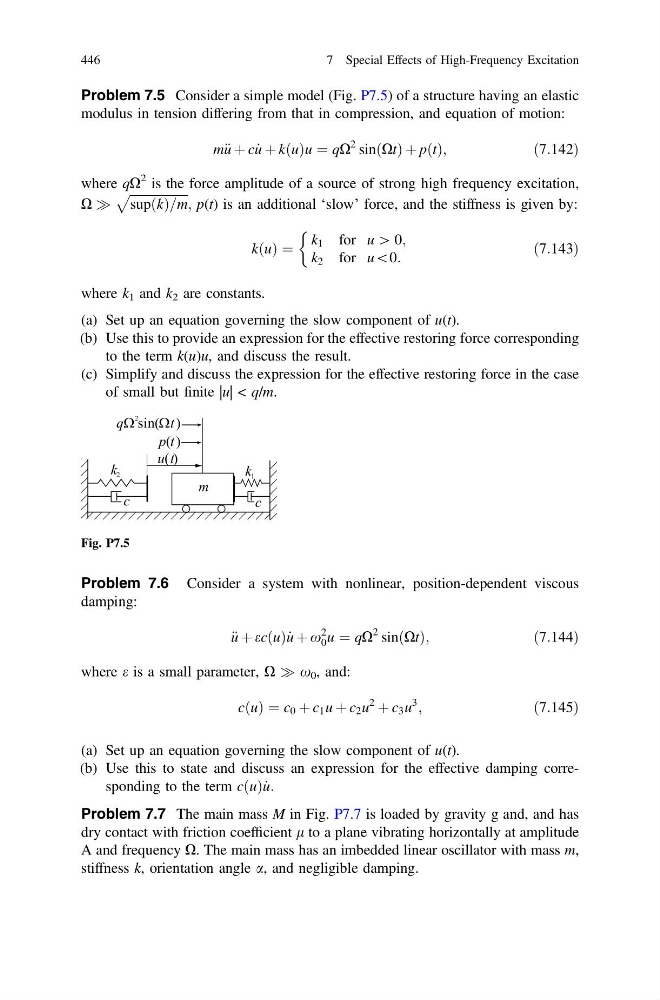
Problem 7.5 Consider a simple model (Fig. P7.5) of a structure having an elastic
modulus in tension differing from that in compression, and equation of motion:
m€ u þ c _
u þ kðuÞu ¼ qX
2 sinðXtÞ þ pðtÞ;
ð7:142Þ
where qX
2 is the force amplitude of a source of strong high frequency excitation,
X )
ffiffiffiffiffiffiffiffiffiffiffiffiffiffiffiffiffiffi ffi
supðkÞ=m
p
; p(t) is an additional ‘slow’ force, and the stiffness is given by:
kðuÞ ¼
k 1 for u [ 0;
k 2 for u\0:
&
ð7:143Þ
where k 1 and k 2 are constants.
(a) Set up an equation governing the slow component of u(t).
(b) Use this to provide an expression for the effective restoring force corresponding
to the term k(u)u, and discuss the result.
(c) Simplify and discuss the expression for the effective restoring force in the case
of small but finite |u| < q/m.
Problem 7.6 Consider a system with nonlinear, position-dependent viscous
damping:
€ u þ ecðuÞ _
u þ x
2
0 u ¼ qX
2 sinðXtÞ;
ð7:144Þ
where e is a small parameter, X ) x 0 , and:
cðuÞ ¼ c 0 þ c 1 u þ c 2 u
2
þ c 3 u
3
;
ð7:145Þ
(a) Set up an equation governing the slow component of u(t).
(b) Use this to state and discuss an expression for the effective damping corresponding to the term cðuÞ _
u:
Problem 7.7 The main mass M in Fig. P7.7 is loaded by gravity g and, and has
dry contact with friction coefficient l to a plane vibrating horizontally at amplitude
A and frequency X. The main mass has an imbedded linear oscillator with mass m,
stiffness k, orientation angle a, and negligible damping.
Fig. P7.5
446
7 Special Effects of High-Frequency Excitation
modulus in tension differing from that in compression, and equation of motion:
m€ u þ c _
u þ kðuÞu ¼ qX
2 sinðXtÞ þ pðtÞ;
ð7:142Þ
where qX
2 is the force amplitude of a source of strong high frequency excitation,
X )
ffiffiffiffiffiffiffiffiffiffiffiffiffiffiffiffiffiffi ffi
supðkÞ=m
p
; p(t) is an additional ‘slow’ force, and the stiffness is given by:
kðuÞ ¼
k 1 for u [ 0;
k 2 for u\0:
&
ð7:143Þ
where k 1 and k 2 are constants.
(a) Set up an equation governing the slow component of u(t).
(b) Use this to provide an expression for the effective restoring force corresponding
to the term k(u)u, and discuss the result.
(c) Simplify and discuss the expression for the effective restoring force in the case
of small but finite |u| < q/m.
Problem 7.6 Consider a system with nonlinear, position-dependent viscous
damping:
€ u þ ecðuÞ _
u þ x
2
0 u ¼ qX
2 sinðXtÞ;
ð7:144Þ
where e is a small parameter, X ) x 0 , and:
cðuÞ ¼ c 0 þ c 1 u þ c 2 u
2
þ c 3 u
3
;
ð7:145Þ
(a) Set up an equation governing the slow component of u(t).
(b) Use this to state and discuss an expression for the effective damping corresponding to the term cðuÞ _
u:
Problem 7.7 The main mass M in Fig. P7.7 is loaded by gravity g and, and has
dry contact with friction coefficient l to a plane vibrating horizontally at amplitude
A and frequency X. The main mass has an imbedded linear oscillator with mass m,
stiffness k, orientation angle a, and negligible damping.
Fig. P7.5
446
7 Special Effects of High-Frequency Excitation