

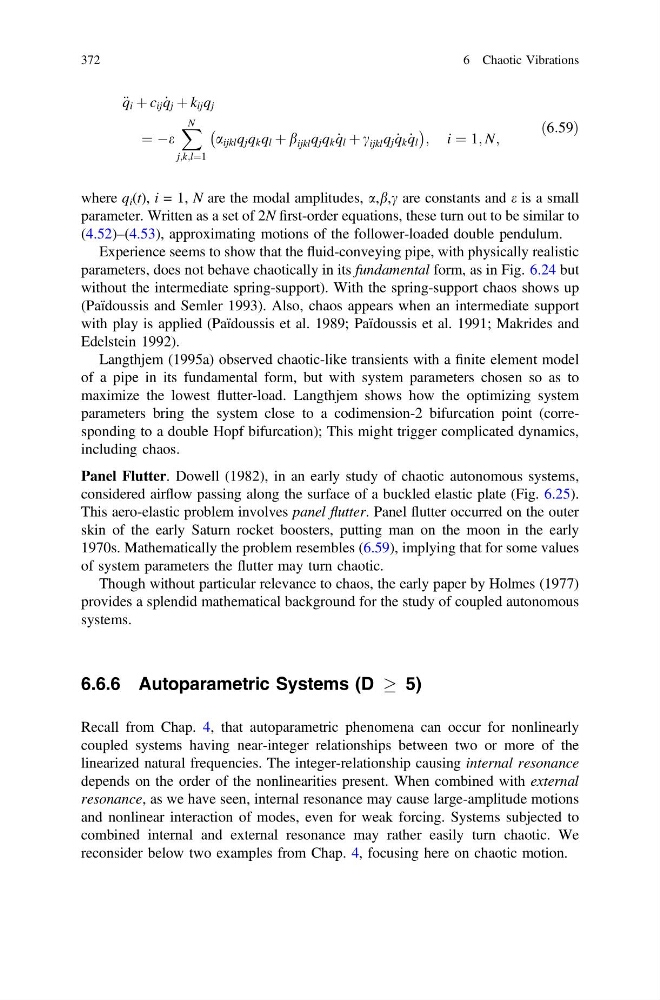
€ q i þ c ij _
q j þ k ij q j
¼ Àe
X N
j;k;l¼1
a ijkl q j q k q l þ b ijkl q j q k _
q l þ c ijkl q j _
q k _
q l
À
Á ; i ¼ 1; N;
ð6:59Þ
where q i (t), i = 1, N are the modal amplitudes, a,b,c are constants and e is a small
parameter. Written as a set of 2N first-order equations, these turn out to be similar to
(4.52)–(4.53), approximating motions of the follower-loaded double pendulum.
Experience seems to show that the fluid-conveying pipe, with physically realistic
parameters, does not behave chaotically in its fundamental form, as in Fig. 6.24 but
without the intermediate spring-support). With the spring-support chaos shows up
(Païdoussis and Semler 1993). Also, chaos appears when an intermediate support
with play is applied (Païdoussis et al. 1989; Païdoussis et al. 1991; Makrides and
Edelstein 1992).
Langthjem (1995a) observed chaotic-like transients with a finite element model
of a pipe in its fundamental form, but with system parameters chosen so as to
maximize the lowest flutter-load. Langthjem shows how the optimizing system
parameters bring the system close to a codimension-2 bifurcation point (corresponding to a double Hopf bifurcation); This might trigger complicated dynamics,
including chaos.
Panel Flutter. Dowell (1982), in an early study of chaotic autonomous systems,
considered airflow passing along the surface of a buckled elastic plate (Fig. 6.25).
This aero-elastic problem involves panel flutter. Panel flutter occurred on the outer
skin of the early Saturn rocket boosters, putting man on the moon in the early
1970s. Mathematically the problem resembles (6.59), implying that for some values
of system parameters the flutter may turn chaotic.
Though without particular relevance to chaos, the early paper by Holmes (1977)
provides a splendid mathematical background for the study of coupled autonomous
systems.
6.6.6 Autoparametric Systems (D ! 5)
Recall from Chap. 4, that autoparametric phenomena can occur for nonlinearly
coupled systems having near-integer relationships between two or more of the
linearized natural frequencies. The integer-relationship causing internal resonance
depends on the order of the nonlinearities present. When combined with external
resonance, as we have seen, internal resonance may cause large-amplitude motions
and nonlinear interaction of modes, even for weak forcing. Systems subjected to
combined internal and external resonance may rather easily turn chaotic. We
reconsider below two examples from Chap. 4, focusing here on chaotic motion.
372
6 Chaotic Vibrations
q j þ k ij q j
¼ Àe
X N
j;k;l¼1
a ijkl q j q k q l þ b ijkl q j q k _
q l þ c ijkl q j _
q k _
q l
À
Á ; i ¼ 1; N;
ð6:59Þ
where q i (t), i = 1, N are the modal amplitudes, a,b,c are constants and e is a small
parameter. Written as a set of 2N first-order equations, these turn out to be similar to
(4.52)–(4.53), approximating motions of the follower-loaded double pendulum.
Experience seems to show that the fluid-conveying pipe, with physically realistic
parameters, does not behave chaotically in its fundamental form, as in Fig. 6.24 but
without the intermediate spring-support). With the spring-support chaos shows up
(Païdoussis and Semler 1993). Also, chaos appears when an intermediate support
with play is applied (Païdoussis et al. 1989; Païdoussis et al. 1991; Makrides and
Edelstein 1992).
Langthjem (1995a) observed chaotic-like transients with a finite element model
of a pipe in its fundamental form, but with system parameters chosen so as to
maximize the lowest flutter-load. Langthjem shows how the optimizing system
parameters bring the system close to a codimension-2 bifurcation point (corresponding to a double Hopf bifurcation); This might trigger complicated dynamics,
including chaos.
Panel Flutter. Dowell (1982), in an early study of chaotic autonomous systems,
considered airflow passing along the surface of a buckled elastic plate (Fig. 6.25).
This aero-elastic problem involves panel flutter. Panel flutter occurred on the outer
skin of the early Saturn rocket boosters, putting man on the moon in the early
1970s. Mathematically the problem resembles (6.59), implying that for some values
of system parameters the flutter may turn chaotic.
Though without particular relevance to chaos, the early paper by Holmes (1977)
provides a splendid mathematical background for the study of coupled autonomous
systems.
6.6.6 Autoparametric Systems (D ! 5)
Recall from Chap. 4, that autoparametric phenomena can occur for nonlinearly
coupled systems having near-integer relationships between two or more of the
linearized natural frequencies. The integer-relationship causing internal resonance
depends on the order of the nonlinearities present. When combined with external
resonance, as we have seen, internal resonance may cause large-amplitude motions
and nonlinear interaction of modes, even for weak forcing. Systems subjected to
combined internal and external resonance may rather easily turn chaotic. We
reconsider below two examples from Chap. 4, focusing here on chaotic motion.
372
6 Chaotic Vibrations