

r s ¼ À2 Á 10
À4
ð
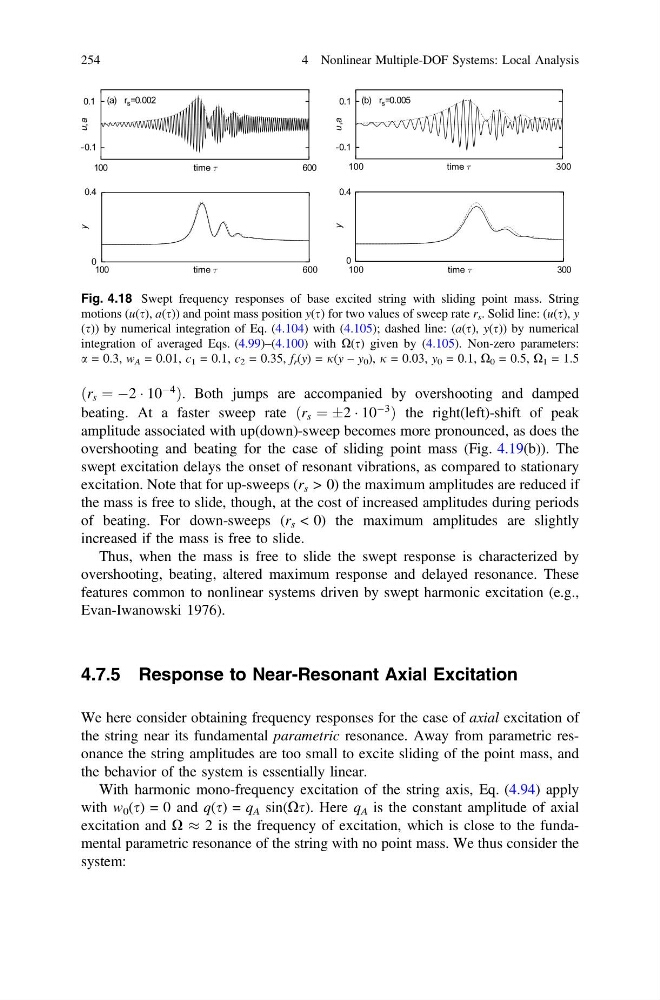
Þ . Both jumps are accompanied by overshooting and damped
beating. At a faster sweep rate ðr s ¼ Æ2 Á 10
À3
Þ the right(left)-shift of peak
amplitude associated with up(down)-sweep becomes more pronounced, as does the
overshooting and beating for the case of sliding point mass (Fig. 4.19(b)). The
swept excitation delays the onset of resonant vibrations, as compared to stationary
excitation. Note that for up-sweeps (r s > 0) the maximum amplitudes are reduced if
the mass is free to slide, though, at the cost of increased amplitudes during periods
of beating. For down-sweeps (r s < 0) the maximum amplitudes are slightly
increased if the mass is free to slide.
Thus, when the mass is free to slide the swept response is characterized by
overshooting, beating, altered maximum response and delayed resonance. These
features common to nonlinear systems driven by swept harmonic excitation (e.g.,
Evan-Iwanowski 1976).
4.7.5 Response to Near-Resonant Axial Excitation
We here consider obtaining frequency responses for the case of axial excitation of
the string near its fundamental parametric resonance. Away from parametric resonance the string amplitudes are too small to excite sliding of the point mass, and
the behavior of the system is essentially linear.
With harmonic mono-frequency excitation of the string axis, Eq. (4.94) apply
with w 0 (s) = 0 and q(s) = q A sin(Xs). Here q A is the constant amplitude of axial
excitation and X % 2 is the frequency of excitation, which is close to the fundamental parametric resonance of the string with no point mass. We thus consider the
system:
-0.1
0.1
100
600
u a
,
time
(a) r s =0.002
0
0.4
100
600
y
time
-0.1
0.1
100
300
u a
,
time
(b) r s =0.005
0
0.4
100
300
y
time
Fig. 4.18 Swept frequency responses of base excited string with sliding point mass. String
motions (u(s), a(s)) and point mass position y(s) for two values of sweep rate r s . Solid line: (u(s), y
(s)) by numerical integration of Eq. (4.104) with (4.105); dashed line: (a(s), y(s)) by numerical
integration of averaged Eqs. (4.99)–(4.100) with X(s) given by (4.105). Non-zero parameters:
a = 0.3, w A = 0.01, c 1 = 0.1, c 2 = 0.35, f r (y) = j(y – y 0 ), j = 0.03, y 0 = 0.1, X 0 = 0.5, X 1 = 1.5
254
4 Nonlinear Multiple-DOF Systems: Local Analysis
À4
ð
Þ . Both jumps are accompanied by overshooting and damped
beating. At a faster sweep rate ðr s ¼ Æ2 Á 10
À3
Þ the right(left)-shift of peak
amplitude associated with up(down)-sweep becomes more pronounced, as does the
overshooting and beating for the case of sliding point mass (Fig. 4.19(b)). The
swept excitation delays the onset of resonant vibrations, as compared to stationary
excitation. Note that for up-sweeps (r s > 0) the maximum amplitudes are reduced if
the mass is free to slide, though, at the cost of increased amplitudes during periods
of beating. For down-sweeps (r s < 0) the maximum amplitudes are slightly
increased if the mass is free to slide.
Thus, when the mass is free to slide the swept response is characterized by
overshooting, beating, altered maximum response and delayed resonance. These
features common to nonlinear systems driven by swept harmonic excitation (e.g.,
Evan-Iwanowski 1976).
4.7.5 Response to Near-Resonant Axial Excitation
We here consider obtaining frequency responses for the case of axial excitation of
the string near its fundamental parametric resonance. Away from parametric resonance the string amplitudes are too small to excite sliding of the point mass, and
the behavior of the system is essentially linear.
With harmonic mono-frequency excitation of the string axis, Eq. (4.94) apply
with w 0 (s) = 0 and q(s) = q A sin(Xs). Here q A is the constant amplitude of axial
excitation and X % 2 is the frequency of excitation, which is close to the fundamental parametric resonance of the string with no point mass. We thus consider the
system:
-0.1
0.1
100
600
u a
,
time
(a) r s =0.002
0
0.4
100
600
y
time
-0.1
0.1
100
300
u a
,
time
(b) r s =0.005
0
0.4
100
300
y
time
Fig. 4.18 Swept frequency responses of base excited string with sliding point mass. String
motions (u(s), a(s)) and point mass position y(s) for two values of sweep rate r s . Solid line: (u(s), y
(s)) by numerical integration of Eq. (4.104) with (4.105); dashed line: (a(s), y(s)) by numerical
integration of averaged Eqs. (4.99)–(4.100) with X(s) given by (4.105). Non-zero parameters:
a = 0.3, w A = 0.01, c 1 = 0.1, c 2 = 0.35, f r (y) = j(y – y 0 ), j = 0.03, y 0 = 0.1, X 0 = 0.5, X 1 = 1.5
254
4 Nonlinear Multiple-DOF Systems: Local Analysis