

which differs from the van der Pol Eq. (3.243) only by the nonlinear coefficient to
_
u being proportional to _
u
2 rather than to u
2 . That is, rather than changing sign at a
certain level of |u|, the damping changes sign at a certain level of | _
u|. This makes no
difference to the qualitative behavior of the oscillators, who both exhibit the
characteristic of an unstable trivial solution and a single stable limit cycle. Also, the
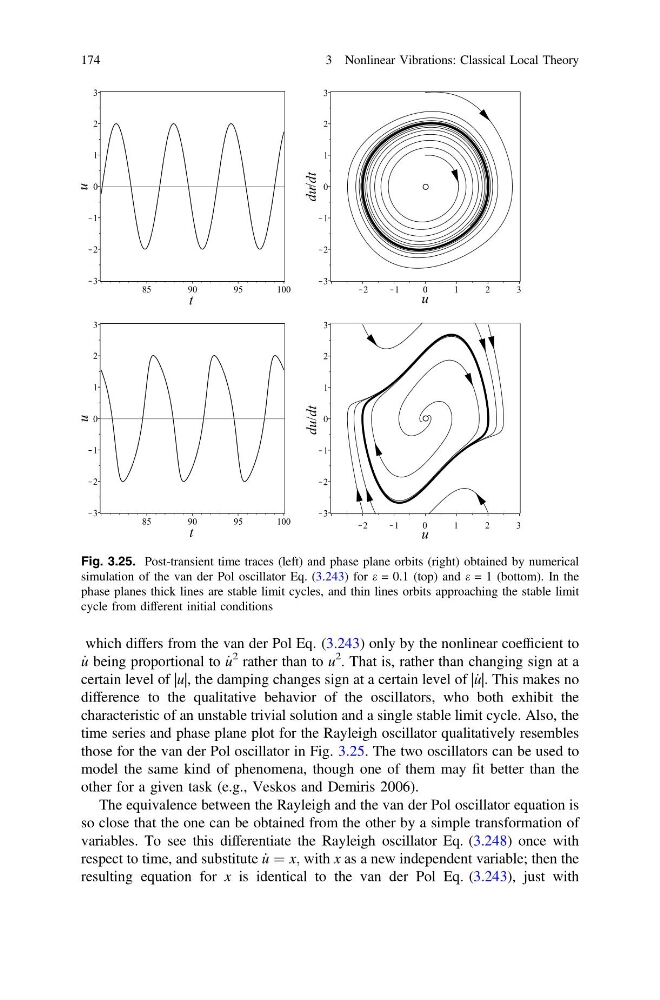
time series and phase plane plot for the Rayleigh oscillator qualitatively resembles
those for the van der Pol oscillator in Fig. 3.25. The two oscillators can be used to
model the same kind of phenomena, though one of them may fit better than the
other for a given task (e.g., Veskos and Demiris 2006).
The equivalence between the Rayleigh and the van der Pol oscillator equation is
so close that the one can be obtained from the other by a simple transformation of
variables. To see this differentiate the Rayleigh oscillator Eq. (3.248) once with
respect to time, and substitute _
u ¼ x; with x as a new independent variable; then the
resulting equation for x is identical to the van der Pol Eq. (3.243), just with
Fig. 3.25. Post-transient time traces (left) and phase plane orbits (right) obtained by numerical
simulation of the van der Pol oscillator Eq. (3.243) for e = 0.1 (top) and e = 1 (bottom). In the
phase planes thick lines are stable limit cycles, and thin lines orbits approaching the stable limit
cycle from different initial conditions
174
3 Nonlinear Vibrations: Classical Local Theory
_
u being proportional to _
u
2 rather than to u
2 . That is, rather than changing sign at a
certain level of |u|, the damping changes sign at a certain level of | _
u|. This makes no
difference to the qualitative behavior of the oscillators, who both exhibit the
characteristic of an unstable trivial solution and a single stable limit cycle. Also, the
time series and phase plane plot for the Rayleigh oscillator qualitatively resembles
those for the van der Pol oscillator in Fig. 3.25. The two oscillators can be used to
model the same kind of phenomena, though one of them may fit better than the
other for a given task (e.g., Veskos and Demiris 2006).
The equivalence between the Rayleigh and the van der Pol oscillator equation is
so close that the one can be obtained from the other by a simple transformation of
variables. To see this differentiate the Rayleigh oscillator Eq. (3.248) once with
respect to time, and substitute _
u ¼ x; with x as a new independent variable; then the
resulting equation for x is identical to the van der Pol Eq. (3.243), just with
Fig. 3.25. Post-transient time traces (left) and phase plane orbits (right) obtained by numerical
simulation of the van der Pol oscillator Eq. (3.243) for e = 0.1 (top) and e = 1 (bottom). In the
phase planes thick lines are stable limit cycles, and thin lines orbits approaching the stable limit
cycle from different initial conditions
174
3 Nonlinear Vibrations: Classical Local Theory