

90
16.2 Background
Since the split Hopkinson pressure bar (SHPB) was firstly introduced, split Hopkinson tension bar (SHTB) techniques have
also been largely developed due to the easy application of longitudinal wave theory for the calculation of stresses and strains
within the specimen. Different approaches to the generation of tensile pulses have been proposed. These can be divided into
two categories. The first approach relies on the direct impact of a hollow striker on the flanged end of the incident bar to
generate the tensile wave, which is the most common method [1–3]. In the other method, the tensile wave is generated by the
quick release of a tensile load initially stored in a section of the incident bar [4]. A few previous efforts have been devoted to
the development of split Hopkinson torsion bar (SHToB). The most widely used method for generating the torsional wave is
a sudden release of torsional energy initially stored in the end section of the incident bar. Since the quick release of the stored
energy has a direct influence on the quality of the incident wave, special techniques have been proposed, including the discharge of the high voltage capacitor [5, 6], the fracture of the notched pin [7, 8], and explosives [9, 10]. However, no existing
combined tension and torsion Hopkinson bar has been found in the literature.
16.3 Tension-Torsion Split Hopkinson Bar Design
16.3.1 Working Principle
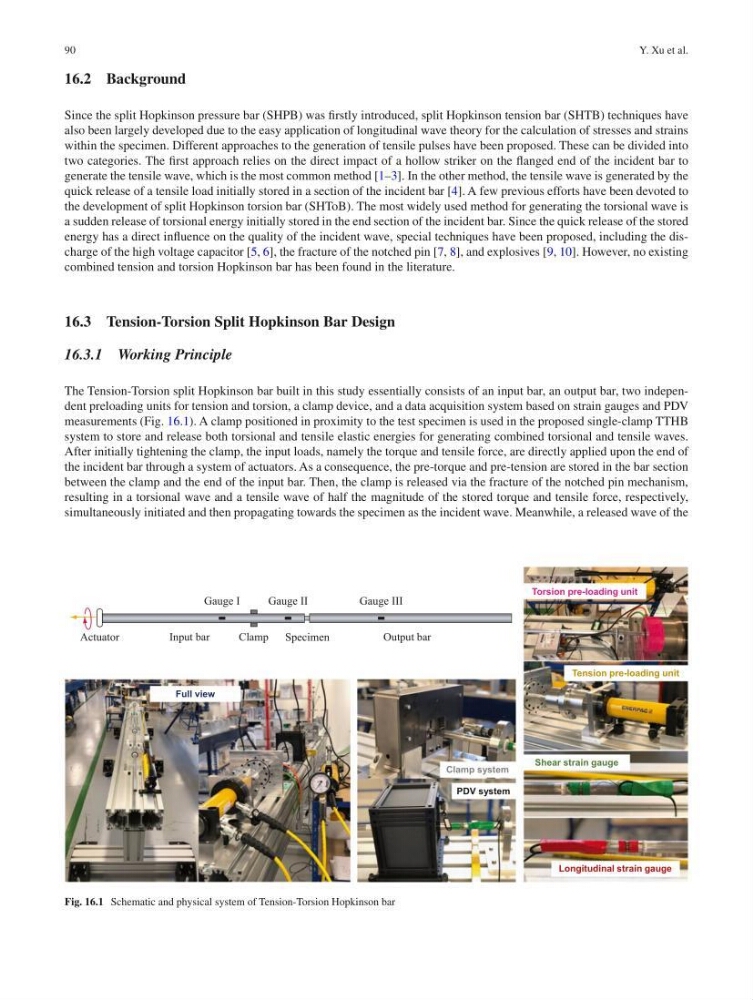
The Tension-Torsion split Hopkinson bar built in this study essentially consists of an input bar, an output bar, two independent preloading units for tension and torsion, a clamp device, and a data acquisition system based on strain gauges and PDV
measurements (Fig. 16.1). A clamp positioned in proximity to the test specimen is used in the proposed single- clamp TTHB
system to store and release both torsional and tensile elastic energies for generating combined torsional and tensile waves.
After initially tightening the clamp, the input loads, namely the torque and tensile force, are directly applied upon the end of
the incident bar through a system of actuators. As a consequence, the pre-torque and pre-tension are stored in the bar section
between the clamp and the end of the input bar. Then, the clamp is released via the fracture of the notched pin mechanism,
resulting in a torsional wave and a tensile wave of half the magnitude of the stored torque and tensile force, respectively,
simultaneously initiated and then propagating towards the specimen as the incident wave. Meanwhile, a released wave of the
Clamp system
PDV system
Shear strain gauge
Longitudinal strain gauge
Full view
Tension pre-loading unit
Torsion pre-loading unit
Input bar
Output bar
Clamp
Fig. 16.1 Schematic and physical system of Tension-Torsion Hopkinson bar
Y. Xu et al.
16.2 Background
Since the split Hopkinson pressure bar (SHPB) was firstly introduced, split Hopkinson tension bar (SHTB) techniques have
also been largely developed due to the easy application of longitudinal wave theory for the calculation of stresses and strains
within the specimen. Different approaches to the generation of tensile pulses have been proposed. These can be divided into
two categories. The first approach relies on the direct impact of a hollow striker on the flanged end of the incident bar to
generate the tensile wave, which is the most common method [1–3]. In the other method, the tensile wave is generated by the
quick release of a tensile load initially stored in a section of the incident bar [4]. A few previous efforts have been devoted to
the development of split Hopkinson torsion bar (SHToB). The most widely used method for generating the torsional wave is
a sudden release of torsional energy initially stored in the end section of the incident bar. Since the quick release of the stored
energy has a direct influence on the quality of the incident wave, special techniques have been proposed, including the discharge of the high voltage capacitor [5, 6], the fracture of the notched pin [7, 8], and explosives [9, 10]. However, no existing
combined tension and torsion Hopkinson bar has been found in the literature.
16.3 Tension-Torsion Split Hopkinson Bar Design
16.3.1 Working Principle
The Tension-Torsion split Hopkinson bar built in this study essentially consists of an input bar, an output bar, two independent preloading units for tension and torsion, a clamp device, and a data acquisition system based on strain gauges and PDV
measurements (Fig. 16.1). A clamp positioned in proximity to the test specimen is used in the proposed single- clamp TTHB
system to store and release both torsional and tensile elastic energies for generating combined torsional and tensile waves.
After initially tightening the clamp, the input loads, namely the torque and tensile force, are directly applied upon the end of
the incident bar through a system of actuators. As a consequence, the pre-torque and pre-tension are stored in the bar section
between the clamp and the end of the input bar. Then, the clamp is released via the fracture of the notched pin mechanism,
resulting in a torsional wave and a tensile wave of half the magnitude of the stored torque and tensile force, respectively,
simultaneously initiated and then propagating towards the specimen as the incident wave. Meanwhile, a released wave of the
Clamp system
PDV system
Shear strain gauge
Longitudinal strain gauge
Full view
Tension pre-loading unit
Torsion pre-loading unit
Input bar
Output bar
Clamp
Fig. 16.1 Schematic and physical system of Tension-Torsion Hopkinson bar
Y. Xu et al.