

9
2.3 Experimental Approach
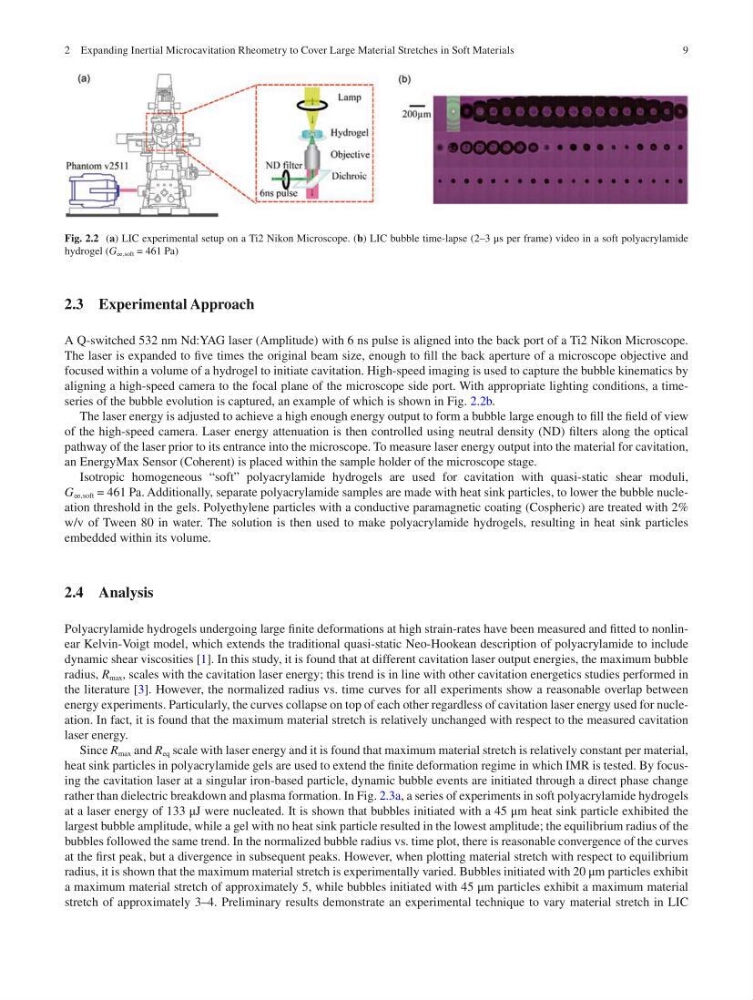
A Q-switched 532 nm Nd:YAG laser (Amplitude) with 6 ns pulse is aligned into the back port of a Ti2 Nikon Microscope.
The laser is expanded to five times the original beam size, enough to fill the back aperture of a microscope objective and
focused within a volume of a hydrogel to initiate cavitation. High-speed imaging is used to capture the bubble kinematics by
aligning a high-speed camera to the focal plane of the microscope side port. With appropriate lighting conditions, a timeseries of the bubble evolution is captured, an example of which is shown in Fig. 2.2b.
The laser energy is adjusted to achieve a high enough energy output to form a bubble large enough to fill the field of view
of the high-speed camera. Laser energy attenuation is then controlled using neutral density (ND) filters along the optical
pathway of the laser prior to its entrance into the microscope. To measure laser energy output into the material for cavitation,
an EnergyMax Sensor (Coherent) is placed within the sample holder of the microscope stage.
Isotropic homogeneous “soft” polyacrylamide hydrogels are used for cavitation with quasi-static shear moduli,
G ∞,soft = 461 Pa. Additionally, separate polyacrylamide samples are made with heat sink particles, to lower the bubble nucleation threshold in the gels. Polyethylene particles with a conductive paramagnetic coating (Cospheric) are treated with 2%
w/v of Tween 80 in water. The solution is then used to make polyacrylamide hydrogels, resulting in heat sink particles
embedded within its volume.
2.4 Analysis
Polyacrylamide hydrogels undergoing large finite deformations at high strain-rates have been measured and fitted to nonlinear Kelvin-Voigt model, which extends the traditional quasi-static Neo-Hookean description of polyacrylamide to include
dynamic shear viscosities [1]. In this study, it is found that at different cavitation laser output energies, the maximum bubble
radius, R max , scales with the cavitation laser energy; this trend is in line with other cavitation energetics studies performed in
the literature [3]. However, the normalized radius vs. time curves for all experiments show a reasonable overlap between
energy experiments. Particularly, the curves collapse on top of each other regardless of cavitation laser energy used for nucleation. In fact, it is found that the maximum material stretch is relatively unchanged with respect to the measured cavitation
laser energy.
Since R max and R eq scale with laser energy and it is found that maximum material stretch is relatively constant per material,
heat sink particles in polyacrylamide gels are used to extend the finite deformation regime in which IMR is tested. By focusing the cavitation laser at a singular iron- based particle, dynamic bubble events are initiated through a direct phase change
rather than dielectric breakdown and plasma formation. In Fig. 2.3a, a series of experiments in soft polyacrylamide hydrogels
at a laser energy of 133 μJ were nucleated. It is shown that bubbles initiated with a 45 μm heat sink particle exhibited the
largest bubble amplitude, while a gel with no heat sink particle resulted in the lowest amplitude; the equilibrium radius of the
bubbles followed the same trend. In the normalized bubble radius vs. time plot, there is reasonable convergence of the curves
at the first peak, but a divergence in subsequent peaks. However, when plotting material stretch with respect to equilibrium
radius, it is shown that the maximum material stretch is experimentally varied. Bubbles initiated with 20 μm particles exhibit
a maximum material stretch of approximately 5, while bubbles initiated with 45 μm particles exhibit a maximum material
stretch of approximately 3–4. Preliminary results demonstrate an experimental technique to vary material stretch in LIC
Fig. 2.2 (a) LIC experimental setup on a Ti2 Nikon Microscope. (b) LIC bubble time-lapse (2–3 μs per frame) video in a soft polyacrylamide
hydrogel (G ∞,soft = 461 Pa)
2 Expanding Inertial Microcavitation Rheometry to Cover Large Material Stretches in Soft Materials
2.3 Experimental Approach
A Q-switched 532 nm Nd:YAG laser (Amplitude) with 6 ns pulse is aligned into the back port of a Ti2 Nikon Microscope.
The laser is expanded to five times the original beam size, enough to fill the back aperture of a microscope objective and
focused within a volume of a hydrogel to initiate cavitation. High-speed imaging is used to capture the bubble kinematics by
aligning a high-speed camera to the focal plane of the microscope side port. With appropriate lighting conditions, a timeseries of the bubble evolution is captured, an example of which is shown in Fig. 2.2b.
The laser energy is adjusted to achieve a high enough energy output to form a bubble large enough to fill the field of view
of the high-speed camera. Laser energy attenuation is then controlled using neutral density (ND) filters along the optical
pathway of the laser prior to its entrance into the microscope. To measure laser energy output into the material for cavitation,
an EnergyMax Sensor (Coherent) is placed within the sample holder of the microscope stage.
Isotropic homogeneous “soft” polyacrylamide hydrogels are used for cavitation with quasi-static shear moduli,
G ∞,soft = 461 Pa. Additionally, separate polyacrylamide samples are made with heat sink particles, to lower the bubble nucleation threshold in the gels. Polyethylene particles with a conductive paramagnetic coating (Cospheric) are treated with 2%
w/v of Tween 80 in water. The solution is then used to make polyacrylamide hydrogels, resulting in heat sink particles
embedded within its volume.
2.4 Analysis
Polyacrylamide hydrogels undergoing large finite deformations at high strain-rates have been measured and fitted to nonlinear Kelvin-Voigt model, which extends the traditional quasi-static Neo-Hookean description of polyacrylamide to include
dynamic shear viscosities [1]. In this study, it is found that at different cavitation laser output energies, the maximum bubble
radius, R max , scales with the cavitation laser energy; this trend is in line with other cavitation energetics studies performed in
the literature [3]. However, the normalized radius vs. time curves for all experiments show a reasonable overlap between
energy experiments. Particularly, the curves collapse on top of each other regardless of cavitation laser energy used for nucleation. In fact, it is found that the maximum material stretch is relatively unchanged with respect to the measured cavitation
laser energy.
Since R max and R eq scale with laser energy and it is found that maximum material stretch is relatively constant per material,
heat sink particles in polyacrylamide gels are used to extend the finite deformation regime in which IMR is tested. By focusing the cavitation laser at a singular iron- based particle, dynamic bubble events are initiated through a direct phase change
rather than dielectric breakdown and plasma formation. In Fig. 2.3a, a series of experiments in soft polyacrylamide hydrogels
at a laser energy of 133 μJ were nucleated. It is shown that bubbles initiated with a 45 μm heat sink particle exhibited the
largest bubble amplitude, while a gel with no heat sink particle resulted in the lowest amplitude; the equilibrium radius of the
bubbles followed the same trend. In the normalized bubble radius vs. time plot, there is reasonable convergence of the curves
at the first peak, but a divergence in subsequent peaks. However, when plotting material stretch with respect to equilibrium
radius, it is shown that the maximum material stretch is experimentally varied. Bubbles initiated with 20 μm particles exhibit
a maximum material stretch of approximately 5, while bubbles initiated with 45 μm particles exhibit a maximum material
stretch of approximately 3–4. Preliminary results demonstrate an experimental technique to vary material stretch in LIC
Fig. 2.2 (a) LIC experimental setup on a Ti2 Nikon Microscope. (b) LIC bubble time-lapse (2–3 μs per frame) video in a soft polyacrylamide
hydrogel (G ∞,soft = 461 Pa)
2 Expanding Inertial Microcavitation Rheometry to Cover Large Material Stretches in Soft Materials