

72
4 Nonlinear Constitutive Relations
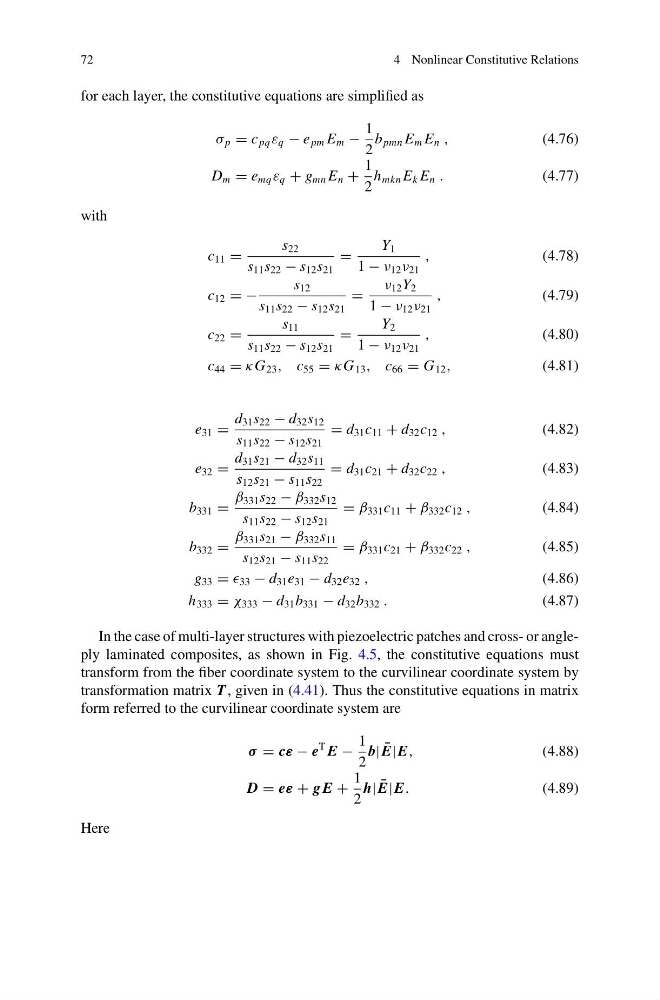
for each layer, the constitutive equations are simplified as
σ p = c pq ε q − e pm E m −
1
2
b pmn E m E n ,
(4.76)
D m = e mq ε q + g mn E n +
1
2
h mkn E k E n .
(4.77)
with
c 11 =
s 22
s 11 s 22 − s 12 s 21
=
Y 1
1 − ν 12 ν 21
,
(4.78)
c 12 = −
s 12
s 11 s 22 − s 12 s 21
=
ν 12 Y 2
1 − ν 12 ν 21
,
(4.79)
c 22 =
s 11
s 11 s 22 − s 12 s 21
=
Y 2
1 − ν 12 ν 21
,
(4.80)
c 44 = κG 23 , c 55 = κG 13 , c 66 = G 12 ,
(4.81)
e 31 =
d 31 s 22 − d 32 s 12
s 11 s 22 − s 12 s 21
= d 31 c 11 + d 32 c 12 ,
(4.82)
e 32 =
d 31 s 21 − d 32 s 11
s 12 s 21 − s 11 s 22
= d 31 c 21 + d 32 c 22 ,
(4.83)
b 331 =
β 331 s 22 − β 332 s 12
s 11 s 22 − s 12 s 21
= β 331 c 11 + β 332 c 12 ,
(4.84)
b 332 =
β 331 s 21 − β 332 s 11
s 12 s 21 − s 11 s 22
= β 331 c 21 + β 332 c 22 ,
(4.85)
g 33 = 33 − d 31 e 31 − d 32 e 32 ,
(4.86)
h 333 = χ 333 − d 31 b 331 − d 32 b 332 .
(4.87)
In the case of multi-layer structures with piezoelectric patches and cross- or angleply laminated composites, as shown in Fig. 4.5, the constitutive equations must
transform from the fiber coordinate system to the curvilinear coordinate system by
transformation matrix T , given in (4.41). Thus the constitutive equations in matrix
form referred to the curvilinear coordinate system are
σ = cε − e
T E −
1
2
b| ¯
E|E,
(4.88)
D = eε + g E +
1
2
h| ¯
E|E.
(4.89)
Here
4 Nonlinear Constitutive Relations
for each layer, the constitutive equations are simplified as
σ p = c pq ε q − e pm E m −
1
2
b pmn E m E n ,
(4.76)
D m = e mq ε q + g mn E n +
1
2
h mkn E k E n .
(4.77)
with
c 11 =
s 22
s 11 s 22 − s 12 s 21
=
Y 1
1 − ν 12 ν 21
,
(4.78)
c 12 = −
s 12
s 11 s 22 − s 12 s 21
=
ν 12 Y 2
1 − ν 12 ν 21
,
(4.79)
c 22 =
s 11
s 11 s 22 − s 12 s 21
=
Y 2
1 − ν 12 ν 21
,
(4.80)
c 44 = κG 23 , c 55 = κG 13 , c 66 = G 12 ,
(4.81)
e 31 =
d 31 s 22 − d 32 s 12
s 11 s 22 − s 12 s 21
= d 31 c 11 + d 32 c 12 ,
(4.82)
e 32 =
d 31 s 21 − d 32 s 11
s 12 s 21 − s 11 s 22
= d 31 c 21 + d 32 c 22 ,
(4.83)
b 331 =
β 331 s 22 − β 332 s 12
s 11 s 22 − s 12 s 21
= β 331 c 11 + β 332 c 12 ,
(4.84)
b 332 =
β 331 s 21 − β 332 s 11
s 12 s 21 − s 11 s 22
= β 331 c 21 + β 332 c 22 ,
(4.85)
g 33 = 33 − d 31 e 31 − d 32 e 32 ,
(4.86)
h 333 = χ 333 − d 31 b 331 − d 32 b 332 .
(4.87)
In the case of multi-layer structures with piezoelectric patches and cross- or angleply laminated composites, as shown in Fig. 4.5, the constitutive equations must
transform from the fiber coordinate system to the curvilinear coordinate system by
transformation matrix T , given in (4.41). Thus the constitutive equations in matrix
form referred to the curvilinear coordinate system are
σ = cε − e
T E −
1
2
b| ¯
E|E,
(4.88)
D = eε + g E +
1
2
h| ¯
E|E.
(4.89)
Here