

102
6 Nonlinear Analysis of Piezoceramic Laminated Structures
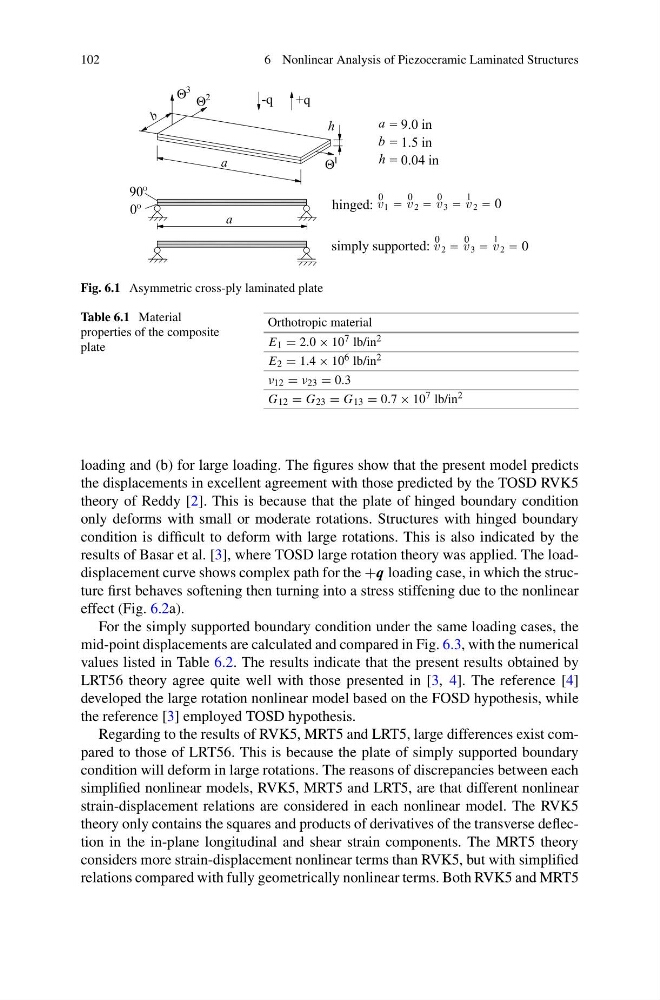
Fig. 6.1 Asymmetric cross-ply laminated plate
Table 6.1 Material
properties of the composite
plate
Orthotropic material
E 1 = 2.0 × 10 7 lb/in 2
E 2 = 1.4 × 10 6 lb/in 2
ν 12 = ν 23 = 0.3
G 12 = G 23 = G 13 = 0.7 × 10 7 lb/in 2
loading and (b) for large loading. The figures show that the present model predicts
the displacements in excellent agreement with those predicted by the TOSD RVK5
theory of Reddy [2]. This is because that the plate of hinged boundary condition
only deforms with small or moderate rotations. Structures with hinged boundary
condition is difficult to deform with large rotations. This is also indicated by the
results of Basar et al. [3], where TOSD large rotation theory was applied. The loaddisplacement curve shows complex path for the +q loading case, in which the structure first behaves softening then turning into a stress stiffening due to the nonlinear
effect (Fig. 6.2a).
For the simply supported boundary condition under the same loading cases, the
mid-point displacements are calculated and compared in Fig. 6.3, with the numerical
values listed in Table 6.2. The results indicate that the present results obtained by
LRT56 theory agree quite well with those presented in [3, 4]. The reference [4]
developed the large rotation nonlinear model based on the FOSD hypothesis, while
the reference [3] employed TOSD hypothesis.
Regarding to the results of RVK5, MRT5 and LRT5, large differences exist compared to those of LRT56. This is because the plate of simply supported boundary
condition will deform in large rotations. The reasons of discrepancies between each
simplified nonlinear models, RVK5, MRT5 and LRT5, are that different nonlinear
strain-displacement relations are considered in each nonlinear model. The RVK5
theory only contains the squares and products of derivatives of the transverse deflection in the in-plane longitudinal and shear strain components. The MRT5 theory
considers more strain-displacement nonlinear terms than RVK5, but with simplified
relations compared with fully geometrically nonlinear terms. Both RVK5 and MRT5
6 Nonlinear Analysis of Piezoceramic Laminated Structures
Fig. 6.1 Asymmetric cross-ply laminated plate
Table 6.1 Material
properties of the composite
plate
Orthotropic material
E 1 = 2.0 × 10 7 lb/in 2
E 2 = 1.4 × 10 6 lb/in 2
ν 12 = ν 23 = 0.3
G 12 = G 23 = G 13 = 0.7 × 10 7 lb/in 2
loading and (b) for large loading. The figures show that the present model predicts
the displacements in excellent agreement with those predicted by the TOSD RVK5
theory of Reddy [2]. This is because that the plate of hinged boundary condition
only deforms with small or moderate rotations. Structures with hinged boundary
condition is difficult to deform with large rotations. This is also indicated by the
results of Basar et al. [3], where TOSD large rotation theory was applied. The loaddisplacement curve shows complex path for the +q loading case, in which the structure first behaves softening then turning into a stress stiffening due to the nonlinear
effect (Fig. 6.2a).
For the simply supported boundary condition under the same loading cases, the
mid-point displacements are calculated and compared in Fig. 6.3, with the numerical
values listed in Table 6.2. The results indicate that the present results obtained by
LRT56 theory agree quite well with those presented in [3, 4]. The reference [4]
developed the large rotation nonlinear model based on the FOSD hypothesis, while
the reference [3] employed TOSD hypothesis.
Regarding to the results of RVK5, MRT5 and LRT5, large differences exist compared to those of LRT56. This is because the plate of simply supported boundary
condition will deform in large rotations. The reasons of discrepancies between each
simplified nonlinear models, RVK5, MRT5 and LRT5, are that different nonlinear
strain-displacement relations are considered in each nonlinear model. The RVK5
theory only contains the squares and products of derivatives of the transverse deflection in the in-plane longitudinal and shear strain components. The MRT5 theory
considers more strain-displacement nonlinear terms than RVK5, but with simplified
relations compared with fully geometrically nonlinear terms. Both RVK5 and MRT5