

82
5 Finite Element Formulations
given in (5.17) must be linearized by means of the Taylor series expansion, with the
higher-order terms neglected, as [4]
Δ
1
v i =
∂
1
v i
∂ϕ 1
t
Δϕ 1 +
∂
1
v i
∂ϕ 2
t
Δϕ 2 ,
(5.19)
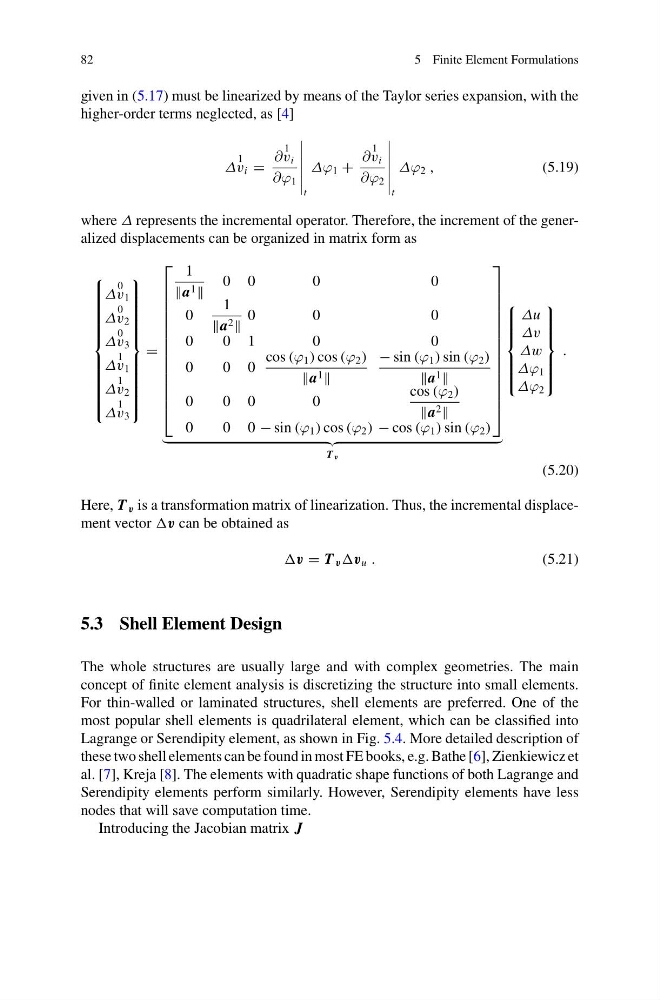
where Δ represents the incremental operator. Therefore, the increment of the generalized displacements can be organized in matrix form as
⎧
⎪ ⎪ ⎪ ⎪ ⎪ ⎪ ⎪ ⎪ ⎪ ⎪ ⎨
⎪ ⎪ ⎪ ⎪ ⎪ ⎪ ⎪ ⎪ ⎪ ⎪ ⎩
Δ
0
v 1
Δ
0
v 2
Δ
0
v 3
Δ
1
v 1
Δ
1
v 2
Δ
1
v 3
⎫
⎪ ⎪ ⎪ ⎪ ⎪ ⎪ ⎪ ⎪ ⎪ ⎪ ⎬
⎪ ⎪ ⎪ ⎪ ⎪ ⎪ ⎪ ⎪ ⎪ ⎪ ⎭
=
⎡
⎢
⎢
⎢
⎢
⎢
⎢
⎢
⎢
⎢
⎢
⎢
⎢
⎢
⎣
1
a 1
0 0
0
0
0
1
a 2
0
0
0
0
0 1
0
0
0
0 0
cos (ϕ 1 ) cos (ϕ 2 )
a 1
− sin (ϕ 1 ) sin (ϕ 2 )
a 1
0
0 0
0
cos (ϕ 2 )
a 2
0
0 0 − sin (ϕ 1 ) cos (ϕ 2 ) − cos (ϕ 1 ) sin (ϕ 2 )
⎤
⎥
⎥
⎥
⎥
⎥
⎥
⎥
⎥
⎥
⎥
⎥
⎥
⎥
⎦
T v
⎧
⎪ ⎪ ⎪ ⎪ ⎨
⎪ ⎪ ⎪ ⎪ ⎩
Δu
Δv
Δw
Δϕ 1
Δϕ 2
⎫
⎪ ⎪ ⎪ ⎪ ⎬
⎪ ⎪ ⎪ ⎪ ⎭
.
(5.20)
Here, T v is a transformation matrix of linearization. Thus, the incremental displacement vector v can be obtained as
v = T v v u .
(5.21)
5.3 Shell Element Design
The whole structures are usually large and with complex geometries. The main
concept of finite element analysis is discretizing the structure into small elements.
For thin-walled or laminated structures, shell elements are preferred. One of the
most popular shell elements is quadrilateral element, which can be classified into
Lagrange or Serendipity element, as shown in Fig. 5.4. More detailed description of
these two shell elements can be found in most FE books, e.g. Bathe [6], Zienkiewicz et
al. [7], Kreja [8]. The elements with quadratic shape functions of both Lagrange and
Serendipity elements perform similarly. However, Serendipity elements have less
nodes that will save computation time.
Introducing the Jacobian matrix J
5 Finite Element Formulations
given in (5.17) must be linearized by means of the Taylor series expansion, with the
higher-order terms neglected, as [4]
Δ
1
v i =
∂
1
v i
∂ϕ 1
t
Δϕ 1 +
∂
1
v i
∂ϕ 2
t
Δϕ 2 ,
(5.19)
where Δ represents the incremental operator. Therefore, the increment of the generalized displacements can be organized in matrix form as
⎧
⎪ ⎪ ⎪ ⎪ ⎪ ⎪ ⎪ ⎪ ⎪ ⎪ ⎨
⎪ ⎪ ⎪ ⎪ ⎪ ⎪ ⎪ ⎪ ⎪ ⎪ ⎩
Δ
0
v 1
Δ
0
v 2
Δ
0
v 3
Δ
1
v 1
Δ
1
v 2
Δ
1
v 3
⎫
⎪ ⎪ ⎪ ⎪ ⎪ ⎪ ⎪ ⎪ ⎪ ⎪ ⎬
⎪ ⎪ ⎪ ⎪ ⎪ ⎪ ⎪ ⎪ ⎪ ⎪ ⎭
=
⎡
⎢
⎢
⎢
⎢
⎢
⎢
⎢
⎢
⎢
⎢
⎢
⎢
⎢
⎣
1
a 1
0 0
0
0
0
1
a 2
0
0
0
0
0 1
0
0
0
0 0
cos (ϕ 1 ) cos (ϕ 2 )
a 1
− sin (ϕ 1 ) sin (ϕ 2 )
a 1
0
0 0
0
cos (ϕ 2 )
a 2
0
0 0 − sin (ϕ 1 ) cos (ϕ 2 ) − cos (ϕ 1 ) sin (ϕ 2 )
⎤
⎥
⎥
⎥
⎥
⎥
⎥
⎥
⎥
⎥
⎥
⎥
⎥
⎥
⎦
T v
⎧
⎪ ⎪ ⎪ ⎪ ⎨
⎪ ⎪ ⎪ ⎪ ⎩
Δu
Δv
Δw
Δϕ 1
Δϕ 2
⎫
⎪ ⎪ ⎪ ⎪ ⎬
⎪ ⎪ ⎪ ⎪ ⎭
.
(5.20)
Here, T v is a transformation matrix of linearization. Thus, the incremental displacement vector v can be obtained as
v = T v v u .
(5.21)
5.3 Shell Element Design
The whole structures are usually large and with complex geometries. The main
concept of finite element analysis is discretizing the structure into small elements.
For thin-walled or laminated structures, shell elements are preferred. One of the
most popular shell elements is quadrilateral element, which can be classified into
Lagrange or Serendipity element, as shown in Fig. 5.4. More detailed description of
these two shell elements can be found in most FE books, e.g. Bathe [6], Zienkiewicz et
al. [7], Kreja [8]. The elements with quadratic shape functions of both Lagrange and
Serendipity elements perform similarly. However, Serendipity elements have less
nodes that will save computation time.
Introducing the Jacobian matrix J