

4.7 The Energy Principle, A Self-evident Proposition?
The second part of the clarification is Kelvin’s energy principle. Useful though the
Carnot–Kelvin formula was, the unresolved goal for Kelvin was to formulate an
overarching version of the idea of the irreversible world that could be a counterpoint to the principle of conservation of energy, which, as the mature version of
MEH, is a quantitative, mathematical equation—unsurpassed in the simplicity of its
premises, the disparate things it relates to, and the extent of its area of applicability.
Existing statements, the Kelvin Statement and the Clausius Statement (see
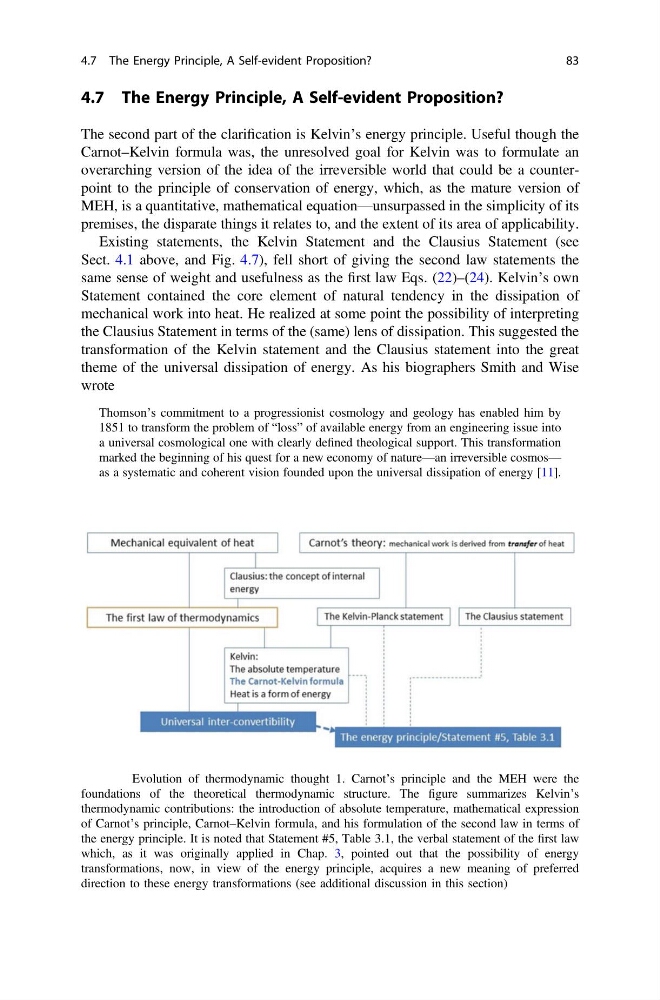
Sect. 4.1 above, and Fig. 4.7), fell short of giving the second law statements the
same sense of weight and usefulness as the first law Eqs. (22)–(24). Kelvin’s own
Statement contained the core element of natural tendency in the dissipation of
mechanical work into heat. He realized at some point the possibility of interpreting
the Clausius Statement in terms of the (same) lens of dissipation. This suggested the
transformation of the Kelvin statement and the Clausius statement into the great
theme of the universal dissipation of energy. As his biographers Smith and Wise
wrote
Thomson’s commitment to a progressionist cosmology and geology has enabled him by
1851 to transform the problem of “loss” of available energy from an engineering issue into
a universal cosmological one with clearly defined theological support. This transformation
marked the beginning of his quest for a new economy of nature—an irreversible cosmos—
as a systematic and coherent vision founded upon the universal dissipation of energy [11].
Fig. 4.7 Evolution of thermodynamic thought 1. Carnot’s principle and the MEH were the
foundations of the theoretical thermodynamic structure. The figure summarizes Kelvin’s
thermodynamic contributions: the introduction of absolute temperature, mathematical expression
of Carnot’s principle, Carnot–Kelvin formula, and his formulation of the second law in terms of
the energy principle. It is noted that Statement #5, Table 3.1, the verbal statement of the first law
which, as it was originally applied in Chap. 3, pointed out that the possibility of energy
transformations, now, in view of the energy principle, acquires a new meaning of preferred
direction to these energy transformations (see additional discussion in this section)
4.7 The Energy Principle, A Self-evident Proposition?
83
The second part of the clarification is Kelvin’s energy principle. Useful though the
Carnot–Kelvin formula was, the unresolved goal for Kelvin was to formulate an
overarching version of the idea of the irreversible world that could be a counterpoint to the principle of conservation of energy, which, as the mature version of
MEH, is a quantitative, mathematical equation—unsurpassed in the simplicity of its
premises, the disparate things it relates to, and the extent of its area of applicability.
Existing statements, the Kelvin Statement and the Clausius Statement (see
Sect. 4.1 above, and Fig. 4.7), fell short of giving the second law statements the
same sense of weight and usefulness as the first law Eqs. (22)–(24). Kelvin’s own
Statement contained the core element of natural tendency in the dissipation of
mechanical work into heat. He realized at some point the possibility of interpreting
the Clausius Statement in terms of the (same) lens of dissipation. This suggested the
transformation of the Kelvin statement and the Clausius statement into the great
theme of the universal dissipation of energy. As his biographers Smith and Wise
wrote
Thomson’s commitment to a progressionist cosmology and geology has enabled him by
1851 to transform the problem of “loss” of available energy from an engineering issue into
a universal cosmological one with clearly defined theological support. This transformation
marked the beginning of his quest for a new economy of nature—an irreversible cosmos—
as a systematic and coherent vision founded upon the universal dissipation of energy [11].
Fig. 4.7 Evolution of thermodynamic thought 1. Carnot’s principle and the MEH were the
foundations of the theoretical thermodynamic structure. The figure summarizes Kelvin’s
thermodynamic contributions: the introduction of absolute temperature, mathematical expression
of Carnot’s principle, Carnot–Kelvin formula, and his formulation of the second law in terms of
the energy principle. It is noted that Statement #5, Table 3.1, the verbal statement of the first law
which, as it was originally applied in Chap. 3, pointed out that the possibility of energy
transformations, now, in view of the energy principle, acquires a new meaning of preferred
direction to these energy transformations (see additional discussion in this section)
4.7 The Energy Principle, A Self-evident Proposition?
83