

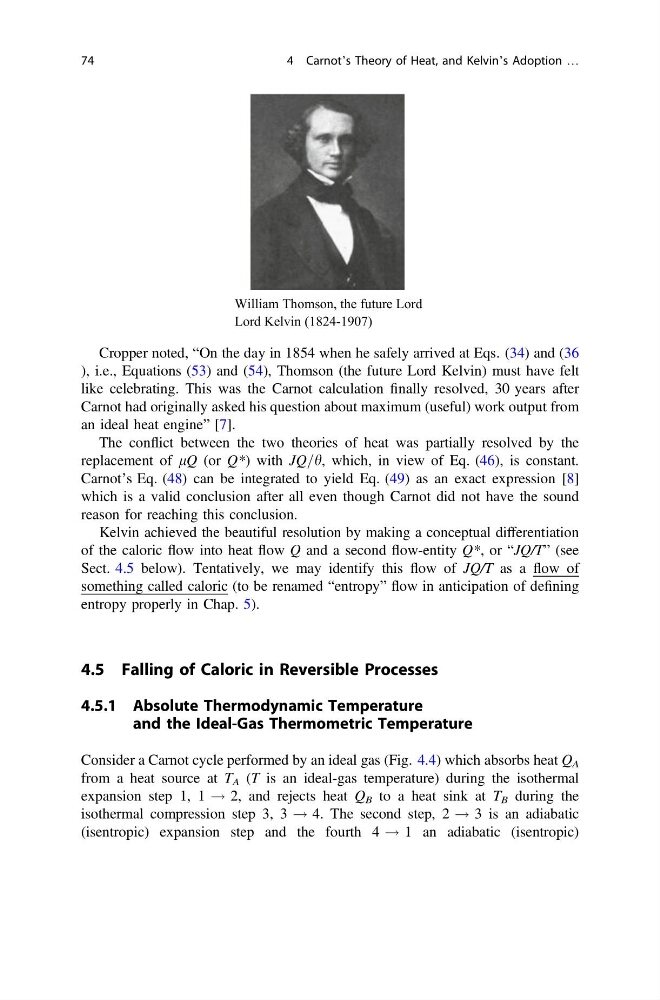
William Thomson, the future Lord
Lord Kelvin (1824-1907)
Cropper noted, “On the day in 1854 when he safely arrived at Eqs. (34) and (36
), i.e., Equations (53) and (54), Thomson (the future Lord Kelvin) must have felt
like celebrating. This was the Carnot calculation finally resolved, 30 years after
Carnot had originally asked his question about maximum (useful) work output from
an ideal heat engine” [7].
The conflict between the two theories of heat was partially resolved by the
replacement of lQ (or Q*) with JQ=h, which, in view of Eq. (46), is constant.
Carnot’s Eq. (48) can be integrated to yield Eq. (49) as an exact expression [8]
which is a valid conclusion after all even though Carnot did not have the sound
reason for reaching this conclusion.
Kelvin achieved the beautiful resolution by making a conceptual differentiation
of the caloric flow into heat flow Q and a second flow-entity Q*, or “JQ/T” (see
Sect. 4.5 below). Tentatively, we may identify this flow of JQ/T as a flow of
something called caloric (to be renamed “entropy” flow in anticipation of defining
entropy properly in Chap. 5).
4.5 Falling of Caloric in Reversible Processes
4.5.1 Absolute Thermodynamic Temperature
and the Ideal-Gas Thermometric Temperature
Consider a Carnot cycle performed by an ideal gas (Fig. 4.4) which absorbs heat Q A
from a heat source at T A (T is an ideal-gas temperature) during the isothermal
expansion step 1, 1 ! 2, and rejects heat Q B to a heat sink at T B during the
isothermal compression step 3, 3 ! 4. The second step, 2 ! 3 is an adiabatic
(isentropic) expansion step and the fourth 4 ! 1 an adiabatic (isentropic)
74
4 Carnot’s Theory of Heat, and Kelvin’s Adoption …
Lord Kelvin (1824-1907)
Cropper noted, “On the day in 1854 when he safely arrived at Eqs. (34) and (36
), i.e., Equations (53) and (54), Thomson (the future Lord Kelvin) must have felt
like celebrating. This was the Carnot calculation finally resolved, 30 years after
Carnot had originally asked his question about maximum (useful) work output from
an ideal heat engine” [7].
The conflict between the two theories of heat was partially resolved by the
replacement of lQ (or Q*) with JQ=h, which, in view of Eq. (46), is constant.
Carnot’s Eq. (48) can be integrated to yield Eq. (49) as an exact expression [8]
which is a valid conclusion after all even though Carnot did not have the sound
reason for reaching this conclusion.
Kelvin achieved the beautiful resolution by making a conceptual differentiation
of the caloric flow into heat flow Q and a second flow-entity Q*, or “JQ/T” (see
Sect. 4.5 below). Tentatively, we may identify this flow of JQ/T as a flow of
something called caloric (to be renamed “entropy” flow in anticipation of defining
entropy properly in Chap. 5).
4.5 Falling of Caloric in Reversible Processes
4.5.1 Absolute Thermodynamic Temperature
and the Ideal-Gas Thermometric Temperature
Consider a Carnot cycle performed by an ideal gas (Fig. 4.4) which absorbs heat Q A
from a heat source at T A (T is an ideal-gas temperature) during the isothermal
expansion step 1, 1 ! 2, and rejects heat Q B to a heat sink at T B during the
isothermal compression step 3, 3 ! 4. The second step, 2 ! 3 is an adiabatic
(isentropic) expansion step and the fourth 4 ! 1 an adiabatic (isentropic)
74
4 Carnot’s Theory of Heat, and Kelvin’s Adoption …