

where Q* = µQ. That is, “the motive power produced would be found exactly
proportional to the fall of caloric.” He, however, drew back from endorsing this
special case afterward, realizing that he did not have the sound reason for this
conclusion.
A detailed account of the intellectual journey began with Eq. (48) that would
lead to the birth of thermodynamics can be found in Truesdell’s estimable book,
The Tragicomical History of Thermodynamics, 1822–1854 [6]. A scholarly account
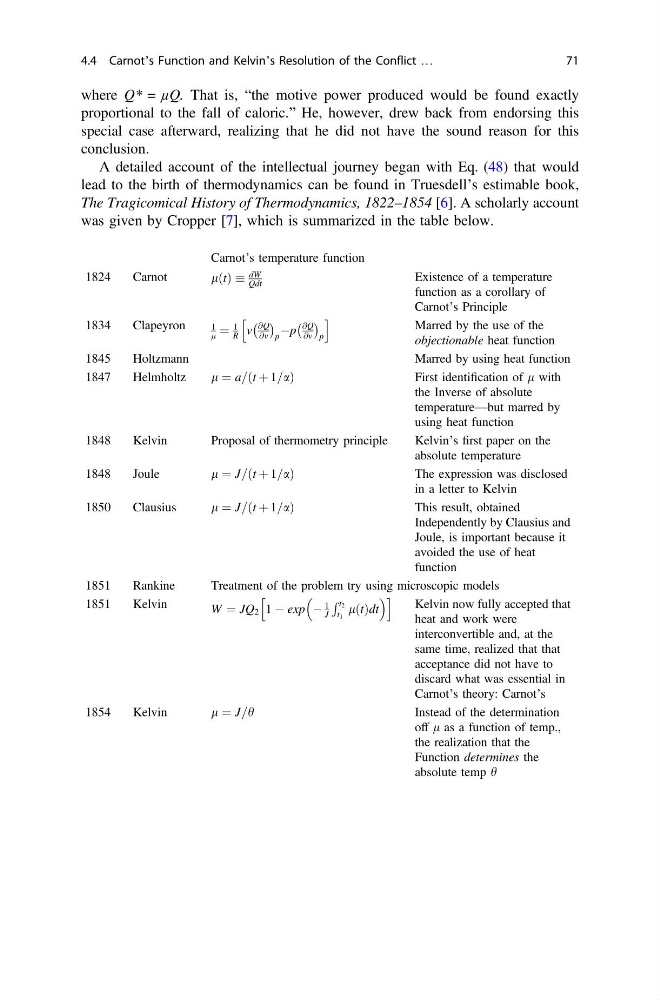
was given by Cropper [7], which is summarized in the table below.
Carnot’s temperature function
1824
Carnot
lðtÞ
dW
Qdt
Existence of a temperature
function as a corollary of
Carnot’s Principle
1834
Clapeyron
1
l ¼
1
R v
@Q
@v
À Á
p
Àp
@Q
@v
À Á
p
h
i
Marred by the use of the
objectionable heat function
1845
Holtzmann
Marred by using heat function
1847
Helmholtz
l ¼ a=ðt þ 1=aÞ
First identification of l with
the Inverse of absolute
temperature—but marred by
using heat function
1848
Kelvin
Proposal of thermometry principle
Kelvin’s first paper on the
absolute temperature
1848
Joule
l ¼ J=ðt þ 1=aÞ
The expression was disclosed
in a letter to Kelvin
1850
Clausius
l ¼ J=ðt þ 1=aÞ
This result, obtained
Independently by Clausius and
Joule, is important because it
avoided the use of heat
function
1851
Rankine
Treatment of the problem try using microscopic models
1851
Kelvin
W ¼ JQ 2 1 À exp À
1
J
R t2
t1 lðtÞdt
h
i
Kelvin now fully accepted that
heat and work were
interconvertible and, at the
same time, realized that that
acceptance did not have to
discard what was essential in
Carnot’s theory: Carnot’s
1854
Kelvin
l ¼ J=h
Instead of the determination
off l as a function of temp.,
the realization that the
Function determines the
absolute temp h
4.4 Carnot’s Function and Kelvin’s Resolution of the Conflict …
71
proportional to the fall of caloric.” He, however, drew back from endorsing this
special case afterward, realizing that he did not have the sound reason for this
conclusion.
A detailed account of the intellectual journey began with Eq. (48) that would
lead to the birth of thermodynamics can be found in Truesdell’s estimable book,
The Tragicomical History of Thermodynamics, 1822–1854 [6]. A scholarly account
was given by Cropper [7], which is summarized in the table below.
Carnot’s temperature function
1824
Carnot
lðtÞ
dW
Qdt
Existence of a temperature
function as a corollary of
Carnot’s Principle
1834
Clapeyron
1
l ¼
1
R v
@Q
@v
À Á
p
Àp
@Q
@v
À Á
p
h
i
Marred by the use of the
objectionable heat function
1845
Holtzmann
Marred by using heat function
1847
Helmholtz
l ¼ a=ðt þ 1=aÞ
First identification of l with
the Inverse of absolute
temperature—but marred by
using heat function
1848
Kelvin
Proposal of thermometry principle
Kelvin’s first paper on the
absolute temperature
1848
Joule
l ¼ J=ðt þ 1=aÞ
The expression was disclosed
in a letter to Kelvin
1850
Clausius
l ¼ J=ðt þ 1=aÞ
This result, obtained
Independently by Clausius and
Joule, is important because it
avoided the use of heat
function
1851
Rankine
Treatment of the problem try using microscopic models
1851
Kelvin
W ¼ JQ 2 1 À exp À
1
J
R t2
t1 lðtÞdt
h
i
Kelvin now fully accepted that
heat and work were
interconvertible and, at the
same time, realized that that
acceptance did not have to
discard what was essential in
Carnot’s theory: Carnot’s
1854
Kelvin
l ¼ J=h
Instead of the determination
off l as a function of temp.,
the realization that the
Function determines the
absolute temp h
4.4 Carnot’s Function and Kelvin’s Resolution of the Conflict …
71