

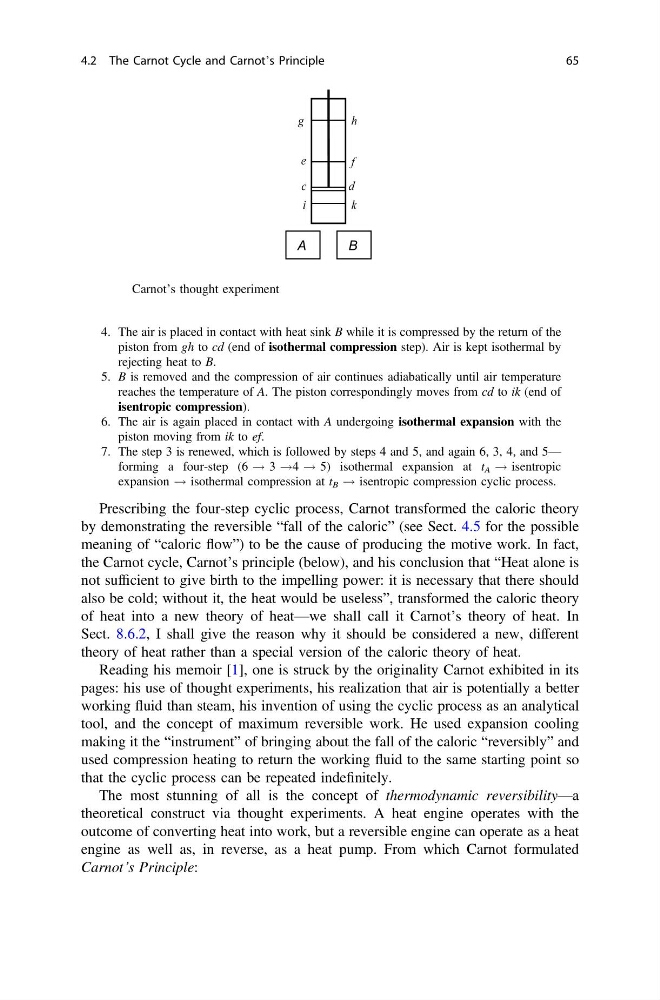
4. The air is placed in contact with heat sink B while it is compressed by the return of the
piston from gh to cd (end of isothermal compression step). Air is kept isothermal by
rejecting heat to B.
5. B is removed and the compression of air continues adiabatically until air temperature
reaches the temperature of A. The piston correspondingly moves from cd to ik (end of
isentropic compression).
6. The air is again placed in contact with A undergoing isothermal expansion with the
piston moving from ik to ef.
7. The step 3 is renewed, which is followed by steps 4 and 5, and again 6, 3, 4, and 5—
forming a four-step (6 ! 3 !4 ! 5) isothermal expansion at t A ! isentropic
expansion ! isothermal compression at t B ! isentropic compression cyclic process.
Prescribing the four-step cyclic process, Carnot transformed the caloric theory
by demonstrating the reversible “fall of the caloric” (see Sect. 4.5 for the possible
meaning of “caloric flow”) to be the cause of producing the motive work. In fact,
the Carnot cycle, Carnot’s principle (below), and his conclusion that “Heat alone is
not sufficient to give birth to the impelling power: it is necessary that there should
also be cold; without it, the heat would be useless”, transformed the caloric theory
of heat into a new theory of heat—we shall call it Carnot’s theory of heat. In
Sect. 8.6.2, I shall give the reason why it should be considered a new, different
theory of heat rather than a special version of the caloric theory of heat.
Reading his memoir [1], one is struck by the originality Carnot exhibited in its
pages: his use of thought experiments, his realization that air is potentially a better
working fluid than steam, his invention of using the cyclic process as an analytical
tool, and the concept of maximum reversible work. He used expansion cooling
making it the “instrument” of bringing about the fall of the caloric “reversibly” and
used compression heating to return the working fluid to the same starting point so
that the cyclic process can be repeated indefinitely.
The most stunning of all is the concept of thermodynamic reversibility—a
theoretical construct via thought experiments. A heat engine operates with the
outcome of converting heat into work, but a reversible engine can operate as a heat
engine as well as, in reverse, as a heat pump. From which Carnot formulated
Carnot’s Principle:
A
B
i
k
g
h
e
f
c
d
Fig. 4.2 Carnot’s thought experiment
4.2 The Carnot Cycle and Carnot’s Principle
65
piston from gh to cd (end of isothermal compression step). Air is kept isothermal by
rejecting heat to B.
5. B is removed and the compression of air continues adiabatically until air temperature
reaches the temperature of A. The piston correspondingly moves from cd to ik (end of
isentropic compression).
6. The air is again placed in contact with A undergoing isothermal expansion with the
piston moving from ik to ef.
7. The step 3 is renewed, which is followed by steps 4 and 5, and again 6, 3, 4, and 5—
forming a four-step (6 ! 3 !4 ! 5) isothermal expansion at t A ! isentropic
expansion ! isothermal compression at t B ! isentropic compression cyclic process.
Prescribing the four-step cyclic process, Carnot transformed the caloric theory
by demonstrating the reversible “fall of the caloric” (see Sect. 4.5 for the possible
meaning of “caloric flow”) to be the cause of producing the motive work. In fact,
the Carnot cycle, Carnot’s principle (below), and his conclusion that “Heat alone is
not sufficient to give birth to the impelling power: it is necessary that there should
also be cold; without it, the heat would be useless”, transformed the caloric theory
of heat into a new theory of heat—we shall call it Carnot’s theory of heat. In
Sect. 8.6.2, I shall give the reason why it should be considered a new, different
theory of heat rather than a special version of the caloric theory of heat.
Reading his memoir [1], one is struck by the originality Carnot exhibited in its
pages: his use of thought experiments, his realization that air is potentially a better
working fluid than steam, his invention of using the cyclic process as an analytical
tool, and the concept of maximum reversible work. He used expansion cooling
making it the “instrument” of bringing about the fall of the caloric “reversibly” and
used compression heating to return the working fluid to the same starting point so
that the cyclic process can be repeated indefinitely.
The most stunning of all is the concept of thermodynamic reversibility—a
theoretical construct via thought experiments. A heat engine operates with the
outcome of converting heat into work, but a reversible engine can operate as a heat
engine as well as, in reverse, as a heat pump. From which Carnot formulated
Carnot’s Principle:
A
B
i
k
g
h
e
f
c
d
Fig. 4.2 Carnot’s thought experiment
4.2 The Carnot Cycle and Carnot’s Principle
65