

Energy can be represented in terms of force-driven interactions in a reversible
universe as well as an irreversible universe. (Though such representation is sterile,
and the meaningful understanding of energy and its definition including the notion
of energy’s availability require consideration of what makes a universe irreversible.) Heat, i.e., heat phenomena or heat processes, on other hand, can only
have meaning in an irreversible universe—one that is far from equilibrium (or, at
least, away from equilibrium) abounding with unidirectional processes.
1 Ours is an
irreversible universe.
In an irreversible universe, hot lava cools; bouncing balls come to rest; sugar
dissolves; batteries discharge; orderly things fall apart; as Thomson (later, Lord
Kelvin) put it: mechanical energy dissipates into heat. Thermodynamics began with
these simple observations that nature abounds with spontaneous natural (or,
spontaneous for short) processes. They can be identified into two kinds (archetypes): dispersive kinds such as hot lava cools, sugar dissolves, compost decays and
generates heat; dissipative kinds or frictional kinds
2 such as bouncing balls come to
rest, wind flows and ebbs, spinning tops wind down. The dispersive ones, unless
maintained by “driving forces” (such as temperature gradient, concentration gradient, and chemical affinity), lead to the disappearance of gradients—and the
frictional ones convert work, or mechanical and electrical energy, into heat energy.
Both kinds of processes occur in their “preferred directions”: spontaneous changes
in the opposite directions are impossible.
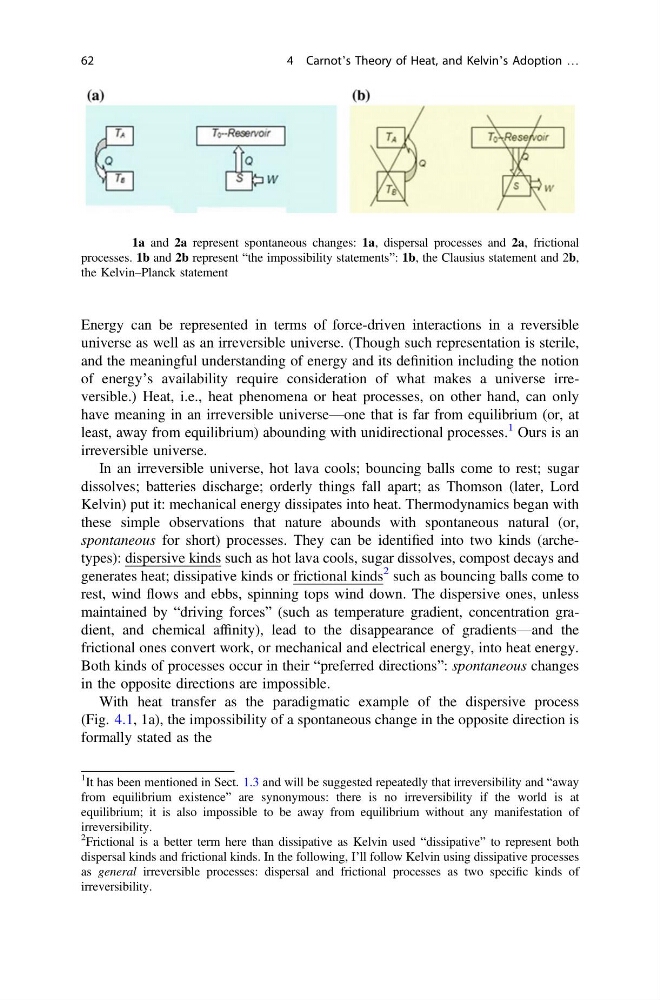
With heat transfer as the paradigmatic example of the dispersive process
(Fig. 4.1, 1a), the impossibility of a spontaneous change in the opposite direction is
formally stated as the
Fig. 4.1 1a and 2a represent spontaneous changes: 1a, dispersal processes and 2a, frictional
processes. 1b and 2b represent “the impossibility statements”: 1b, the Clausius statement and 2b,
the Kelvin–Planck statement
1
It has been mentioned in Sect. 1.3 and will be suggested repeatedly that irreversibility and “away
from equilibrium existence” are synonymous: there is no irreversibility if the world is at
equilibrium; it is also impossible to be away from equilibrium without any manifestation of
irreversibility.
2
Frictional is a better term here than dissipative as Kelvin used “dissipative” to represent both
dispersal kinds and frictional kinds. In the following, I’ll follow Kelvin using dissipative processes
as general irreversible processes: dispersal and frictional processes as two specific kinds of
irreversibility.
62
4 Carnot’s Theory of Heat, and Kelvin’s Adoption …
universe as well as an irreversible universe. (Though such representation is sterile,
and the meaningful understanding of energy and its definition including the notion
of energy’s availability require consideration of what makes a universe irreversible.) Heat, i.e., heat phenomena or heat processes, on other hand, can only
have meaning in an irreversible universe—one that is far from equilibrium (or, at
least, away from equilibrium) abounding with unidirectional processes.
1 Ours is an
irreversible universe.
In an irreversible universe, hot lava cools; bouncing balls come to rest; sugar
dissolves; batteries discharge; orderly things fall apart; as Thomson (later, Lord
Kelvin) put it: mechanical energy dissipates into heat. Thermodynamics began with
these simple observations that nature abounds with spontaneous natural (or,
spontaneous for short) processes. They can be identified into two kinds (archetypes): dispersive kinds such as hot lava cools, sugar dissolves, compost decays and
generates heat; dissipative kinds or frictional kinds
2 such as bouncing balls come to
rest, wind flows and ebbs, spinning tops wind down. The dispersive ones, unless
maintained by “driving forces” (such as temperature gradient, concentration gradient, and chemical affinity), lead to the disappearance of gradients—and the
frictional ones convert work, or mechanical and electrical energy, into heat energy.
Both kinds of processes occur in their “preferred directions”: spontaneous changes
in the opposite directions are impossible.
With heat transfer as the paradigmatic example of the dispersive process
(Fig. 4.1, 1a), the impossibility of a spontaneous change in the opposite direction is
formally stated as the
Fig. 4.1 1a and 2a represent spontaneous changes: 1a, dispersal processes and 2a, frictional
processes. 1b and 2b represent “the impossibility statements”: 1b, the Clausius statement and 2b,
the Kelvin–Planck statement
1
It has been mentioned in Sect. 1.3 and will be suggested repeatedly that irreversibility and “away
from equilibrium existence” are synonymous: there is no irreversibility if the world is at
equilibrium; it is also impossible to be away from equilibrium without any manifestation of
irreversibility.
2
Frictional is a better term here than dissipative as Kelvin used “dissipative” to represent both
dispersal kinds and frictional kinds. In the following, I’ll follow Kelvin using dissipative processes
as general irreversible processes: dispersal and frictional processes as two specific kinds of
irreversibility.
62
4 Carnot’s Theory of Heat, and Kelvin’s Adoption …