

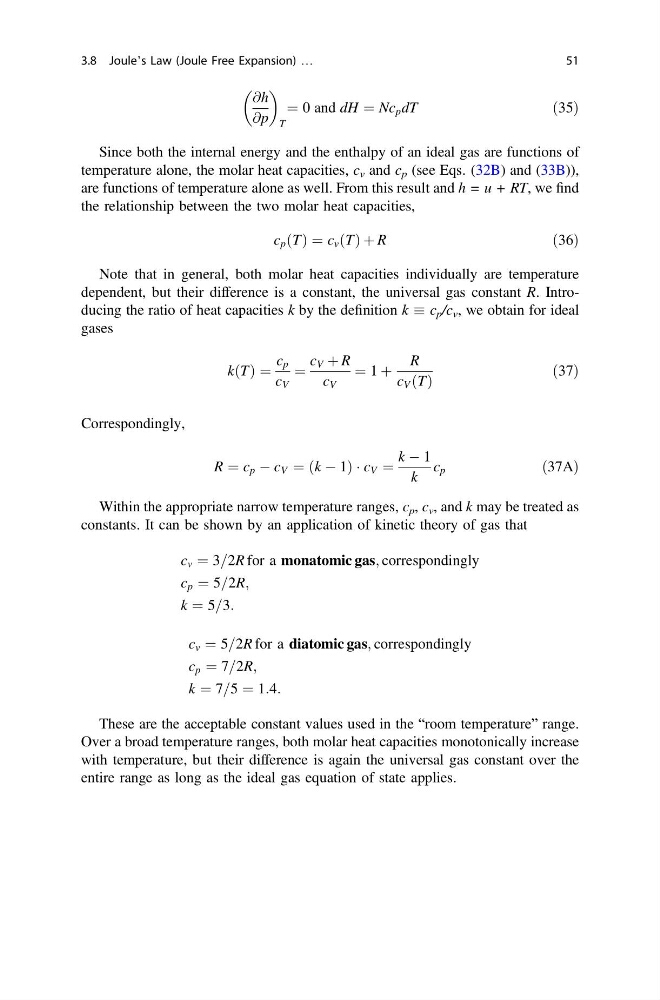
@h
@p
T
¼ 0 and dH ¼ Nc p dT
ð35Þ
Since both the internal energy and the enthalpy of an ideal gas are functions of
temperature alone, the molar heat capacities, c v and c p (see Eqs. (32B) and (33B)),
are functions of temperature alone as well. From this result and h = u + RT, we find
the relationship between the two molar heat capacities,
c p ðTÞ ¼ c v ðTÞ þ R
ð36Þ
Note that in general, both molar heat capacities individually are temperature
dependent, but their difference is a constant, the universal gas constant R. Introducing the ratio of heat capacities k by the definition k c p /c v , we obtain for ideal
gases
kðTÞ ¼
c p
c V
¼
c V þ R
c V
¼ 1 þ
R
c V ðTÞ
ð37Þ
Correspondingly,
R ¼ c p À c V ¼ k À 1
ð
ÞÁc V ¼
k À 1
k
c p
ð37AÞ
Within the appropriate narrow temperature ranges, c p , c v , and k may be treated as
constants. It can be shown by an application of kinetic theory of gas that
c v ¼ 3=2R for a monatomic gas; correspondingly
c p ¼ 5=2R;
k ¼ 5=3:
c v ¼ 5=2R for a diatomic gas; correspondingly
c p ¼ 7=2R;
k ¼ 7=5 ¼ 1:4:
These are the acceptable constant values used in the “room temperature” range.
Over a broad temperature ranges, both molar heat capacities monotonically increase
with temperature, but their difference is again the universal gas constant over the
entire range as long as the ideal gas equation of state applies.
3.8 Joule’s Law (Joule Free Expansion) …
51
@p
T
¼ 0 and dH ¼ Nc p dT
ð35Þ
Since both the internal energy and the enthalpy of an ideal gas are functions of
temperature alone, the molar heat capacities, c v and c p (see Eqs. (32B) and (33B)),
are functions of temperature alone as well. From this result and h = u + RT, we find
the relationship between the two molar heat capacities,
c p ðTÞ ¼ c v ðTÞ þ R
ð36Þ
Note that in general, both molar heat capacities individually are temperature
dependent, but their difference is a constant, the universal gas constant R. Introducing the ratio of heat capacities k by the definition k c p /c v , we obtain for ideal
gases
kðTÞ ¼
c p
c V
¼
c V þ R
c V
¼ 1 þ
R
c V ðTÞ
ð37Þ
Correspondingly,
R ¼ c p À c V ¼ k À 1
ð
ÞÁc V ¼
k À 1
k
c p
ð37AÞ
Within the appropriate narrow temperature ranges, c p , c v , and k may be treated as
constants. It can be shown by an application of kinetic theory of gas that
c v ¼ 3=2R for a monatomic gas; correspondingly
c p ¼ 5=2R;
k ¼ 5=3:
c v ¼ 5=2R for a diatomic gas; correspondingly
c p ¼ 7=2R;
k ¼ 7=5 ¼ 1:4:
These are the acceptable constant values used in the “room temperature” range.
Over a broad temperature ranges, both molar heat capacities monotonically increase
with temperature, but their difference is again the universal gas constant over the
entire range as long as the ideal gas equation of state applies.
3.8 Joule’s Law (Joule Free Expansion) …
51