

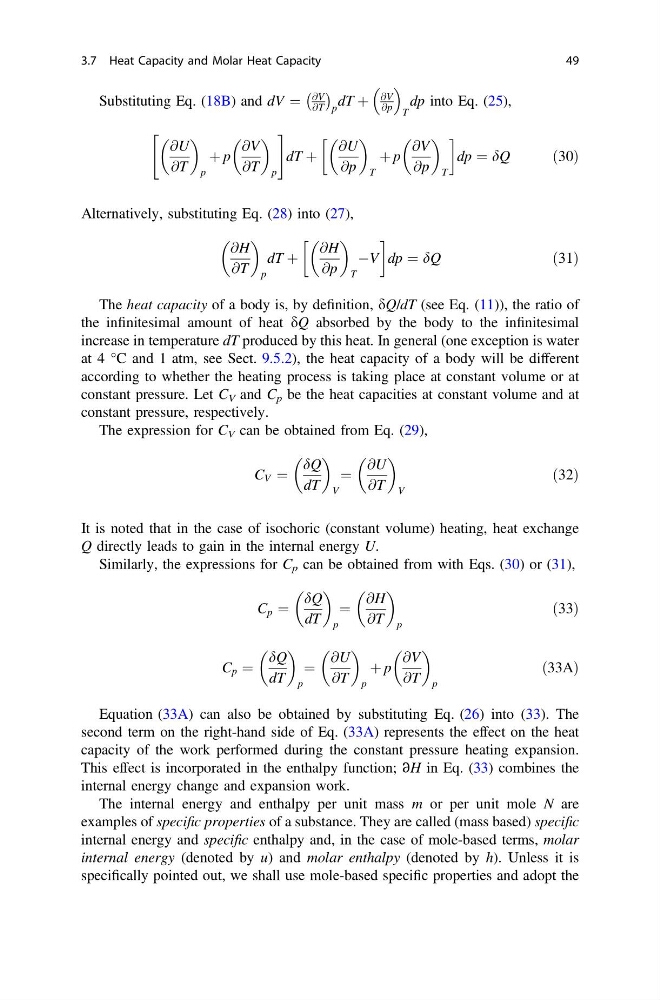
Substituting Eq. (18B) and dV ¼
@V
@T
À Á
p
dT þ
@V
@p
T
dp into Eq. (25),
@U
@T
p
þ p
@V
@T
p
"
#
dT þ
@U
@p
T
þ p
@V
@p
T
!
dp ¼ dQ
ð30Þ
Alternatively, substituting Eq. (28) into (27),
@H
@T
p
dT þ
@H
@p
T
ÀV
!
dp ¼ dQ
ð31Þ
The heat capacity of a body is, by definition, dQ/dT (see Eq. (11)), the ratio of
the infinitesimal amount of heat dQ absorbed by the body to the infinitesimal
increase in temperature dT produced by this heat. In general (one exception is water
at 4 °C and 1 atm, see Sect. 9.5.2), the heat capacity of a body will be different
according to whether the heating process is taking place at constant volume or at
constant pressure. Let C V and C p be the heat capacities at constant volume and at
constant pressure, respectively.
The expression for C V can be obtained from Eq. (29),
C V ¼
dQ
dT
V
¼
@U
@T
V
ð32Þ
It is noted that in the case of isochoric (constant volume) heating, heat exchange
Q directly leads to gain in the internal energy U.
Similarly, the expressions for C p can be obtained from with Eqs. (30) or (31),
C p ¼
dQ
dT
p
¼
@H
@T
p
ð33Þ
C p ¼
dQ
dT
p
¼
@U
@T
p
þ p
@V
@T
p
ð33AÞ
Equation (33A) can also be obtained by substituting Eq. (26) into (33). The
second term on the right-hand side of Eq. (33A) represents the effect on the heat
capacity of the work performed during the constant pressure heating expansion.
This effect is incorporated in the enthalpy function; ∂H in Eq. (33) combines the
internal energy change and expansion work.
The internal energy and enthalpy per unit mass m or per unit mole N are
examples of specific properties of a substance. They are called (mass based) specific
internal energy and specific enthalpy and, in the case of mole-based terms, molar
internal energy (denoted by u) and molar enthalpy (denoted by h). Unless it is
specifically pointed out, we shall use mole-based specific properties and adopt the
3.7 Heat Capacity and Molar Heat Capacity
49
@V
@T
À Á
p
dT þ
@V
@p
T
dp into Eq. (25),
@U
@T
p
þ p
@V
@T
p
"
#
dT þ
@U
@p
T
þ p
@V
@p
T
!
dp ¼ dQ
ð30Þ
Alternatively, substituting Eq. (28) into (27),
@H
@T
p
dT þ
@H
@p
T
ÀV
!
dp ¼ dQ
ð31Þ
The heat capacity of a body is, by definition, dQ/dT (see Eq. (11)), the ratio of
the infinitesimal amount of heat dQ absorbed by the body to the infinitesimal
increase in temperature dT produced by this heat. In general (one exception is water
at 4 °C and 1 atm, see Sect. 9.5.2), the heat capacity of a body will be different
according to whether the heating process is taking place at constant volume or at
constant pressure. Let C V and C p be the heat capacities at constant volume and at
constant pressure, respectively.
The expression for C V can be obtained from Eq. (29),
C V ¼
dQ
dT
V
¼
@U
@T
V
ð32Þ
It is noted that in the case of isochoric (constant volume) heating, heat exchange
Q directly leads to gain in the internal energy U.
Similarly, the expressions for C p can be obtained from with Eqs. (30) or (31),
C p ¼
dQ
dT
p
¼
@H
@T
p
ð33Þ
C p ¼
dQ
dT
p
¼
@U
@T
p
þ p
@V
@T
p
ð33AÞ
Equation (33A) can also be obtained by substituting Eq. (26) into (33). The
second term on the right-hand side of Eq. (33A) represents the effect on the heat
capacity of the work performed during the constant pressure heating expansion.
This effect is incorporated in the enthalpy function; ∂H in Eq. (33) combines the
internal energy change and expansion work.
The internal energy and enthalpy per unit mass m or per unit mole N are
examples of specific properties of a substance. They are called (mass based) specific
internal energy and specific enthalpy and, in the case of mole-based terms, molar
internal energy (denoted by u) and molar enthalpy (denoted by h). Unless it is
specifically pointed out, we shall use mole-based specific properties and adopt the
3.7 Heat Capacity and Molar Heat Capacity
49