

3.4 Energy Conservation in a Reversible Universe
Adequate understanding of heat and energy will have to be obtained after both the
first law and the second law are introduced; as it will be seen, the introduction of the
second law will require several stages in Chaps. 4, 5, 7, and 8. At this point, we can
comment preliminarily, in this section and Sect. 3.5, on heat in terms of a peculiar
notion of heat that has been widely promoted in thermodynamics literature:
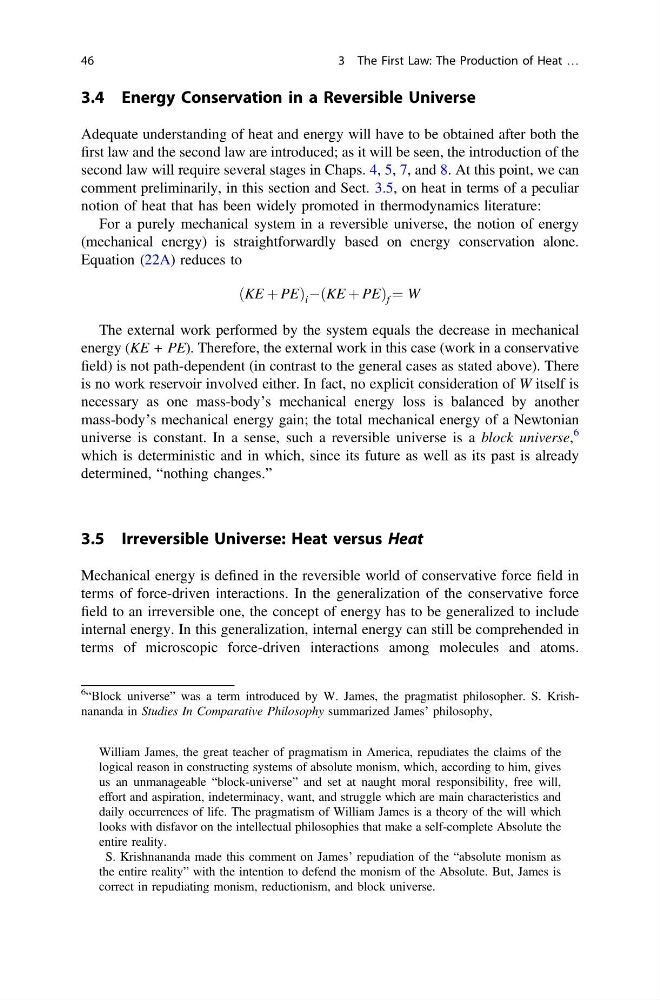
For a purely mechanical system in a reversible universe, the notion of energy
(mechanical energy) is straightforwardly based on energy conservation alone.
Equation (22A) reduces to
KE þ PE
ð
Þ i À KE þ PE
ð
Þ f ¼ W
The external work performed by the system equals the decrease in mechanical
energy (KE + PE). Therefore, the external work in this case (work in a conservative
field) is not path-dependent (in contrast to the general cases as stated above). There
is no work reservoir involved either. In fact, no explicit consideration of W itself is
necessary as one mass-body’s mechanical energy loss is balanced by another
mass-body’s mechanical energy gain; the total mechanical energy of a Newtonian
universe is constant. In a sense, such a reversible universe is a block universe,
6
which is deterministic and in which, since its future as well as its past is already
determined, “nothing changes.”
3.5 Irreversible Universe: Heat versus Heat
Mechanical energy is defined in the reversible world of conservative force field in
terms of force-driven interactions. In the generalization of the conservative force
field to an irreversible one, the concept of energy has to be generalized to include
internal energy. In this generalization, internal energy can still be comprehended in
terms of microscopic force-driven interactions among molecules and atoms.
6
“Block universe” was a term introduced by W. James, the pragmatist philosopher. S. Krishnananda in Studies In Comparative Philosophy summarized James’ philosophy,
William James, the great teacher of pragmatism in America, repudiates the claims of the
logical reason in constructing systems of absolute monism, which, according to him, gives
us an unmanageable “block-universe” and set at naught moral responsibility, free will,
effort and aspiration, indeterminacy, want, and struggle which are main characteristics and
daily occurrences of life. The pragmatism of William James is a theory of the will which
looks with disfavor on the intellectual philosophies that make a self-complete Absolute the
entire reality.
S. Krishnananda made this comment on James’ repudiation of the “absolute monism as
the entire reality” with the intention to defend the monism of the Absolute. But, James is
correct in repudiating monism, reductionism, and block universe.
46
3 The First Law: The Production of Heat …
Adequate understanding of heat and energy will have to be obtained after both the
first law and the second law are introduced; as it will be seen, the introduction of the
second law will require several stages in Chaps. 4, 5, 7, and 8. At this point, we can
comment preliminarily, in this section and Sect. 3.5, on heat in terms of a peculiar
notion of heat that has been widely promoted in thermodynamics literature:
For a purely mechanical system in a reversible universe, the notion of energy
(mechanical energy) is straightforwardly based on energy conservation alone.
Equation (22A) reduces to
KE þ PE
ð
Þ i À KE þ PE
ð
Þ f ¼ W
The external work performed by the system equals the decrease in mechanical
energy (KE + PE). Therefore, the external work in this case (work in a conservative
field) is not path-dependent (in contrast to the general cases as stated above). There
is no work reservoir involved either. In fact, no explicit consideration of W itself is
necessary as one mass-body’s mechanical energy loss is balanced by another
mass-body’s mechanical energy gain; the total mechanical energy of a Newtonian
universe is constant. In a sense, such a reversible universe is a block universe,
6
which is deterministic and in which, since its future as well as its past is already
determined, “nothing changes.”
3.5 Irreversible Universe: Heat versus Heat
Mechanical energy is defined in the reversible world of conservative force field in
terms of force-driven interactions. In the generalization of the conservative force
field to an irreversible one, the concept of energy has to be generalized to include
internal energy. In this generalization, internal energy can still be comprehended in
terms of microscopic force-driven interactions among molecules and atoms.
6
“Block universe” was a term introduced by W. James, the pragmatist philosopher. S. Krishnananda in Studies In Comparative Philosophy summarized James’ philosophy,
William James, the great teacher of pragmatism in America, repudiates the claims of the
logical reason in constructing systems of absolute monism, which, according to him, gives
us an unmanageable “block-universe” and set at naught moral responsibility, free will,
effort and aspiration, indeterminacy, want, and struggle which are main characteristics and
daily occurrences of life. The pragmatism of William James is a theory of the will which
looks with disfavor on the intellectual philosophies that make a self-complete Absolute the
entire reality.
S. Krishnananda made this comment on James’ repudiation of the “absolute monism as
the entire reality” with the intention to defend the monism of the Absolute. But, James is
correct in repudiating monism, reductionism, and block universe.
46
3 The First Law: The Production of Heat …