

1.9.2 A Mass Body and a Thermodynamic System: No
Thermodynamic System is an Island
The doctrine of mechanism presupposes that change in a particle is determined by
local force-driven interactions alone, independent of everything else there is in the
world. This presupposition was overthrown in the twentieth century by quantum
mechanics, which discovered that nature can be described completely only as an
entangled whole. While the mechanistic presupposition remains applicable to the
study of a macroscopic mass body (as the classical limit of quantum system, see
Fig. 1.7a), its validity in all macroscopic systems should have been called into
question (even before quantum mechanics) in the science of heat: a macroscopic
thermodynamic system can only be fully comprehended as a part of the interconnected world in terms of work reservoir and how it interacts with reservoirs and the
rest of its surroundings (see Fig. 1.7b).
Throughout the course of this disquisition, the full implications of the difference
between a mass body and a thermodynamic system will be developed. The thread of
the discussion is irreversibility (or spontaneity) and interconnectedness—manifested in the phenomena of heat (see Sect. 3.5, heat is used as a broader term of
heat: while the definition of heat will be given, no attempt will be made in defining
the broader term heat precisely). By treating thermodynamics as more than a mere
theory of energy understood mechanically, I make the case for identifying heat
phenomena not just in terms of physical forces or energy (in the classical realm of
Newton), but of a new “driving force” (in the statistical realm of Maxwell,
Boltzmann, and Gibbs). Just as the dynamical forces can be quantitatively determined, a quantitative measure of the new driving force, the entropic “forces” or
entropy growth potential will be given in Sects. 8.3–8.5.
A mass
body
A
thermodynamic
system
T 0 & p 0 reservoir
Work
(a)
(b)
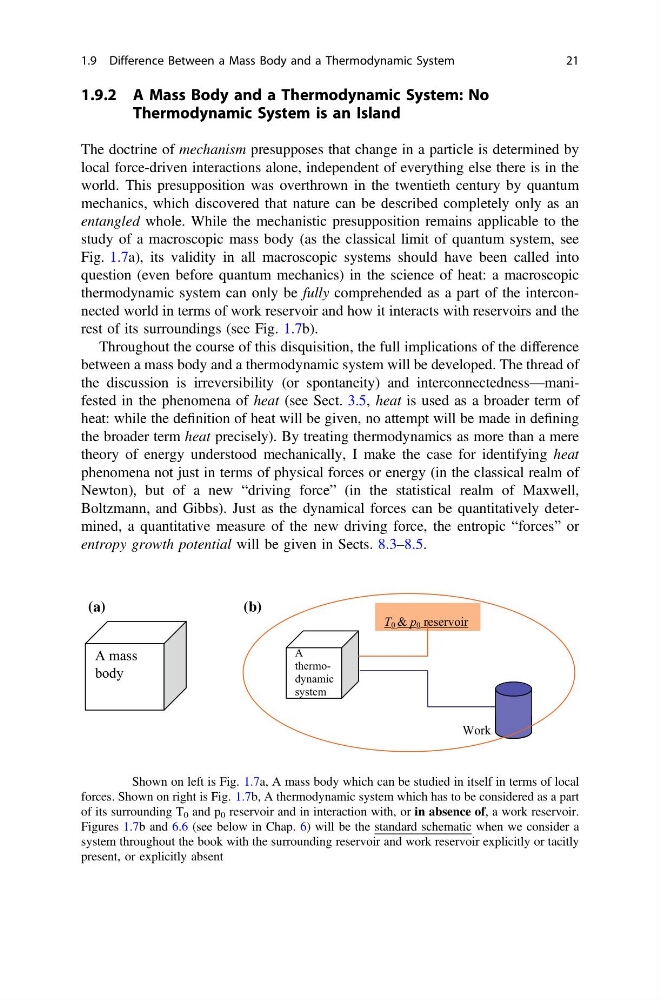
Fig. 1.7 Shown on left is Fig. 1.7a, A mass body which can be studied in itself in terms of local
forces. Shown on right is Fig. 1.7b, A thermodynamic system which has to be considered as a part
of its surrounding T 0 and p 0 reservoir and in interaction with, or in absence of, a work reservoir.
Figures 1.7b and 6.6 (see below in Chap. 6) will be the standard schematic when we consider a
system throughout the book with the surrounding reservoir and work reservoir explicitly or tacitly
present, or explicitly absent
1.9 Difference Between a Mass Body and a Thermodynamic System
21
Thermodynamic System is an Island
The doctrine of mechanism presupposes that change in a particle is determined by
local force-driven interactions alone, independent of everything else there is in the
world. This presupposition was overthrown in the twentieth century by quantum
mechanics, which discovered that nature can be described completely only as an
entangled whole. While the mechanistic presupposition remains applicable to the
study of a macroscopic mass body (as the classical limit of quantum system, see
Fig. 1.7a), its validity in all macroscopic systems should have been called into
question (even before quantum mechanics) in the science of heat: a macroscopic
thermodynamic system can only be fully comprehended as a part of the interconnected world in terms of work reservoir and how it interacts with reservoirs and the
rest of its surroundings (see Fig. 1.7b).
Throughout the course of this disquisition, the full implications of the difference
between a mass body and a thermodynamic system will be developed. The thread of
the discussion is irreversibility (or spontaneity) and interconnectedness—manifested in the phenomena of heat (see Sect. 3.5, heat is used as a broader term of
heat: while the definition of heat will be given, no attempt will be made in defining
the broader term heat precisely). By treating thermodynamics as more than a mere
theory of energy understood mechanically, I make the case for identifying heat
phenomena not just in terms of physical forces or energy (in the classical realm of
Newton), but of a new “driving force” (in the statistical realm of Maxwell,
Boltzmann, and Gibbs). Just as the dynamical forces can be quantitatively determined, a quantitative measure of the new driving force, the entropic “forces” or
entropy growth potential will be given in Sects. 8.3–8.5.
A mass
body
A
thermodynamic
system
T 0 & p 0 reservoir
Work
(a)
(b)
Fig. 1.7 Shown on left is Fig. 1.7a, A mass body which can be studied in itself in terms of local
forces. Shown on right is Fig. 1.7b, A thermodynamic system which has to be considered as a part
of its surrounding T 0 and p 0 reservoir and in interaction with, or in absence of, a work reservoir.
Figures 1.7b and 6.6 (see below in Chap. 6) will be the standard schematic when we consider a
system throughout the book with the surrounding reservoir and work reservoir explicitly or tacitly
present, or explicitly absent
1.9 Difference Between a Mass Body and a Thermodynamic System
21