

1.7 Work
If a system undergoes a displacement or a volume change under the action of a
force, the amount of work is equal to the product of the force and the component of
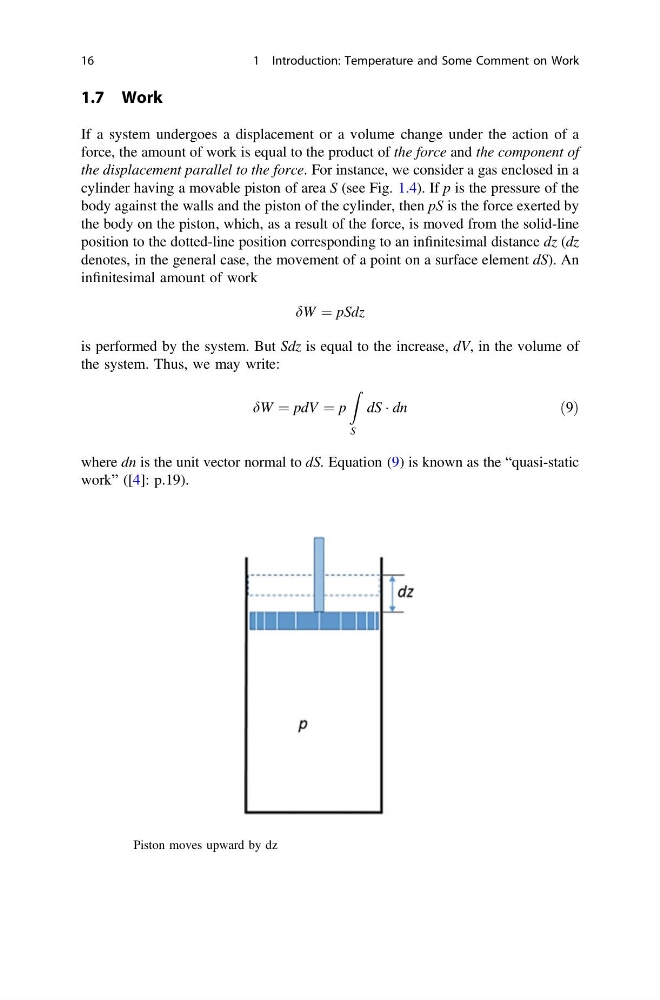
the displacement parallel to the force. For instance, we consider a gas enclosed in a
cylinder having a movable piston of area S (see Fig. 1.4). If p is the pressure of the
body against the walls and the piston of the cylinder, then pS is the force exerted by
the body on the piston, which, as a result of the force, is moved from the solid-line
position to the dotted-line position corresponding to an infinitesimal distance dz (dz
denotes, in the general case, the movement of a point on a surface element dS). An
infinitesimal amount of work
dW ¼ pSdz
is performed by the system. But Sdz is equal to the increase, dV, in the volume of
the system. Thus, we may write:
dW ¼ pdV ¼ p
Z
S
dS Á dn
ð9Þ
where dn is the unit vector normal to dS. Equation (9) is known as the “quasi-static
work” ([4]: p.19).
Fig. 1.4 Piston moves upward by dz
16
1 Introduction: Temperature and Some Comment on Work
If a system undergoes a displacement or a volume change under the action of a
force, the amount of work is equal to the product of the force and the component of
the displacement parallel to the force. For instance, we consider a gas enclosed in a
cylinder having a movable piston of area S (see Fig. 1.4). If p is the pressure of the
body against the walls and the piston of the cylinder, then pS is the force exerted by
the body on the piston, which, as a result of the force, is moved from the solid-line
position to the dotted-line position corresponding to an infinitesimal distance dz (dz
denotes, in the general case, the movement of a point on a surface element dS). An
infinitesimal amount of work
dW ¼ pSdz
is performed by the system. But Sdz is equal to the increase, dV, in the volume of
the system. Thus, we may write:
dW ¼ pdV ¼ p
Z
S
dS Á dn
ð9Þ
where dn is the unit vector normal to dS. Equation (9) is known as the “quasi-static
work” ([4]: p.19).
Fig. 1.4 Piston moves upward by dz
16
1 Introduction: Temperature and Some Comment on Work