

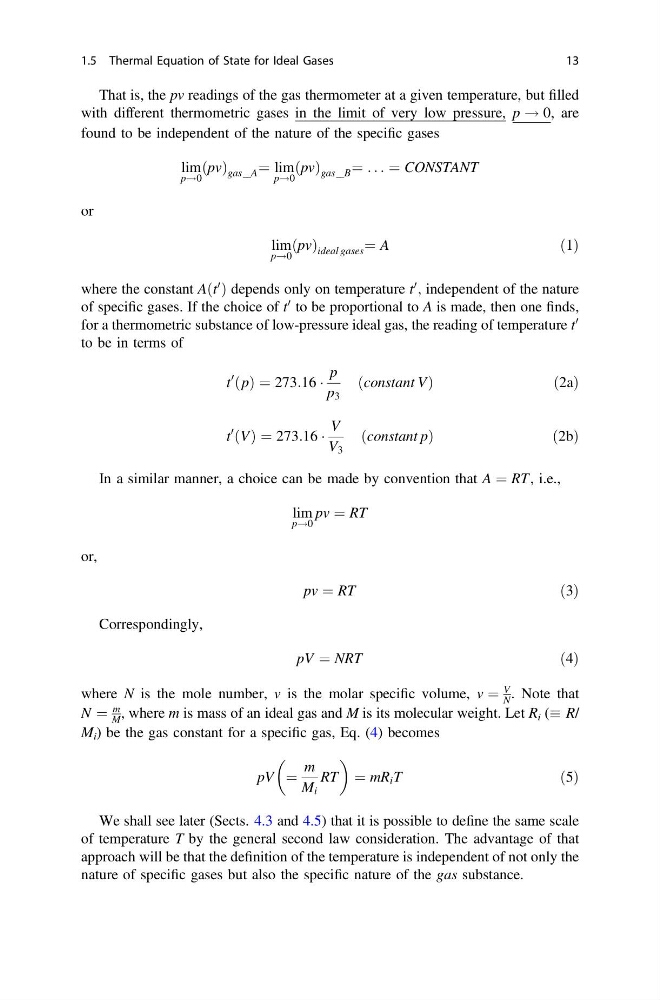
That is, the pv readings of the gas thermometer at a given temperature, but filled
with different thermometric gases in the limit of very low pressure, p ! 0, are
found to be independent of the nature of the specific gases
lim
p!0
pv
ð Þ gas A ¼ lim
p!0
pv
ð Þ gas B ¼ . . . ¼ CONSTANT
or
lim
p!0
pv
ð Þ ideal gases ¼ A
ð1Þ
where the constant Aðt
0
Þ depends only on temperature t
0
; independent of the nature
of specific gases. If the choice of t
0 to be proportional to A is made, then one finds,
for a thermometric substance of low-pressure ideal gas, the reading of temperature t
0
to be in terms of
t
0 p
ð Þ ¼ 273:16 Á
p
p 3
constant V
ð
Þ
ð 2aÞ
t
0 V
ð Þ ¼ 273:16 Á
V
V 3
constant p
ð
Þ
ð 2bÞ
In a similar manner, a choice can be made by convention that A ¼ RT, i.e.,
lim
p!0
pv ¼ RT
or,
pv ¼ RT
ð3Þ
Correspondingly,
pV ¼ NRT
ð4Þ
where N is the mole number, v is the molar specific volume, v ¼
V
N . Note that
N ¼
m
M , where m is mass of an ideal gas and M is its molecular weight. Let R i ( R/
M i ) be the gas constant for a specific gas, Eq. (4) becomes
pV ¼
m
M i
RT
¼ mR i T
ð5Þ
We shall see later (Sects. 4.3 and 4.5) that it is possible to define the same scale
of temperature T by the general second law consideration. The advantage of that
approach will be that the definition of the temperature is independent of not only the
nature of specific gases but also the specific nature of the gas substance.
1.5 Thermal Equation of State for Ideal Gases
13
with different thermometric gases in the limit of very low pressure, p ! 0, are
found to be independent of the nature of the specific gases
lim
p!0
pv
ð Þ gas A ¼ lim
p!0
pv
ð Þ gas B ¼ . . . ¼ CONSTANT
or
lim
p!0
pv
ð Þ ideal gases ¼ A
ð1Þ
where the constant Aðt
0
Þ depends only on temperature t
0
; independent of the nature
of specific gases. If the choice of t
0 to be proportional to A is made, then one finds,
for a thermometric substance of low-pressure ideal gas, the reading of temperature t
0
to be in terms of
t
0 p
ð Þ ¼ 273:16 Á
p
p 3
constant V
ð
Þ
ð 2aÞ
t
0 V
ð Þ ¼ 273:16 Á
V
V 3
constant p
ð
Þ
ð 2bÞ
In a similar manner, a choice can be made by convention that A ¼ RT, i.e.,
lim
p!0
pv ¼ RT
or,
pv ¼ RT
ð3Þ
Correspondingly,
pV ¼ NRT
ð4Þ
where N is the mole number, v is the molar specific volume, v ¼
V
N . Note that
N ¼
m
M , where m is mass of an ideal gas and M is its molecular weight. Let R i ( R/
M i ) be the gas constant for a specific gas, Eq. (4) becomes
pV ¼
m
M i
RT
¼ mR i T
ð5Þ
We shall see later (Sects. 4.3 and 4.5) that it is possible to define the same scale
of temperature T by the general second law consideration. The advantage of that
approach will be that the definition of the temperature is independent of not only the
nature of specific gases but also the specific nature of the gas substance.
1.5 Thermal Equation of State for Ideal Gases
13