

8.2.1 Calculation or Determination of Entropy Production
Entropy production is the primary concept in modern formalism. Entropy production can be calculated explicitly in terms of phenomenological relationships,
e.g., Fourier’s law of conduction, between “thermodynamic forces” and “thermodynamic flows” in the form d G S ¼ FdX in which F is the thermodynamics force,
e.g., temperature gradient, and dX is the corresponding thermodynamic flow, e.g.,
heat flow. See, for instance, examples in [25:121–127] and in [25: Chap. 11]. This
explicit procedure is applied to individual problems when phenomenological
relationships are known and solutions to the phenomenological “governing equations” are obtained.
Alternatively, when we take laws of balance as the primary concept, entropy
production d G S can be implicitly determined by substituting “the entropy exchange
d E S values from Eq. (86A)” and “the system entropy change dS values” from the
application of thermodynamic property relationships into Eq. (84B)
dS ¼ d E S þ d G S
The implicit procedure is especially powerful (no need for solving the phenomenological governing equations), and well suited for making inferences based
on theoretical thought experiments. It will be extensively used in the following
discussion.
8.3 The Entropic Drive Corollary
This section and the next consider the production of mechanical work derived from
a system’s tendency toward equilibrium. In this section, the tendency toward
equilibrium is the result of the system’s interaction with its surroundings (a surrounding heat reservoir). In the next section, it is the result of a system approaching
internal equilibrium.
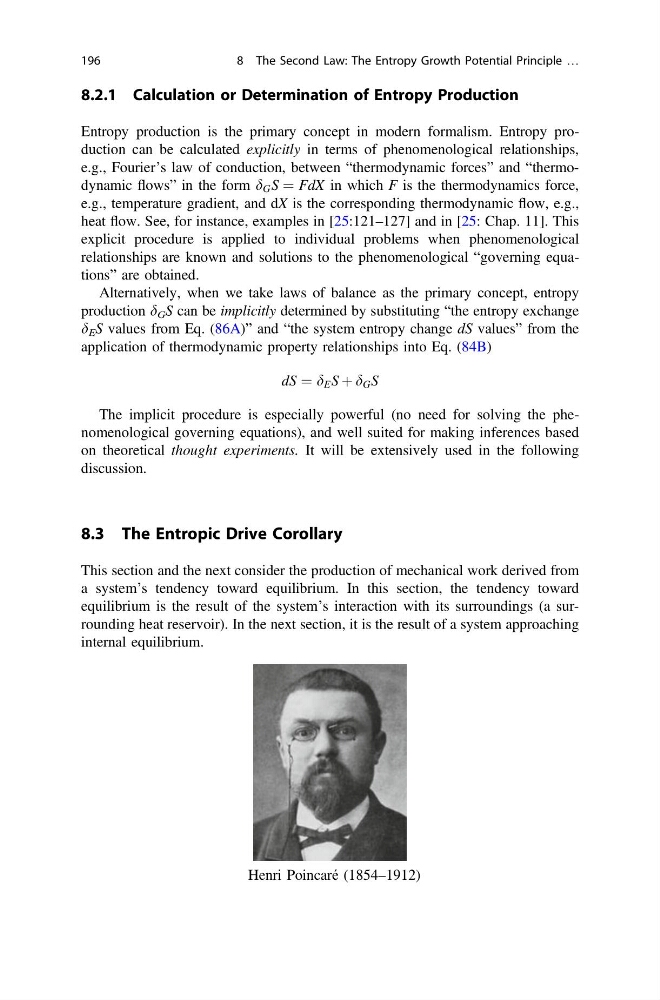
Henri Poincaré (1854–1912)
196
8 The Second Law: The Entropy Growth Potential Principle …
Entropy production is the primary concept in modern formalism. Entropy production can be calculated explicitly in terms of phenomenological relationships,
e.g., Fourier’s law of conduction, between “thermodynamic forces” and “thermodynamic flows” in the form d G S ¼ FdX in which F is the thermodynamics force,
e.g., temperature gradient, and dX is the corresponding thermodynamic flow, e.g.,
heat flow. See, for instance, examples in [25:121–127] and in [25: Chap. 11]. This
explicit procedure is applied to individual problems when phenomenological
relationships are known and solutions to the phenomenological “governing equations” are obtained.
Alternatively, when we take laws of balance as the primary concept, entropy
production d G S can be implicitly determined by substituting “the entropy exchange
d E S values from Eq. (86A)” and “the system entropy change dS values” from the
application of thermodynamic property relationships into Eq. (84B)
dS ¼ d E S þ d G S
The implicit procedure is especially powerful (no need for solving the phenomenological governing equations), and well suited for making inferences based
on theoretical thought experiments. It will be extensively used in the following
discussion.
8.3 The Entropic Drive Corollary
This section and the next consider the production of mechanical work derived from
a system’s tendency toward equilibrium. In this section, the tendency toward
equilibrium is the result of the system’s interaction with its surroundings (a surrounding heat reservoir). In the next section, it is the result of a system approaching
internal equilibrium.
Henri Poincaré (1854–1912)
196
8 The Second Law: The Entropy Growth Potential Principle …