

The only approximation of approaching restricted dead state applies to the latter
case of the mixing of nonreactive material components at thermomechanical disequilibrium. In this situation, it may be a useful approximation to consider the
process of approaching a restricted dead state in the device defining control volume
with individual components exiting from the device where, once outside the control
volume, mixing of individual components can take place.
The required treatment-distinction between a nonchemical system and a chemical
system is not by classifying physical exergy and chemical exergy according to
Eq. (114), but interpreting h À h 0
ð
ÞÀT 0 s À s 0
ð
Þ, accordingly, dependent on whether the system is in internal chemical equilibrium or not. We reject Eq. (114), for
such classification of exergy is philosophically problematic and pedagogically futile.
7.5.1 Energy and Exergy Equations for a Control Volume
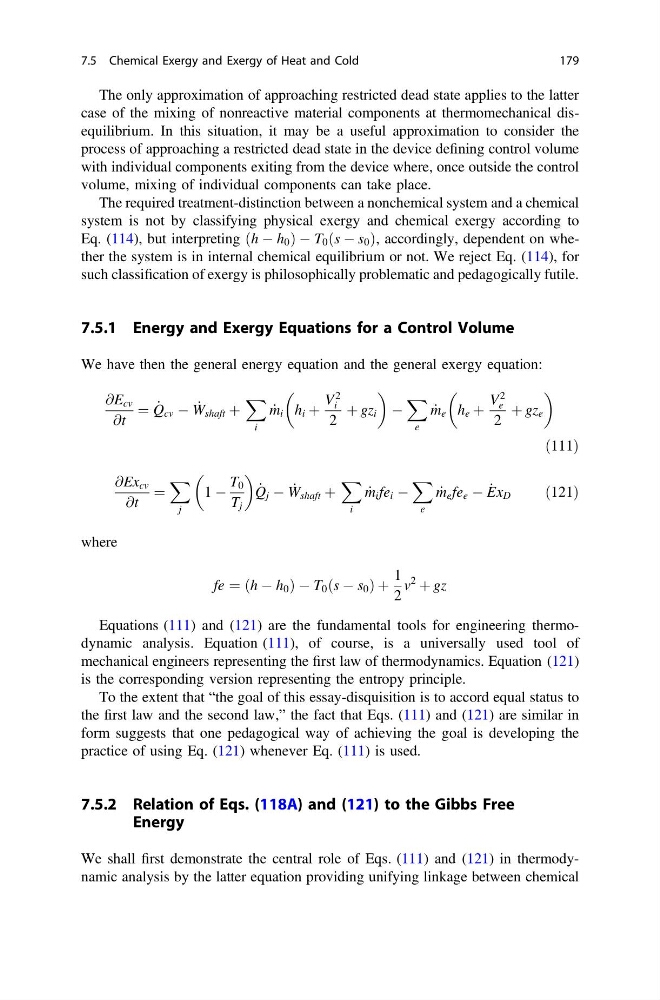
We have then the general energy equation and the general exergy equation:
@E cv
@t
¼ _
Q cv À _
W shaft þ
X
i
_
m i h i þ
V
2
i
2
þ gz i
À
X
e
_
m e h e þ
V
2
e
2
þ gz e
ð111Þ
@Ex cv
@t
¼
X
j
1 À
T 0
T j
_
Q j À _
W shaft þ
X
i
_
m i fe i À
X
e
_
m e fe e À _
Ex D
ð121Þ
where
fe ¼ h À h 0
ð
ÞÀT 0 s À s 0
ð
Þþ
1
2
v
2
þ gz
Equations (111) and (121) are the fundamental tools for engineering thermodynamic analysis. Equation (111), of course, is a universally used tool of
mechanical engineers representing the first law of thermodynamics. Equation (121)
is the corresponding version representing the entropy principle.
To the extent that “the goal of this essay-disquisition is to accord equal status to
the first law and the second law,” the fact that Eqs. (111) and (121) are similar in
form suggests that one pedagogical way of achieving the goal is developing the
practice of using Eq. (121) whenever Eq. (111) is used.
7.5.2 Relation of Eqs. (118A) and (121) to the Gibbs Free
Energy
We shall first demonstrate the central role of Eqs. (111) and (121) in thermodynamic analysis by the latter equation providing unifying linkage between chemical
7.5 Chemical Exergy and Exergy of Heat and Cold
179
case of the mixing of nonreactive material components at thermomechanical disequilibrium. In this situation, it may be a useful approximation to consider the
process of approaching a restricted dead state in the device defining control volume
with individual components exiting from the device where, once outside the control
volume, mixing of individual components can take place.
The required treatment-distinction between a nonchemical system and a chemical
system is not by classifying physical exergy and chemical exergy according to
Eq. (114), but interpreting h À h 0
ð
ÞÀT 0 s À s 0
ð
Þ, accordingly, dependent on whether the system is in internal chemical equilibrium or not. We reject Eq. (114), for
such classification of exergy is philosophically problematic and pedagogically futile.
7.5.1 Energy and Exergy Equations for a Control Volume
We have then the general energy equation and the general exergy equation:
@E cv
@t
¼ _
Q cv À _
W shaft þ
X
i
_
m i h i þ
V
2
i
2
þ gz i
À
X
e
_
m e h e þ
V
2
e
2
þ gz e
ð111Þ
@Ex cv
@t
¼
X
j
1 À
T 0
T j
_
Q j À _
W shaft þ
X
i
_
m i fe i À
X
e
_
m e fe e À _
Ex D
ð121Þ
where
fe ¼ h À h 0
ð
ÞÀT 0 s À s 0
ð
Þþ
1
2
v
2
þ gz
Equations (111) and (121) are the fundamental tools for engineering thermodynamic analysis. Equation (111), of course, is a universally used tool of
mechanical engineers representing the first law of thermodynamics. Equation (121)
is the corresponding version representing the entropy principle.
To the extent that “the goal of this essay-disquisition is to accord equal status to
the first law and the second law,” the fact that Eqs. (111) and (121) are similar in
form suggests that one pedagogical way of achieving the goal is developing the
practice of using Eq. (121) whenever Eq. (111) is used.
7.5.2 Relation of Eqs. (118A) and (121) to the Gibbs Free
Energy
We shall first demonstrate the central role of Eqs. (111) and (121) in thermodynamic analysis by the latter equation providing unifying linkage between chemical
7.5 Chemical Exergy and Exergy of Heat and Cold
179