

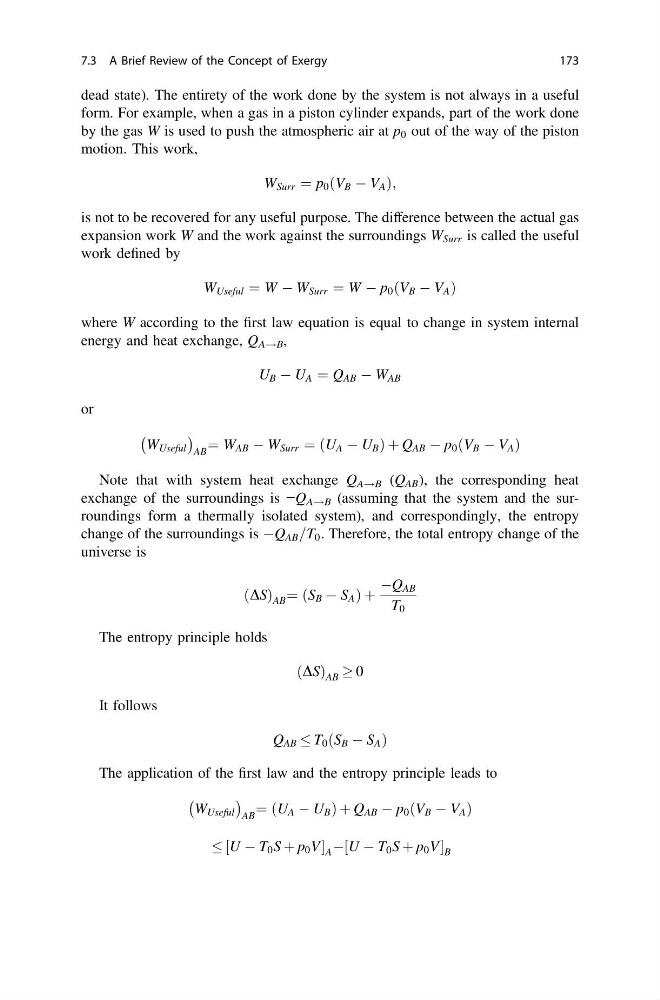
dead state). The entirety of the work done by the system is not always in a useful
form. For example, when a gas in a piston cylinder expands, part of the work done
by the gas W is used to push the atmospheric air at p 0 out of the way of the piston
motion. This work,
W Surr ¼ p 0 V B À V A
ð
Þ ;
is not to be recovered for any useful purpose. The difference between the actual gas
expansion work W and the work against the surroundings W Surr is called the useful
work defined by
W Useful ¼ W À W Surr ¼ W À p 0 V B À V A
ð
Þ
where W according to the first law equation is equal to change in system internal
energy and heat exchange, Q A!B ,
U B À U A ¼ Q AB À W AB
or
W Useful
À
Á
AB
¼ W AB À W Surr ¼ U A À U B
ð
ÞþQ AB À p 0 V B À V A
ð
Þ
Note that with system heat exchange Q A!B (Q AB ), the corresponding heat
exchange of the surroundings is −Q A!B (assuming that the system and the surroundings form a thermally isolated system), and correspondingly, the entropy
change of the surroundings is ÀQ AB =T 0 . Therefore, the total entropy change of the
universe is
DS
ð Þ AB ¼ S B À S A
ð
Þþ
ÀQ AB
T 0
The entropy principle holds
DS
ð Þ AB ! 0
It follows
Q AB T 0 S B À S A
ð
Þ
The application of the first law and the entropy principle leads to
W Useful
À
Á
AB
¼ U A À U B
ð
ÞþQ AB À p 0 V B À V A
ð
Þ
U À T 0 S þ p 0 V
½
A À U À T 0 S þ p 0 V
½
B
7.3 A Brief Review of the Concept of Exergy
173
form. For example, when a gas in a piston cylinder expands, part of the work done
by the gas W is used to push the atmospheric air at p 0 out of the way of the piston
motion. This work,
W Surr ¼ p 0 V B À V A
ð
Þ ;
is not to be recovered for any useful purpose. The difference between the actual gas
expansion work W and the work against the surroundings W Surr is called the useful
work defined by
W Useful ¼ W À W Surr ¼ W À p 0 V B À V A
ð
Þ
where W according to the first law equation is equal to change in system internal
energy and heat exchange, Q A!B ,
U B À U A ¼ Q AB À W AB
or
W Useful
À
Á
AB
¼ W AB À W Surr ¼ U A À U B
ð
ÞþQ AB À p 0 V B À V A
ð
Þ
Note that with system heat exchange Q A!B (Q AB ), the corresponding heat
exchange of the surroundings is −Q A!B (assuming that the system and the surroundings form a thermally isolated system), and correspondingly, the entropy
change of the surroundings is ÀQ AB =T 0 . Therefore, the total entropy change of the
universe is
DS
ð Þ AB ¼ S B À S A
ð
Þþ
ÀQ AB
T 0
The entropy principle holds
DS
ð Þ AB ! 0
It follows
Q AB T 0 S B À S A
ð
Þ
The application of the first law and the entropy principle leads to
W Useful
À
Á
AB
¼ U A À U B
ð
ÞþQ AB À p 0 V B À V A
ð
Þ
U À T 0 S þ p 0 V
½
A À U À T 0 S þ p 0 V
½
B
7.3 A Brief Review of the Concept of Exergy
173