

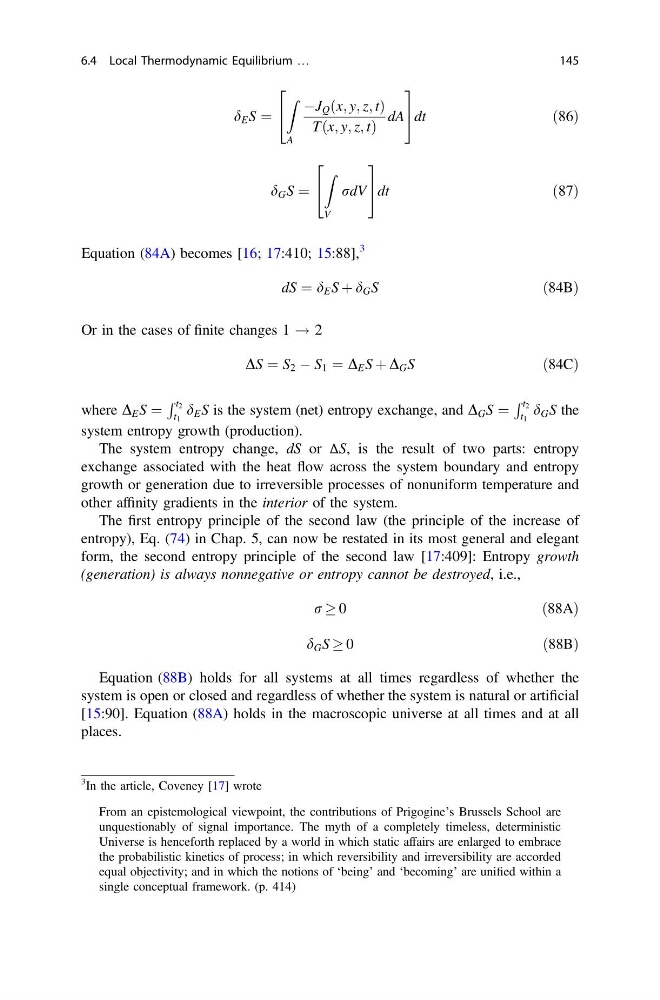
d E S ¼
Z
A
ÀJ Q x; y; z; t
ð
Þ
T x; y; z; t
ð
Þ
dA
2
4
3
5 dt
ð86Þ
d G S ¼
Z
V
rdV
2
4
3
5 dt
ð87Þ
Equation (84A) becomes [16; 17:410; 15:88],
3
dS ¼ d E S þ d G S
ð84BÞ
Or in the cases of finite changes 1 ! 2
DS ¼ S 2 À S 1 ¼ D E S þ D G S
ð84CÞ
where D E S ¼
R t 2
t 1
d E S is the system (net) entropy exchange, and D G S ¼
R t 2
t 1
d G S the
system entropy growth (production).
The system entropy change, dS or ΔS, is the result of two parts: entropy
exchange associated with the heat flow across the system boundary and entropy
growth or generation due to irreversible processes of nonuniform temperature and
other affinity gradients in the interior of the system.
The first entropy principle of the second law (the principle of the increase of
entropy), Eq. (74) in Chap. 5, can now be restated in its most general and elegant
form, the second entropy principle of the second law [17:409]: Entropy growth
(generation) is always nonnegative or entropy cannot be destroyed, i.e.,
r ! 0
ð88AÞ
d G S ! 0
ð88BÞ
Equation (88B) holds for all systems at all times regardless of whether the
system is open or closed and regardless of whether the system is natural or artificial
[15:90]. Equation (88A) holds in the macroscopic universe at all times and at all
places.
3
In the article, Coveney [17] wrote
From an epistemological viewpoint, the contributions of Prigogine’s Brussels School are
unquestionably of signal importance. The myth of a completely timeless, deterministic
Universe is henceforth replaced by a world in which static affairs are enlarged to embrace
the probabilistic kinetics of process; in which reversibility and irreversibility are accorded
equal objectivity; and in which the notions of ‘being’ and ‘becoming’ are unified within a
single conceptual framework. (p. 414)
6.4 Local Thermodynamic Equilibrium …
145
Z
A
ÀJ Q x; y; z; t
ð
Þ
T x; y; z; t
ð
Þ
dA
2
4
3
5 dt
ð86Þ
d G S ¼
Z
V
rdV
2
4
3
5 dt
ð87Þ
Equation (84A) becomes [16; 17:410; 15:88],
3
dS ¼ d E S þ d G S
ð84BÞ
Or in the cases of finite changes 1 ! 2
DS ¼ S 2 À S 1 ¼ D E S þ D G S
ð84CÞ
where D E S ¼
R t 2
t 1
d E S is the system (net) entropy exchange, and D G S ¼
R t 2
t 1
d G S the
system entropy growth (production).
The system entropy change, dS or ΔS, is the result of two parts: entropy
exchange associated with the heat flow across the system boundary and entropy
growth or generation due to irreversible processes of nonuniform temperature and
other affinity gradients in the interior of the system.
The first entropy principle of the second law (the principle of the increase of
entropy), Eq. (74) in Chap. 5, can now be restated in its most general and elegant
form, the second entropy principle of the second law [17:409]: Entropy growth
(generation) is always nonnegative or entropy cannot be destroyed, i.e.,
r ! 0
ð88AÞ
d G S ! 0
ð88BÞ
Equation (88B) holds for all systems at all times regardless of whether the
system is open or closed and regardless of whether the system is natural or artificial
[15:90]. Equation (88A) holds in the macroscopic universe at all times and at all
places.
3
In the article, Coveney [17] wrote
From an epistemological viewpoint, the contributions of Prigogine’s Brussels School are
unquestionably of signal importance. The myth of a completely timeless, deterministic
Universe is henceforth replaced by a world in which static affairs are enlarged to embrace
the probabilistic kinetics of process; in which reversibility and irreversibility are accorded
equal objectivity; and in which the notions of ‘being’ and ‘becoming’ are unified within a
single conceptual framework. (p. 414)
6.4 Local Thermodynamic Equilibrium …
145