

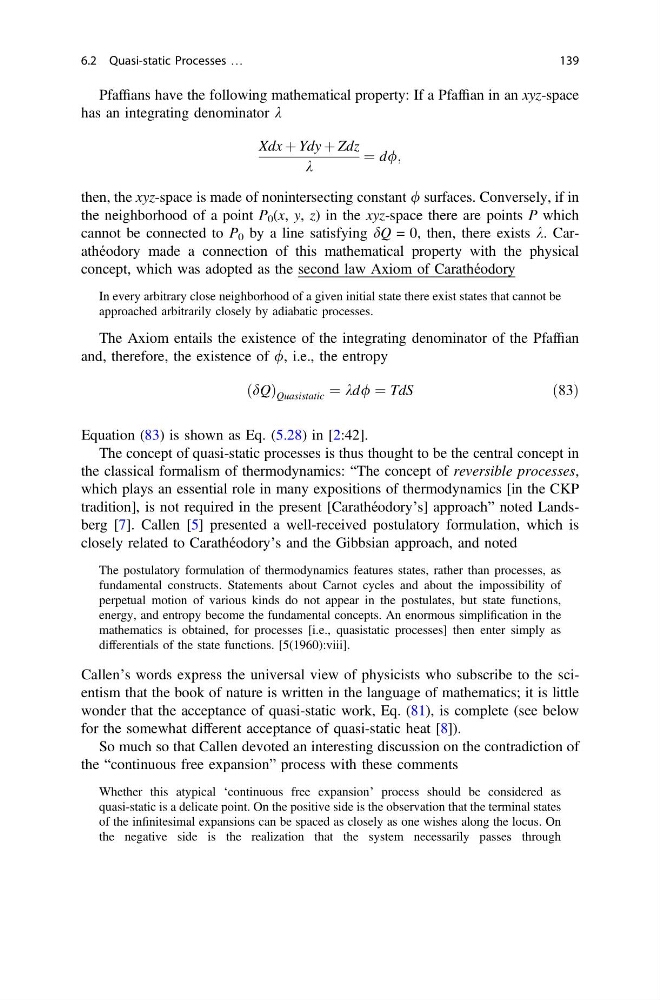
Pfaffians have the following mathematical property: If a Pfaffian in an xyz-space
has an integrating denominator k
Xdx þ Ydy þ Zdz
k
¼ d/;
then, the xyz-space is made of nonintersecting constant / surfaces. Conversely, if in
the neighborhood of a point P 0 (x, y, z) in the xyz-space there are points P which
cannot be connected to P 0 by a line satisfying dQ = 0, then, there exists k. Carathéodory made a connection of this mathematical property with the physical
concept, which was adopted as the second law Axiom of Carathéodory
In every arbitrary close neighborhood of a given initial state there exist states that cannot be
approached arbitrarily closely by adiabatic processes.
The Axiom entails the existence of the integrating denominator of the Pfaffian
and, therefore, the existence of /, i.e., the entropy
ðdQÞ Quasistatic ¼ kd/ ¼ TdS
ð83Þ
Equation (83) is shown as Eq. (5.28) in [2:42].
The concept of quasi-static processes is thus thought to be the central concept in
the classical formalism of thermodynamics: “The concept of reversible processes,
which plays an essential role in many expositions of thermodynamics [in the CKP
tradition], is not required in the present [Carathéodory’s] approach” noted Landsberg [7]. Callen [5] presented a well-received postulatory formulation, which is
closely related to Carathéodory’s and the Gibbsian approach, and noted
The postulatory formulation of thermodynamics features states, rather than processes, as
fundamental constructs. Statements about Carnot cycles and about the impossibility of
perpetual motion of various kinds do not appear in the postulates, but state functions,
energy, and entropy become the fundamental concepts. An enormous simplification in the
mathematics is obtained, for processes [i.e., quasistatic processes] then enter simply as
differentials of the state functions. [5(1960):viii].
Callen’s words express the universal view of physicists who subscribe to the scientism that the book of nature is written in the language of mathematics; it is little
wonder that the acceptance of quasi-static work, Eq. (81), is complete (see below
for the somewhat different acceptance of quasi-static heat [8]).
So much so that Callen devoted an interesting discussion on the contradiction of
the “continuous free expansion” process with these comments
Whether this atypical ‘continuous free expansion’ process should be considered as
quasi-static is a delicate point. On the positive side is the observation that the terminal states
of the infinitesimal expansions can be spaced as closely as one wishes along the locus. On
the negative side is the realization that the system necessarily passes through
6.2 Quasi-static Processes …
139
has an integrating denominator k
Xdx þ Ydy þ Zdz
k
¼ d/;
then, the xyz-space is made of nonintersecting constant / surfaces. Conversely, if in
the neighborhood of a point P 0 (x, y, z) in the xyz-space there are points P which
cannot be connected to P 0 by a line satisfying dQ = 0, then, there exists k. Carathéodory made a connection of this mathematical property with the physical
concept, which was adopted as the second law Axiom of Carathéodory
In every arbitrary close neighborhood of a given initial state there exist states that cannot be
approached arbitrarily closely by adiabatic processes.
The Axiom entails the existence of the integrating denominator of the Pfaffian
and, therefore, the existence of /, i.e., the entropy
ðdQÞ Quasistatic ¼ kd/ ¼ TdS
ð83Þ
Equation (83) is shown as Eq. (5.28) in [2:42].
The concept of quasi-static processes is thus thought to be the central concept in
the classical formalism of thermodynamics: “The concept of reversible processes,
which plays an essential role in many expositions of thermodynamics [in the CKP
tradition], is not required in the present [Carathéodory’s] approach” noted Landsberg [7]. Callen [5] presented a well-received postulatory formulation, which is
closely related to Carathéodory’s and the Gibbsian approach, and noted
The postulatory formulation of thermodynamics features states, rather than processes, as
fundamental constructs. Statements about Carnot cycles and about the impossibility of
perpetual motion of various kinds do not appear in the postulates, but state functions,
energy, and entropy become the fundamental concepts. An enormous simplification in the
mathematics is obtained, for processes [i.e., quasistatic processes] then enter simply as
differentials of the state functions. [5(1960):viii].
Callen’s words express the universal view of physicists who subscribe to the scientism that the book of nature is written in the language of mathematics; it is little
wonder that the acceptance of quasi-static work, Eq. (81), is complete (see below
for the somewhat different acceptance of quasi-static heat [8]).
So much so that Callen devoted an interesting discussion on the contradiction of
the “continuous free expansion” process with these comments
Whether this atypical ‘continuous free expansion’ process should be considered as
quasi-static is a delicate point. On the positive side is the observation that the terminal states
of the infinitesimal expansions can be spaced as closely as one wishes along the locus. On
the negative side is the realization that the system necessarily passes through
6.2 Quasi-static Processes …
139