

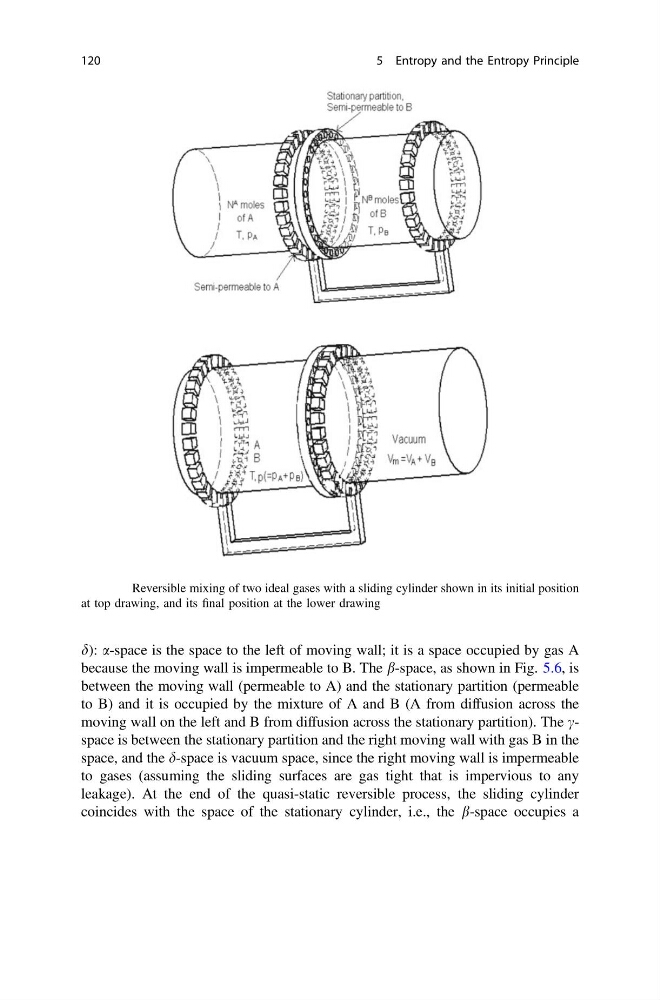
d): a-space is the space to the left of moving wall; it is a space occupied by gas A
because the moving wall is impermeable to B. The b-space, as shown in Fig. 5.6, is
between the moving wall (permeable to A) and the stationary partition (permeable
to B) and it is occupied by the mixture of A and B (A from diffusion across the
moving wall on the left and B from diffusion across the stationary partition). The cspace is between the stationary partition and the right moving wall with gas B in the
space, and the d-space is vacuum space, since the right moving wall is impermeable
to gases (assuming the sliding surfaces are gas tight that is impervious to any
leakage). At the end of the quasi-static reversible process, the sliding cylinder
coincides with the space of the stationary cylinder, i.e., the b-space occupies a
Fig. 5.5 Reversible mixing of two ideal gases with a sliding cylinder shown in its initial position
at top drawing, and its final position at the lower drawing
120
5 Entropy and the Entropy Principle
because the moving wall is impermeable to B. The b-space, as shown in Fig. 5.6, is
between the moving wall (permeable to A) and the stationary partition (permeable
to B) and it is occupied by the mixture of A and B (A from diffusion across the
moving wall on the left and B from diffusion across the stationary partition). The cspace is between the stationary partition and the right moving wall with gas B in the
space, and the d-space is vacuum space, since the right moving wall is impermeable
to gases (assuming the sliding surfaces are gas tight that is impervious to any
leakage). At the end of the quasi-static reversible process, the sliding cylinder
coincides with the space of the stationary cylinder, i.e., the b-space occupies a
Fig. 5.5 Reversible mixing of two ideal gases with a sliding cylinder shown in its initial position
at top drawing, and its final position at the lower drawing
120
5 Entropy and the Entropy Principle