

An Example of Carnot Vapor Cycle
A gas cycle, such as an internal combustion piston engine cycle, i.e., IC
engine, or an internal combustion gas turbine cycle, e.g., a jet engine, can be a
closed cycle (the former case of IC engine) or a steady-flow cycle (the latter
case of jet engine). Consider the example of a steady-flow Carnot cycle using
water as the working fluid. Water changes from saturated liquid to saturated
vapor as heat is transferred to it from a source at 250 °C. Heat rejection takes
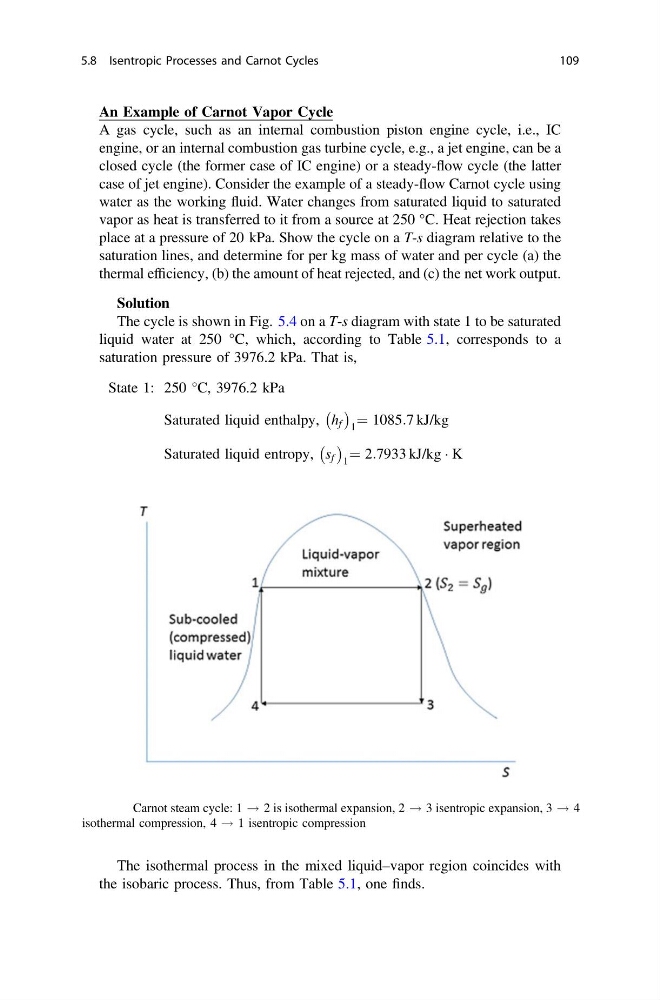
place at a pressure of 20 kPa. Show the cycle on a T-s diagram relative to the
saturation lines, and determine for per kg mass of water and per cycle (a) the
thermal efficiency, (b) the amount of heat rejected, and (c) the net work output.
Solution
The cycle is shown in Fig. 5.4 on a T-s diagram with state 1 to be saturated
liquid water at 250 °C, which, according to Table 5.1, corresponds to a
saturation pressure of 3976.2 kPa. That is,
State 1: 250 °C, 3976.2 kPa
Saturated liquid enthalpy, h f
À Á
1
¼ 1085:7 kJ/kg
Saturated liquid entropy, s f
À Á
1
¼ 2:7933 kJ/kg Á K
The isothermal process in the mixed liquid–vapor region coincides with
the isobaric process. Thus, from Table 5.1, one finds.
Fig. 5.4 Carnot steam cycle: 1 ! 2 is isothermal expansion, 2 ! 3 isentropic expansion, 3 ! 4
isothermal compression, 4 ! 1 isentropic compression
5.8 Isentropic Processes and Carnot Cycles
109
A gas cycle, such as an internal combustion piston engine cycle, i.e., IC
engine, or an internal combustion gas turbine cycle, e.g., a jet engine, can be a
closed cycle (the former case of IC engine) or a steady-flow cycle (the latter
case of jet engine). Consider the example of a steady-flow Carnot cycle using
water as the working fluid. Water changes from saturated liquid to saturated
vapor as heat is transferred to it from a source at 250 °C. Heat rejection takes
place at a pressure of 20 kPa. Show the cycle on a T-s diagram relative to the
saturation lines, and determine for per kg mass of water and per cycle (a) the
thermal efficiency, (b) the amount of heat rejected, and (c) the net work output.
Solution
The cycle is shown in Fig. 5.4 on a T-s diagram with state 1 to be saturated
liquid water at 250 °C, which, according to Table 5.1, corresponds to a
saturation pressure of 3976.2 kPa. That is,
State 1: 250 °C, 3976.2 kPa
Saturated liquid enthalpy, h f
À Á
1
¼ 1085:7 kJ/kg
Saturated liquid entropy, s f
À Á
1
¼ 2:7933 kJ/kg Á K
The isothermal process in the mixed liquid–vapor region coincides with
the isobaric process. Thus, from Table 5.1, one finds.
Fig. 5.4 Carnot steam cycle: 1 ! 2 is isothermal expansion, 2 ! 3 isentropic expansion, 3 ! 4
isothermal compression, 4 ! 1 isentropic compression
5.8 Isentropic Processes and Carnot Cycles
109